Analyzing the operational resilience of Chinese electric vehicle manufacturers often requires looking past headline delivery numbers and diving deep into the logistics tier. Recent Li Auto supply chain bottlenecks have highlighted how even top-tier OEMs remain vulnerable to minor component disruptions. For global automotive analysts and investors tracking China's electric transition, this incident offers a critical look into the fragile nature of high-speed EV scaling.
The Anatomy of a 4,000-Unit Production Drop
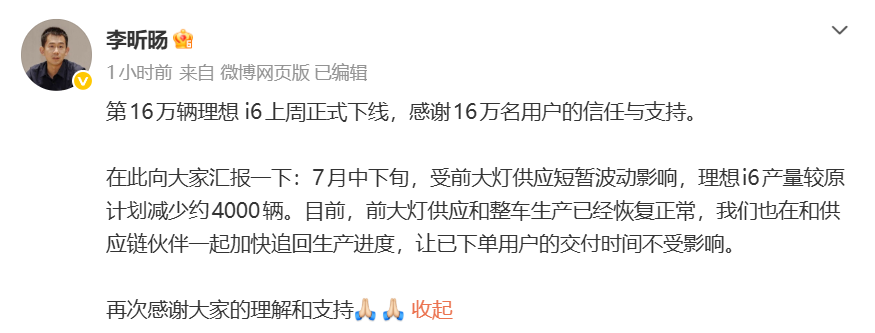
According to Li Xinyang, Head of Product Lines at Li Auto, the company's pure electric SUV model, the i6, suffered from a critical front headlight supplier bottleneck during the latter half of July. This logistics hiccup resulted in a direct production loss of approximately 4,000 vehicles.
While headlight assemblies may seem like a low-tier risk compared to battery cells or advanced driver assistance system (ADAS) silicon, modern smart headlights often feature adaptive driving beams (ADB), integrated sensors, and complex control units. This complexity elevates simple structural components to high-risk bottlenecks.
Li Auto's BEV Transition: Higher Stakes, Complex Logistics
Li Auto has historically dominated the Chinese market with its Extended Range Electric Vehicles (EREVs). These vehicles use a small internal combustion engine to charge the battery, offering a security blanket for consumers anxious about range. However, the company is actively pushing into pure battery electric vehicles (BEVs) to challenge global leaders in the luxury electric SUV segment.
This strategic pivot demands entirely new supply architectures. The transition from EREV models to dedicated BEV platforms like the i6 introduces unique supply chain vulnerabilities, summarized below:
| Metric / Aspect | EREV Platform (L-Series) | BEV Platform (i-Series / Mega) |
|---|---|---|
| Supply Chain Maturity | Highly mature; shared parts across L6, L7, L8, L9 | Emerging; relies on newer high-voltage components |
| Component Vulnerability | Low; high level of vertical integration | High; specialized parts like smart headlights and silicon carbide modules |
| Market Sensitivity | Stable consumer demand | High consumer sensitivity to delivery delays and early reviews |
How the Chinese Ecosystem Resolves Bottlenecks at 'China-Speed'
Despite the severe hit of losing 4,000 units of production, Li Auto was quick to assure the market that the headlight supply issues have been resolved. The manufacturer reported that production schedules have fully recovered, and original delivery commitments remain unaffected. This swift resolution points to a major competitive advantage of the Chinese EV ecosystem: regional cluster density.
In traditional Western manufacturing hubs, sourcing a replacement or ramping up a Tier 2 supplier's capacity after a failure can take months due to geographical dispersion. In contrast, the Yangtze River Delta automotive cluster allows Chinese OEMs to work alongside engineering teams of nearby suppliers to debug production, validate tooling, and ramp output in days. For global auto industry professionals, this speed-of-recovery metric is just as crucial to monitor as the initial bottleneck itself.