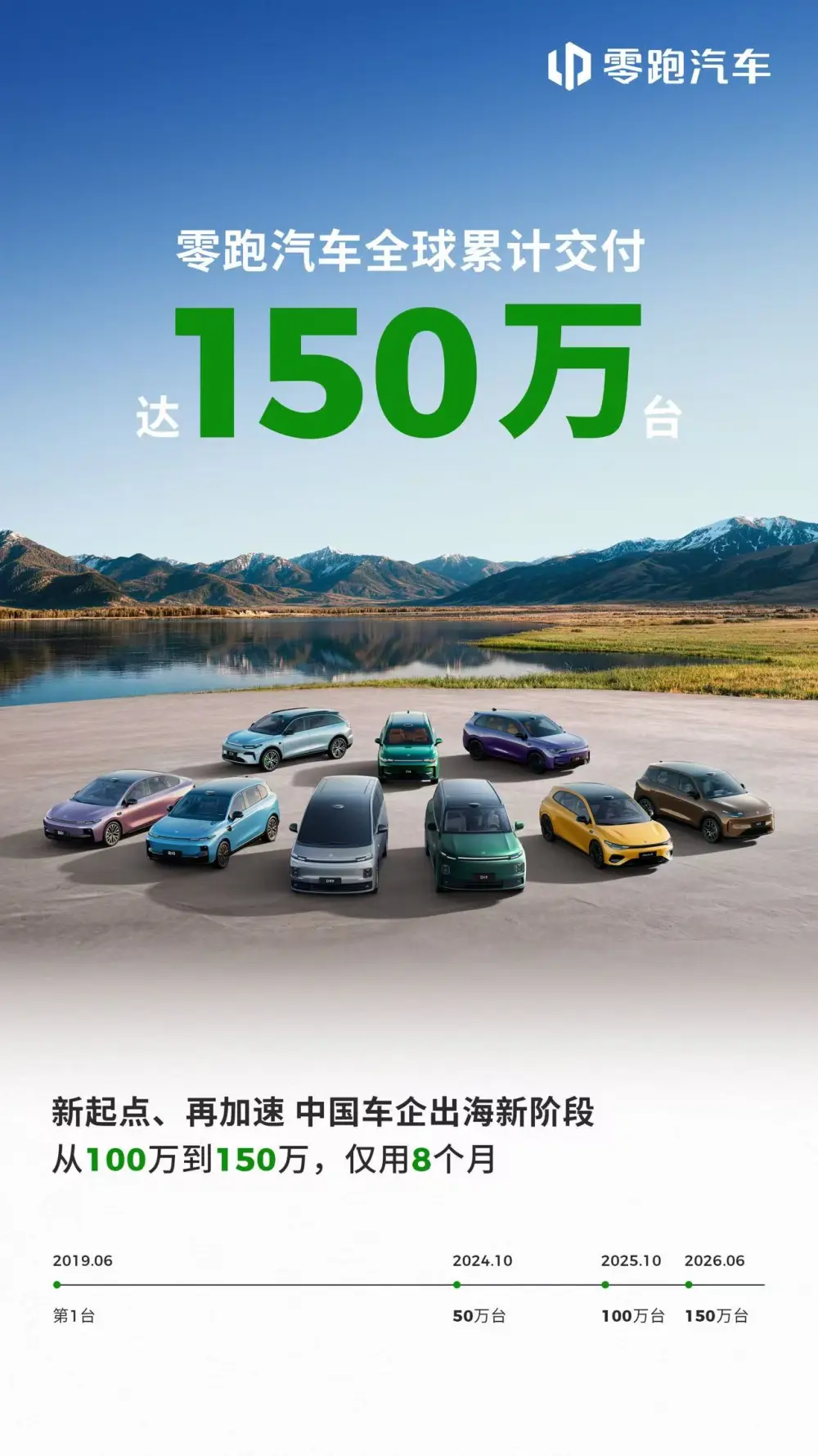
As the Chinese domestic EV penetration rate surges past an unprecedented 62.5% in 2026, a structural shift is taking place. While legacy Western OEMs struggle with complex electrification transitions, agile Chinese players are rewriting the global expansion playbook. At the center of this paradigm shift is Leapmotor. By crossing its landmark 1.5 million vehicle production milestone, the Hangzhou-based OEM is proving that its unique Leapmotor Stellantis EV expansion model might just be the ultimate antidote to rising protectionist tariffs in the US and Europe.
Beyond Exports: The Stellantis Asset-Light Playbook
Historically, Chinese automotive globalization relied on direct CBU (Completely Built Up) exports. However, with the European Commission imposing steep anti-subsidy countervailing duties, this path has become economically unviable for many. Leapmotor's counterstrategy? Leapmotor International—a 51:49 joint venture led by Stellantis.
Unlike traditional joint ventures where Western firms sought market access in China, this alliance is designed to export Chinese cost-efficiency and technical agility to the global market. By utilizing Stellantis’s sprawling global manufacturing footprint (such as the Tychy plant in Poland), Leapmotor can bypass import duties entirely. This localized assembly approach mitigates geopolitical risks while significantly lowering capital expenditure (CapEx) for international scaling.
Strategic Comparison: Traditional Export vs. Leapmotor's JV Model
To understand why this model is turning heads in investment circles, let us compare the structural differences:
| Metric | Traditional Direct Export (CBU) | Leapmotor Stellantis EV Expansion |
|---|---|---|
| Tariff Exposure | Subject to high EU countervailing duties (up to 38%+) | Minimized via localized European assembly (e.g., Poland) |
| CapEx Speed | Slow; requires heavy investment in local factories and distribution | Rapid; leverages existing Stellantis production and dealer networks |
| Regulatory Risk | High; vulnerable to sudden geopolitical policy shifts | Moderate; operates under a local, Western-branded umbrella |
Analyzing the Technical and Strategic Advantages
From an investor perspective, Leapmotor’s value proposition lies in its high degree of vertical integration. Leapmotor designs and builds its own electric powertrains, ADAS platforms, and digital cockpit architectures in-house. When combined with Stellantis's unparalleled global distribution network, which spans thousands of dealerships, Leapmotor gains immediate scale that would otherwise take a decade and billions of dollars to build from scratch.
This is what we call the "China-speed" advantage coupled with Western heritage distribution. For Western legacy OEMs, this JV represents a double-edged sword: a survival mechanism for Stellantis to field affordable EVs, but a severe competitive threat to other European players like Volkswagen and Renault who are slower to adapt.
Potential Bottlenecks and Strategic Risks
While the strategy is theoretically sound, implementation risks remain high. Integrating Leapmotor’s agile, fast-paced Chinese R&D cycles with Stellantis’s deeply unionized, slower-moving European operational culture is a significant challenge. Furthermore, as Western regulators scrutinize "Chinese tech under the hood," safety, data privacy, and localized software adaptation for advanced ADAS systems will be key hurdles to watch.