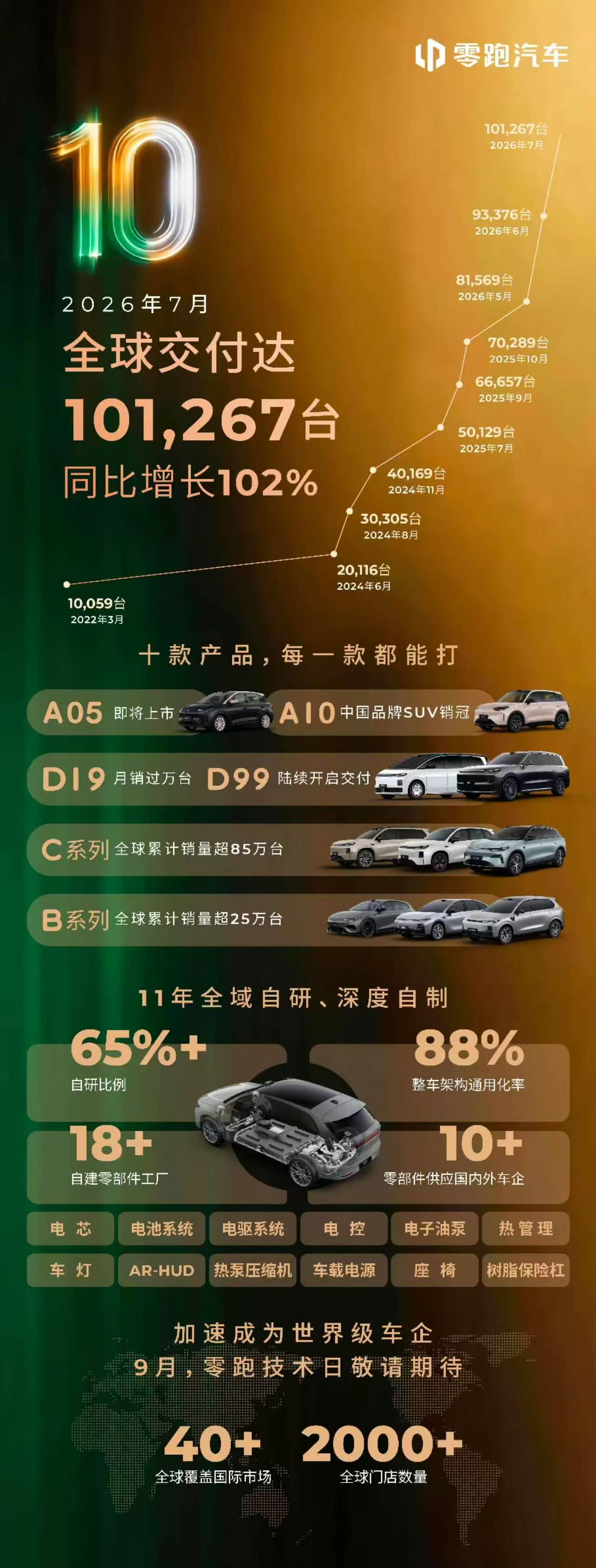
The rapid pace of Leapmotor global expansion has reached a historic milestone. In July, the Chinese electric vehicle manufacturer announced global new vehicle deliveries of 101,267 units, representing a remarkable 102% year-over-year increase. This robust performance underscores how the company's dual strategy of vertical integration and strategic cross-border partnership is reshaping the global automotive landscape.
Anatomy of the July Growth Surge
To put Leapmotor's July milestone into perspective, a year-over-year doubling of delivery volume indicates that their market positioning is resonating strongly with consumers. Unlike players reliant solely on domestic Chinese demand, Leapmotor has built a diversified growth model supported by an expanding international footprint. This rapid scale-up highlights the viability of their market entry strategy in both emerging and mature markets.
| Metric | July Performance | Year-over-Year (YoY) Change |
|---|---|---|
| Global Deliveries | 101,267 units | +102% |
| Primary Tech Driver | All-Domain Self-Development | N/A |
| Key Strategic JV | Leapmotor International (Stellantis) | Active Global Expansion |
Vertical Integration: The 'All-Domain Self-Development' Engine
At the core of Leapmotor's cost-competitiveness and rapid scaling is its vertical integration strategy, internally referred to as 'all-domain self-development' (全域自研). By designing and manufacturing critical components—such as electric drive systems, battery packs (including Cell-to-Chassis technology), smart cabin software, and advanced driver-assistance systems (ADAS)—Leapmotor reduces its reliance on third-party suppliers.
As a professional market analyst, I view this as a vital differentiator. Vertical integration allows Leapmotor to manage margins tightly, iterate software rapidly, and insulate its supply chain from external bottlenecks. In an era where hardware margins are compressed, owning the core IP provides a significant competitive moat.
Strategic Localization and the Stellantis Alliance
For Western observers and investment firms, the most compelling aspect of Leapmotor's trajectory is its strategic joint venture with Stellantis, named Leapmotor International. Rather than attempting to navigate complex geopolitical landscapes independently, Leapmotor has leveraged this cross-border collaboration to secure a localized regional footprint.
This partnership serves as an industry benchmark for supply chain compliance and trade adaptability. By utilizing Stellantis's vast global manufacturing facilities and distribution networks, Leapmotor is establishing assembly nodes within key regional markets. This collaborative approach ensures full tariff compliance and fosters localized value creation, aligning with regulatory frameworks in the European Union and North America while minimizing geopolitical friction.
Strategic Sourcing and the Future of Western Partnerships
The success of Leapmotor International demonstrates that the future of the automotive industry lies in technology integration and strategic sourcing alliances rather than isolated competition. For Western OEMs, partnering with agile Chinese developers allows them to integrate cutting-edge EV architectures rapidly. For Chinese firms, collaboration provides immediate access to established dealer networks and localized manufacturing expertise. It is a mutually beneficial paradigm that accelerates global decarbonization and ESG initiatives.