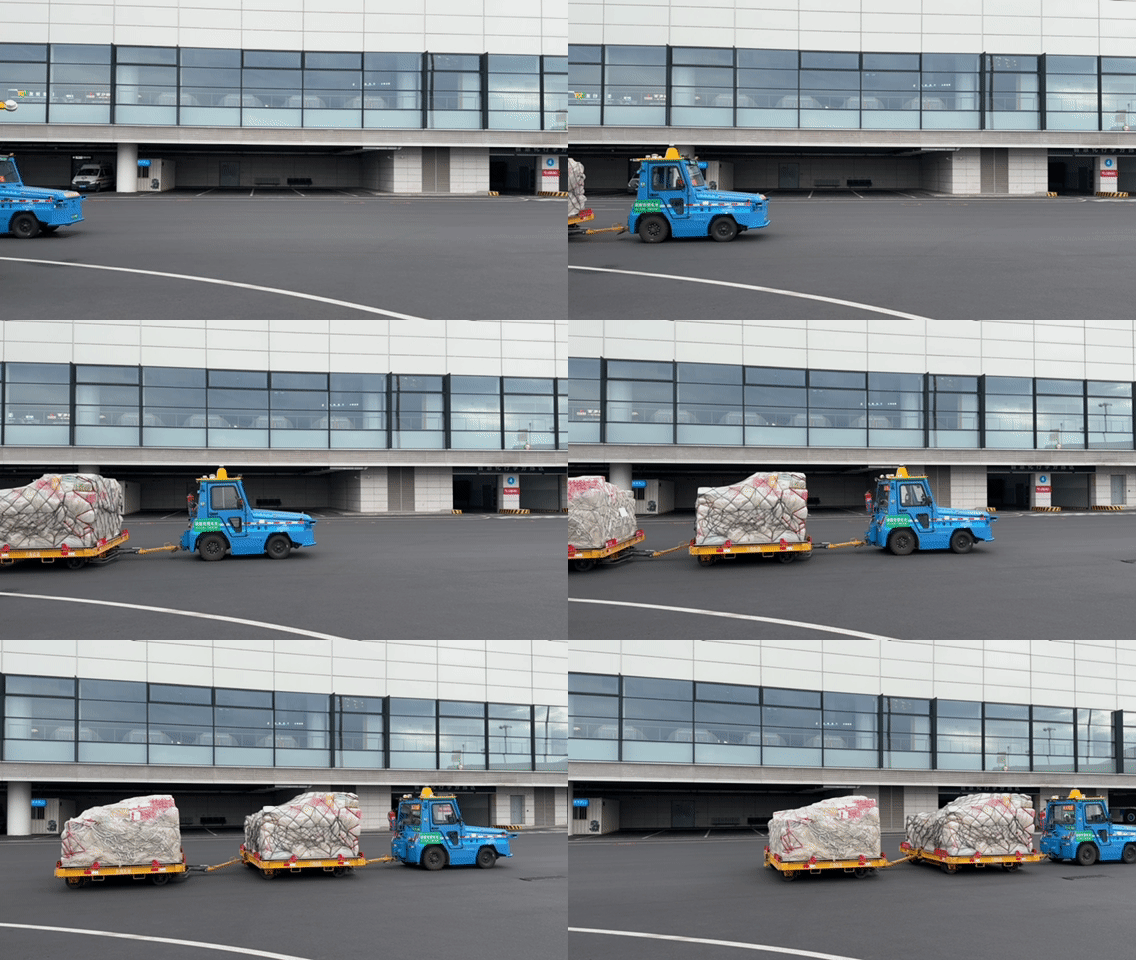
For years, the autonomous driving industry has grappled with a multi-billion-dollar question: when will L4 technology stop burning cash and start generating real returns? While open-road robotaxis continue to navigate complex regulatory and technical hurdles, a quieter, highly profitable revolution is taking place on the tarmac. The deployment of l4 autonomous airport vehicles at major aviation hubs like Urumqi Diwopu International Airport signals a major pivot from speculative technology pilots to strict, metrics-driven commercialization.
The Strategic Pivot: Why Airports Are the First Profitable L4 Frontier
While public roads present unpredictable edge cases—ranging from jaywalking pedestrians to complex weather scenarios—airport aprons offer highly structured, predictable environments. Ground support equipment (GSE) operates on fixed routes, within geofenced parameters, and under strict, standardized speed limits. This controlled complexity significantly reduces the processing demands on onboard AI models like Gemini and DeepSeek, allowing operators to deploy reliable L4 systems today without waiting for full regulatory clearance on public streets.
By focusing on airport logistics, autonomous driving technology providers are sidestepping the regulatory bottlenecks that have stalled urban robotaxi networks. Civil aviation administrations can regulate these vehicles as closed-loop machinery, accelerating safety certifications and enabling immediate commercial operations.
Doing the Math: Comparing Manual vs. Autonomous Airport GSE
To understand why global investors and aviation logistics firms are shifting capital toward airfield automation, we must look at the hard operational economics. The transition to L4 autonomous airport vehicles is fundamentally a play for operational efficiency and risk mitigation.
| Operational Metric | Manual Ground Vehicles | L4 Autonomous Vehicles |
|---|---|---|
| Shift Availability | Subject to driver fatigue, shift handovers | 24/7 continuous operation |
| Labor Cost Efficiency | High (overtime, safety training, high turnover) | Low (predictable SaaS and maintenance fees) |
| Collision Risk & Cost | High (human error in tight, high-stress spaces) | Minimal (sensor redundancy and strict geofencing) |
| Fleet Utilization Rate | Approximately 60-70% | Optimized past 90% via centralized dispatch |
The Hidden Cost of Human Error on the Apron
In international aviation, even a minor ground service collision can ground a commercial aircraft for days, costing airlines hundreds of thousands of dollars in repairs and lost schedules. Human errors during high-stress baggage and cargo handling operations are a major driver of insurance premiums. By integrating high-precision LiDAR, ultrasonic sensors, and multi-modal AI systems, L4 autonomous airport vehicles operate with centimeter-level accuracy, virtually eliminating costly apron mishaps.
Strategic Implications for Western Logistics and Investors
For Western investment firms and tier-1 aerospace suppliers, the rapid scale of autonomous GSE in China offers several crucial insights:
- Accelerated Commercialization Lifecycles: Companies focusing on niche, industrial, and closed-loop environments are generating commercial revenue and acquiring invaluable real-world training data years ahead of open-road developers.
- Standardized Global Tech Integration: Rather than viewing these developments as closed ecosystems, forward-looking Western OEMs can leverage strategic sourcing alliances with experienced automated vehicle developers to update their own regional logistics fleets.
- Regulatory Pathways: Western regulators (such as the FAA and EASA) can look to early operational data from integrated airports like Urumqi and Daxing to establish harmonized safety baselines for autonomous ground operations.
A Look Ahead: Scalability Beyond Baggage Handling
As the underlying hardware costs of LiDAR and high-performance computing platforms continue to fall, the payback period for deploying autonomous airport equipment is projected to shrink to under 24 months. The expansion of L4 capabilities from baggage tractors to high-speed passenger shuttles and automated fueling systems is the logical next step in creating fully modernized, cost-efficient airport ecosystems.