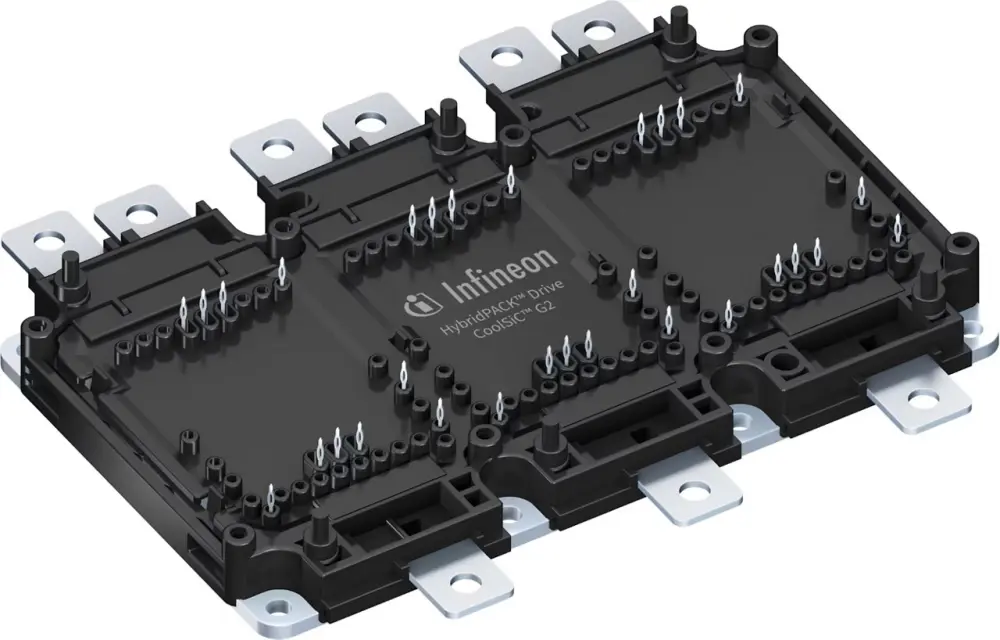
As automotive power electronics race toward higher efficiency and lighter weight, thermal management has remained the ultimate bottleneck. Today, Infineon Technologies AG has shattered the conventional thermal ceiling by launching the first 1300V Infineon 205C SiC module under its famed HybridPACK™ Drive family. This module is engineered to run continuously at junction temperatures of up to 205°C, a massive leap from the current industry standard of 175°C.
Breaking the 175°C Barrier: Why the Infineon 205C SiC Module Matters
Silicon Carbide (SiC) has long been praised for its superior bandgap, high breakdown voltage, and thermal conductivity compared to traditional Silicon (Si). However, packaging limitations and thermal stress have historically capped safe continuous operating temperatures at around 175°C. When EV drivers demand peak acceleration, the inverter's power modules generate intense localized heat, forcing thermal throttling to prevent component failure.
By pushing this limit to 205°C, the new Infineon 205C SiC module provides an unprecedented thermal buffer. According to Stefan Obersriebnig, Senior VP and GM of Automotive High Voltage at Infineon, this development empowers automotive OEMs and Tier 1 suppliers to either extract higher peak output from their existing inverter packaging or design lighter, more cost-effective cooling systems from scratch.
Comparing the Specs: 175°C vs. 205°C SiC Inverters
To understand the engineering implications of this upgrade, let's look at how this shift in thermal capabilities impacts key inverter design metrics:
| Metric | Standard SiC Modules (Legacy) | Infineon 205°C SiC Module |
|---|---|---|
| Max Continuous Junction Temp | 175°C | 205°C |
| Inverter Output Capability | Baseline peak performance | Up to 20-30% higher peak & continuous power |
| Thermal Management Demands | High-volume liquid cooling, large heatsinks | Reduced cooling volume, simplified heat dissipation |
| System Cost & Weight | Heavier, complex packaging bills-of-materials | Lower overall system cost via cooling simplification |
Strategic Implications: The Direct Impact on Western OEMs and Chinese EV Giants
As an analyst tracking global power semiconductor supply chains, I see this innovation as a catalyst for a massive competitive shift. In China's ultra-competitive market, OEMs like BYD, Xiaomi, and Geely are launching high-voltage (800V+) architectures at breakneck speed. These platforms rely heavily on SiC to achieve high efficiency and sub-3-second 0-100 km/h times.
1. Eliminating Thermal Throttling in Extreme Conditions
Current high-performance EVs often experience performance degradation (throttling) under prolonged track driving or repeated high-speed launches. Pushing the operational limit to 205°C means the Infineon 205C SiC module can sustain peak acceleration phases longer without triggering thermal safety rollbacks.
2. Unlocking the Holy Grail: Smaller, Lighter Inverters
For Western OEMs (like Tesla, Ford, and VW) struggling with packaging efficiency and curb weight, this high-temperature tolerance allows them to scale down active cooling loops. A smaller radiator, less coolant volume, and downsized heatsinks translate directly to a lighter chassis, which improves overall vehicle range (WLTP/EPA) without needing larger battery packs.
3. Backward Compatibility and Drop-In Upgrades
Crucially, because this module is part of the widely adopted HybridPACK™ Drive family, Tier 1 suppliers do not need to redesign their entire inverter housing. It acts as a near 'drop-in' upgrade, allowing rapid market adoption and faster time-to-market for premium 2026/2027 EV models.
Market Outlook: Silicon Carbide's Next Frontier
The transition from 175°C to 205°C represents more than just a 30-degree increase; it is a testament to advanced packaging and material sciences (likely utilizing advanced silver-sintering and robust bond-wiring interfaces). As competitors like STMicroelectronics, Onsemi, and Rohm race to catch up, Infineon has firmly established a new benchmark for premium EV power electronics.