The global automotive supply chain is undergoing a seismic shift. For decades, traditional European Tier-1 giants like Bosch, Continental, and ZF held an iron grip on vehicle dynamics, braking systems, and suspension hardware. However, the rise of Software-Defined Vehicles (SDVs) has cracked open this monopoly. At the Harmony Intelligent Mobility Alliance (HIMA) TECH DAY in Shanghai on June 26, 2026, Huawei showcased its most formidable weapon in this transition: the Huawei Tuling platform. Far from just another mechanical chassis, Tuling is a highly integrated, AI-driven platform that elevates the chassis to a new level of intelligence.
Decoding the Tech: What Makes the Huawei Tuling Platform Different?
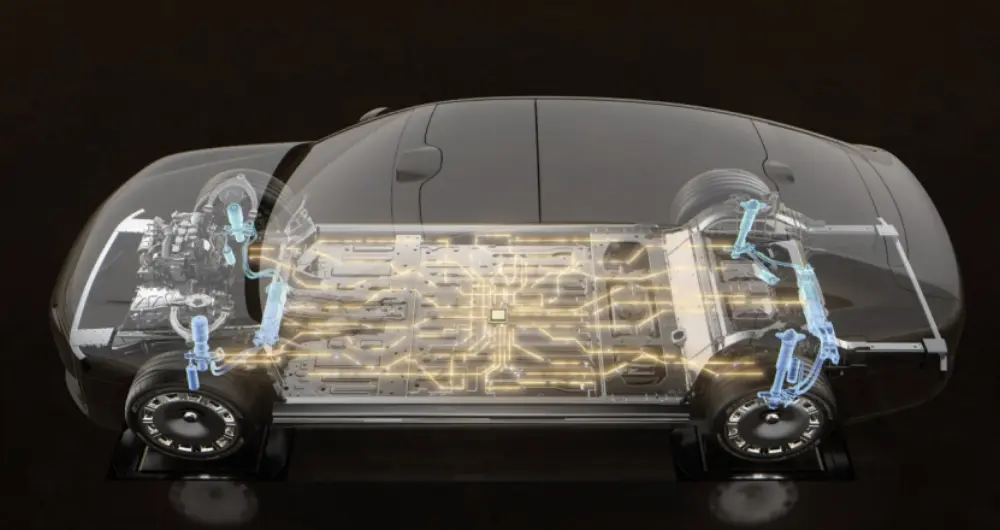
As an industry analyst tracking East Asian automotive supply chains, it is clear that Huawei does not view the chassis as a collection of shocks, springs, and links. Instead, Huawei treats the chassis as an integrated silicon-first edge computer. The Huawei Tuling platform acts as the brain of the vehicle chassis, coordinating propulsion, braking, steering, and damping in real-time through unified AI algorithms.
Traditional vehicles operate with isolated Electronic Control Units (ECUs) for ABS, traction control, and active suspension. These systems are highly reactive, responding only after a tire slips or a bump is hit. The Tuling platform bypasses these legacy bottlenecks through three core layers:
- Multi-Dimensional Perception (Sensing): Utilizing the vehicle\'s onboard LiDAR, high-definition cameras, and IMU sensors, Tuling scans the road environment up to 150 meters ahead, anticipating potholes, speed bumps, and friction changes before the tires ever make contact.
- Collaborative Control (Thinking): Huawei\'s proprietary AI model processes road conditions and vehicle state dynamics in sub-milliseconds, calculating the optimal vertical, lateral, and longitudinal force distribution.
- Precision Execution (Acting): The system instantly adjusts active air suspension dampers, electronic anti-roll bars, and vectoring torque outputs to keep the cabin completely level and stable.
The Disruption of Legacy Tier-1 Suppliers
For decades, Western legacy OEMs relied on premium hardware from suppliers like Bilstein or Öhlins, paired with software calibrations from Bosch. This legacy model is slow, fragmented, and extremely difficult to update over-the-air (OTA). By unifying these controls into a single software stack, the Huawei Tuling platform renders standard mechanical setups obsolete.
Furthermore, Huawei\'s platform approach commoditizes traditional chassis hardware. When the intelligence resides in the centralized software domain, the physical dampers and links become modular executants. This shifts high-margin software value capture away from European legacy firms directly into the hands of intelligent technology integrators like Huawei.
Comparative Analysis: Traditional Chassis vs. Huawei Tuling Platform
The following table illustrates why Western automotive strategists and investors are closely tracking this technological pivot.
| Parameter | Traditional Mechanical/Active Chassis | Huawei Tuling Platform |
|---|---|---|
| Control Style | Reactive (responds after the bump is hit) | Predictive (pre-scans road profile via LiDAR/Cameras) |
| System Integration | Fragmented, decentralized ECUs from multiple vendors | Centralized AI coordination across 3 axes (X, Y, Z) |
| Latency Rate | 10 to 30 milliseconds | Sub-millisecond real-time predictive adjustments |
| OTA Capabilities | Extremely limited or non-existent for hardware dynamics | Continuous evolution of suspension and traction via software updates |
Strategic Implications for Global EV Investors
From an investment thesis standpoint, the deployment of the Huawei Tuling platform across vehicles like the Aito M9 and Luxeed S7 highlights a broader trend: the decoupling of mechanical hardware from vehicle performance characteristics. If a vehicle\'s ride, handling, and safety metrics are dictated by proprietary AI models rather than expensive mechanical tolerances, the competitive advantage of heritage automotive brands diminishes rapidly.
Western automakers looking to compete in the luxury and high-performance EV segments cannot afford to rely on off-the-shelf component catalogs. To bridge the dynamic control gap, they must either develop an equivalent full-stack chassis operating system or find integration partners capable of matching Huawei\'s China-speed iteration timeline.