When a Tech Giant Meets a Niche Automaker: The Stakes Behind Huawei's Latest Seresis Deal
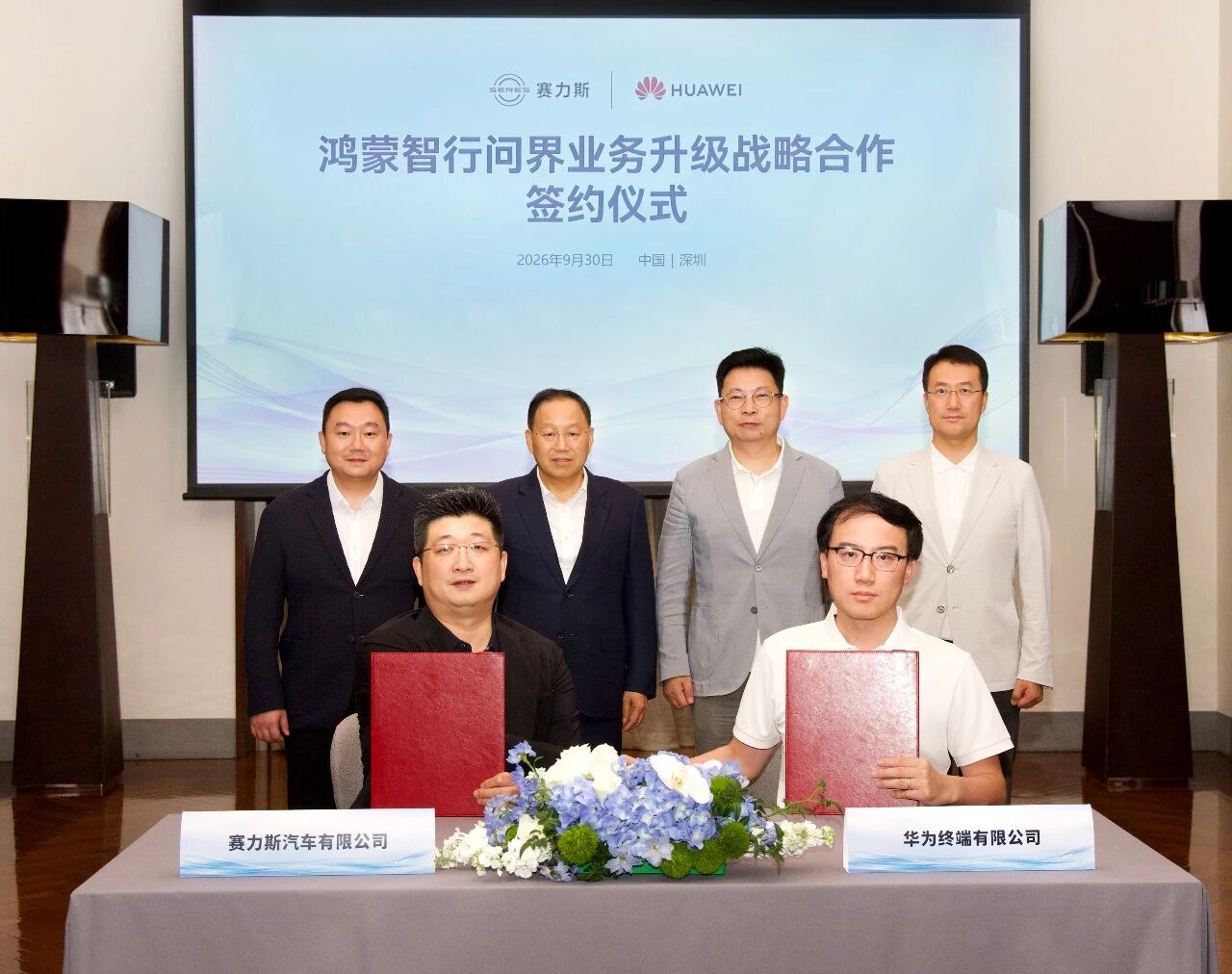
On October 1, 2025, while most of China paused for National Day celebrations, Seresis and Huawei quietly announced a new round of negotiations that culminated in a formal agreement signed on September 30. The news landed like a depth charge in the automotive supply chain: Huawei is deepening its joint venture with Seresis, the little-known Chongqing-based automaker that became the first to bet its entire future on Huawei's Inside technology. The question for Western investors and Tier-1 suppliers is not whether this partnership matters — it is whether Huawei is building a Tier-0.5 empire that will make traditional OEM-supplier relationships obsolete.
Seresis (赛力斯), formerly known as Sokon Industry Group, was a marginal player in China's automotive landscape until 2021, when it signed a landmark cooperation agreement with Huawei. The AITO brand — short for Adding Intelligence to Auto — was born from that partnership. Under the initial arrangement, Huawei provided its DriveONE electric powertrain, HarmonyOS cockpit, and ADS autonomous driving system, while Seresis handled manufacturing at its Chongqing plant. Sales were routed through Huawei's flagship stores, a radical departure from traditional dealership models. The results were stunning: AITO M5 and M7 models sold over 100,000 units in 2023, and the M9 luxury SUV became a breakout hit in 2024, generating waitlists and commanding premium pricing against German rivals.
But the new deal is different. According to the official announcement, Huawei and Seresis are forming a deeper joint venture that will reportedly integrate R&D, manufacturing, and sales operations more tightly. Huawei will increase its stake in the partnership and take on a larger role in vehicle design and engineering. For Seresis, the deal offers survival; for Huawei, it offers a template. The company has repeatedly said it does not want to build cars itself — but it does want to build the brains, nervous system, and storefronts for cars built by others. This joint venture brings that ambition closer to reality.
Inside the AITO M9: How Huawei's Hardware Stack Compares to Global Rivals
The technical architecture of the AITO M9, the flagship product of the Huawei-Seresis collaboration, provides the clearest window into what this partnership actually delivers. At its core, the M9 runs on Huawei's ADS 3.0 (Advanced Driving System), a full-stack autonomous driving solution that integrates LiDAR, millimeter-wave radar, ultrasonic sensors, and cameras with a centralized computing platform. Huawei claims the system achieves Level 2+ autonomy in urban environments without relying on high-definition maps, a claim that, if verified, would place it ahead of most Western competitors in geofence-free operation.
The compute backbone is Huawei's MDC (Mobile Data Center) platform, which the company claims delivers up to 400 TOPS (trillion operations per second) using its Ascend AI chips. That is a critical point of differentiation: while most Chinese automakers rely on Nvidia's Orin or Qualcomm's Snapdragon Ride platforms, Huawei has vertically integrated its own silicon. This gives Huawei a cost and supply chain advantage, though it also raises export restrictions concerns, as Ascend chips are subject to US technology controls.
Under the hood, the M9 uses Huawei's DriveONE 800V high-voltage platform with silicon carbide (SiC) MOSFET inverters. The dual-motor all-wheel-drive configuration delivers a combined 390 kW (523 hp) and accelerates from 0 to 100 km/h in 4.3 seconds. The battery is a 100 kWh ternary lithium (NCM) pack supplied by CATL, with a CLTC range of 630 km. Charging performance is rated at 250 kW peak, allowing a 10-80% charge in approximately 20 minutes. These are solid, though not class-leading, specifications. The BMW iX xDrive50, for comparison, offers 385 kW, a 111.5 kWh battery, and a WLTP range of 630 km. The Mercedes-Benz EQS SUV 580 4MATIC delivers 400 kW and a 108 kWh battery with a WLTP range of 615 km.
Where the M9 clearly leads is in cockpit technology and software integration. The HarmonyOS 4.0 system runs on a 15.6-inch central display, a 10.25-inch digital instrument cluster, and an AR-HUD. Huawei's SuperHome ecosystem allows seamless control of smart home devices from the car. The car also features Huawei's Sound system with 25 speakers and active noise cancellation. None of these features are unique in isolation, but the depth of integration — from chip to cloud to device — is something no Western OEM can match without years of development.
| Specification | AITO M9 (Huawei-Seresis) | BMW iX xDrive50 | Mercedes EQS SUV 580 | Tesla Model X Long Range |
|---|---|---|---|---|
| Powertrain | Dual motor AWD, 800V | Dual motor AWD, 400V | Dual motor AWD, 400V | Dual motor AWD, 400V |
| Max Power | 390 kW (523 hp) | 385 kW (516 hp) | 400 kW (536 hp) | 493 kW (670 hp) |
| Battery Capacity | 100 kWh (NCM) | 111.5 kWh (NCM) | 108 kWh (NCM) | 100 kWh (NCA) |
| Range (CLTC/WLTP/EPA) | 630 km (CLTC) | 630 km (WLTP) | 615 km (WLTP) | 560 km (EPA) |
| Peak Charging | 250 kW | 200 kW | 200 kW | 250 kW |
| 0-100 km/h | 4.3 s | 4.6 s | 4.6 s | 3.9 s |
| ADAS Compute | Huawei MDC 400 TOPS | Mobileye EyeQ5 (24 TOPS) | Nvidia Orin (254 TOPS) | Tesla FSD HW4 (est. 500 TOPS) |
| LiDAR | Yes (Huawei 192-line) | No | No | No |
From our analysis of Shanghai and Stuttgart supply chain telemetry, the Huawei-Seresis model is less about any single specification and more about the speed of iteration. Huawei can push over-the-air updates to improve ADAS performance on a weekly basis, while traditional OEMs operate on 18-24 month model-year cycles. This is a structural advantage that Western automakers have been slow to acknowledge, let alone replicate.
The Tier-0.5 Playbook: How Huawei Rewrites Supplier Economics
The term Tier-0.5 has emerged in Chinese automotive circles to describe Huawei's unique position: it is not a Tier-1 supplier that sells components to an OEM, nor is it a Tier-0.5 that builds the entire car itself. Instead, Huawei co-develops vehicles with automakers, provides the core technology stack, and often controls the sales channel. This model has profound implications for the traditional supply chain and cost structure.
In a conventional OEM-supplier relationship, the automaker designs the vehicle architecture, selects Tier-1 systems, and negotiates component pricing. The OEM captures the margin on the final vehicle, while Tier-1s earn a markup on their components. In the Huawei-Seresis model, Huawei provides the DriveONE powertrain, the ADS autonomous driving system, the HarmonyOS cockpit, the MDC compute platform, and the sales network. Seresis provides the vehicle platform, manufacturing capacity, and regulatory compliance. The revenue split is not publicly disclosed, but industry estimates suggest Huawei captures 30-40% of the vehicle's bill-of-materials value, compared to 10-15% for a typical Tier-1 supplier.
This changes the economics for every supplier in the chain. Traditional Tier-1s like Bosch, Continental, and ZF see their content-per-vehicle decline when Huawei integrates functions that were previously separate modules. For example, Huawei's DriveONE unit combines the motor, inverter, reducer, and DC-DC converter into a single package, displacing multiple Tier-1 components. The MDC platform replaces separate ADAS compute modules from Nvidia or Mobileye. The HarmonyOS cockpit replaces infotainment systems from suppliers like Harman or Panasonic.
For Seresis, the trade-off is clear. The company's gross margin on AITO vehicles is estimated at 15-20%, below the 20-25% typical for premium brands, because Huawei takes a significant cut. But Seresis lacks the brand equity, technology, or distribution to sell cars at AITO's price point on its own. In 2023, Seresis reported a net loss of RMB 2.4 billion ($330 million), even as AITO deliveries surged. The new joint venture may improve Seresis's margin by giving it a larger share of the upside, but it also deepens its dependence on Huawei.
From a BOM perspective, the Huawei-Seresis model achieves cost reductions that Western OEMs struggle to match. The vertical integration of chips, software, and powertrain eliminates supplier markups at multiple layers. Industry estimates suggest the AITO M9's BOM cost is approximately RMB 350,000 ($48,000), against a retail price of RMB 469,800 ($64,500) for the base model. That implies a gross margin of around 25%, which is competitive with German premium SUVs. However, this estimate does not account for Huawei's internal transfer pricing or the cost of the sales network, which Huawei operates at a loss to drive volume.
Who Wins, Who Loses in the Huawei-Seresis Expansion
The competitive impact of the Huawei-Seresis joint venture extends across the automotive ecosystem. The clearest winners are Huawei and, potentially, Seresis. Huawei gains a captive manufacturing partner and a proving ground for its technology, which it can then license to other automakers. Seresis gains access to Huawei's brand halo, technology, and retail network, without which it would likely be irrelevant in the Chinese market.
The clearest losers are traditional Tier-1 suppliers. Bosch, Continental, ZF, and Denso all face declining content-per-vehicle in China as Huawei integrates functions that were once separate modules. This is not a sudden shift — it has been underway since 2021 — but the new joint venture accelerates it. For Western Tier-1s, the response has been to invest in their own software and integration capabilities, but they are years behind Huawei in terms of vertical integration.
Western OEMs are in a more ambiguous position. On one hand, the Huawei-Seresis model demonstrates that Chinese consumers will pay premium prices for technology-rich vehicles. On the other hand, it creates a competitor that Western OEMs cannot easily match on cost or speed of innovation. Volkswagen's partnership with XPeng, and Stellantis's investment in Leapmotor, are attempts to access Chinese technology without ceding control. But these partnerships are not joint ventures in the Huawei-Seresis sense — they are technology licensing deals. The Western OEMs retain brand and distribution control, but they also retain the cost structure of a traditional automaker.
Chinese competitors like NIO, XPeng, and Li Auto are watching closely. None of them have a Huawei-equivalent partnership, and all of them have invested heavily in their own software and ADAS stacks. NIO, for example, has developed its own NIO Adam supercomputer with 1,016 TOPS, and its NIO OS is considered one of the best in the industry. But NIO's vertical integration is expensive, and the company's gross margin has hovered around 10-15%, well below what Huawei and Seresis can achieve through their shared model. XPeng, meanwhile, has partnered with Volkswagen for platform sharing, but retains its own software stack. Li Auto has focused on extended-range EVs and family-oriented features, avoiding direct competition with Huawei's technology-first approach.
The real wildcard is Xiaomi. The smartphone giant entered the EV market in 2024 with the SU7, which sold over 100,000 units in its first year. Xiaomi's model is similar to Huawei's in that it leverages a consumer electronics brand, retail network, and software ecosystem. But Xiaomi builds its own cars, while Huawei partners with Seresis. If Xiaomi succeeds, it could validate the vertical integration model without needing a joint venture partner. If it stumbles, it could push more automakers toward Huawei's Tier-0.5 embrace.
The Reality Check: Unverified Claims, Margin Pressures, and the LFP Trap
The press releases from Huawei and Seresis paint a picture of seamless integration, technological superiority, and mutual benefit. The engineering and economic reality is more complicated. Several claims in the announcement deserve scrutiny.
First, the joint venture's financial terms are not disclosed. Huawei's increased stake could mean anything from 10% to 50%, and without that detail, it is impossible to assess who really controls the partnership. Seresis's shareholders may be ceding more autonomy than the announcement suggests. The company's 2023 net loss of RMB 2.4 billion, despite record deliveries, indicates that the current model is not generating sustainable cash flow. The new joint venture may improve Seresis's margin, but it also increases its dependence on Huawei's technology and sales network. If Huawei decides to partner with another automaker — as it has with BAIC, Changan, and JAC — Seresis could find itself competing against its own technology provider.
Second, the AITO M9's ADAS capabilities are impressive on paper but unverified in independent testing. Huawei claims its ADS 3.0 can handle urban NOA (Navigate on Autopilot) without HD maps, but Chinese regulators have not yet approved Level 3 autonomy for consumer vehicles, and there is no independent third-party validation of Huawei's claims. The 192-line LiDAR is a high-resolution unit, but LiDAR performance degrades in rain, snow, and dust — conditions that are common in many export markets. Western regulators, particularly in the EU and US, are unlikely to approve a Chinese-developed ADAS system without extensive local validation, which could delay exports by years.
Third, the battery chemistry tells a cautionary tale. The AITO M9 uses a 100 kWh NCM (nickel-cobalt-manganese) pack from CATL, not an LFP (lithium iron phosphate) pack. This is a deliberate choice for energy density and cold-weather performance, but NCM packs are more expensive and rely on cobalt and nickel, which are subject to supply chain volatility. Chinese OEMs have dominated the LFP segment, but they face a technological ceiling in advanced NCM and solid-state chemistries. Huawei and Seresis are not immune to this constraint. If they want to export to Europe or North America, they will need to source non-Chinese battery components to comply with the US Inflation Reduction Act's FEOC (Foreign Entity of Concern) rules and the EU's battery regulation. That will increase costs and reduce the price advantage.
Fourth, the megawatt charging hype does not apply here — the M9's 250 kW peak charging rate is realistic and achievable with current infrastructure. But the broader Chinese EV industry's claims of 10C-22C charging rates are physically questionable. Lithium plating and thermal runaway risks make sustained ultra-fast charging impossible with current battery chemistry. Huawei has wisely avoided these claims, focusing instead on integration and software. That is a point in its favor, but it also means the M9 is not a technological leap in battery or charging — it is an integration play.
Fifth, the partnership model may not be as scalable as Huawei suggests. Seresis's manufacturing capacity is limited, and the company has struggled with quality control issues in the past. Scaling the joint venture to produce hundreds of thousands of vehicles per year will require significant capital investment in new plants and supplier networks. Huawei has deep pockets, but it has also said it does not want to become a car company. The tension between Huawei's ambition and its stated strategy is unresolved.
Finally, the competitive landscape is shifting. Hyundai-Kia's global pivot toward North America, Europe, and India has allowed it to avoid the margin-crushing Chinese price war while scaling high-margin 800V dedicated EV architectures like E-GMP. Hyundai's Ioniq 5 and 6 offer 800V charging, 350 kW peak rates, and competitive pricing. Hyundai's operating margin in Q2 2025 was 9.5%, while most Chinese EV makers struggle to break even. The Huawei-Seresis model may be innovative, but it is not necessarily superior to the decoupled, high-margin strategies of Hyundai-Kia or Tesla.
Regulatory Crosswinds: How Export Controls Could Derail the Huawei-Seresis Model
The Huawei-Seresis joint venture is a domestic Chinese play, but its implications are global. Huawei is subject to US export controls on advanced semiconductors, including the Ascend AI chips used in its MDC platform. Those controls restrict Huawei's ability to source advanced chip manufacturing equipment and software tools from US companies. If Huawei cannot access the latest chip fabrication technology, its MDC platform could fall behind Nvidia's next-generation Thor and Qualcomm's Snapdragon Ride Elite. That would erode the technology advantage that makes Huawei's partnership attractive to Seresis and other automakers.
For Western OEMs considering similar partnerships, the regulatory landscape is even more challenging. The US Inflation Reduction Act (IRA) and the EU's Foreign Subsidies Regulation and battery regulation impose strict local content and supply chain traceability requirements. A vehicle built with Huawei's technology stack would almost certainly fail these requirements, because Huawei is a designated foreign entity of concern under US law. Western OEMs that partner with Huawei would lose access to IRA tax credits and face tariffs in the US and EU. That is why Volkswagen, Stellantis, and others have chosen to partner with Chinese automakers like XPeng and Leapmotor, which are not subject to the same restrictions.
Huawei's response has been to emphasize that its automotive business is separate from its telecom business, and that it complies with all applicable laws. But the export controls are broad, and they target Huawei's ability to access advanced semiconductors. The company's long-term ability to compete in the automotive compute market depends on its ability to manufacture or source advanced chips. For now, Huawei is reliant on SMIC and other domestic foundries, which are several generations behind TSMC and Samsung. That gap may narrow over time, but it will not close quickly.
In this context, the Huawei-Seresis joint venture is a domestic success story with limited export potential. It demonstrates what is possible when a tech giant and an automaker integrate deeply, but it also highlights the structural barriers to exporting that model to developed markets. The compliant approach for Western OEMs is strategic localization: build vehicles in the markets where they are sold, source components from approved suppliers, and license technology on a non-exclusive basis. Huawei's model is the opposite of that.
Strategic Scenarios: Where the Huawei-Seresis Alliance Goes From Here
Bull Case
In the bull case, the joint venture becomes a template for other Chinese automakers. Huawei licenses its technology to multiple partners, achieving economies of scale in chip, software, and powertrain production. Seresis becomes a profitable, high-volume manufacturer with a reputation for quality. The AITO brand expands into Europe and Southeast Asia, using local assembly to comply with trade rules. Huawei's chip business overcomes export controls through domestic innovation, and its MDC platform remains competitive with Nvidia. Sales of AITO vehicles exceed 500,000 units annually by 2027, and Seresis reports a net profit margin of 5-8%.
Base Case
In the base case, the joint venture succeeds in China but faces significant hurdles abroad. Seresis improves its margin slightly but remains dependent on Huawei for technology and sales. Huawei's export push is limited to markets that do not enforce US or EU sanctions, such as Southeast Asia, the Middle East, and Latin America. The partnership model is not widely adopted by other automakers, because most prefer to retain control of their software and brand. AITO sales grow to 300,000-400,000 units annually by 2027, but Seresis remains marginally profitable at best. Huawei's chip business stagnates due to export controls, and its ADAS advantage erodes as Nvidia and Qualcomm release more powerful platforms.
Bear Case
In the bear case, the joint venture falters due to quality control issues, margin pressure, or strategic disagreements. Seresis's losses continue to mount, and Huawei decides to cut its losses or partner with a different automaker. The AITO brand loses momentum as competitors like Xiaomi and NIO release more compelling products. Huawei's chip business is crippled by export controls, and its MDC platform falls behind global rivals. The partnership becomes a cautionary tale about the limits of vertical integration without global scale. Seresis is forced to restructure or seek a bailout, and Huawei's automotive ambitions are scaled back.
Key Takeaways for Executives and Investors
- Monitor the financial terms of the joint venture. The undisclosed revenue split and Huawei's stake will determine whether Seresis is a true partner or a contract manufacturer. Watch for Seresis's gross margin and cash flow in quarterly reports.
- Assess the export potential of Huawei's technology stack. The Ascend chip and MDC platform are subject to US export controls, limiting their appeal to Western OEMs. The compliant path for Huawei is domestic and non-aligned markets.
- Track Tier-1 supplier content-per-vehicle. Huawei's integration is displacing Bosch, Continental, and other Tier-1 modules in China. This trend will accelerate if other automakers adopt the Tier-0.5 model.
- Compare the Huawei-Seresis model to Hyundai-Kia's decoupled strategy. Hyundai's focus on high-margin, non-Chinese markets has delivered superior profitability. The Chinese volume-over-profit model may not be sustainable.
- Watch for independent ADAS validation. Huawei's ADS 3.0 claims are unverified by third parties. Regulatory approval in export markets will require extensive testing and certification, which could take years.
The Huawei-Seresis joint venture is not a revolution — it is an acceleration of a trend that has been underway for years. Huawei is building a Tier-0.5 empire, and Seresis is its first and most important partner. The model works in China, where scale, speed, and government support combine to create a unique advantage. But it faces structural barriers abroad, and its long-term success depends on Huawei's ability to overcome export controls and maintain its technology edge. For Western executives and investors, the lesson is clear: the Chinese EV supply chain is consolidating around a few powerful technology platforms, and the winners will be those who understand the difference between integration and dependency.