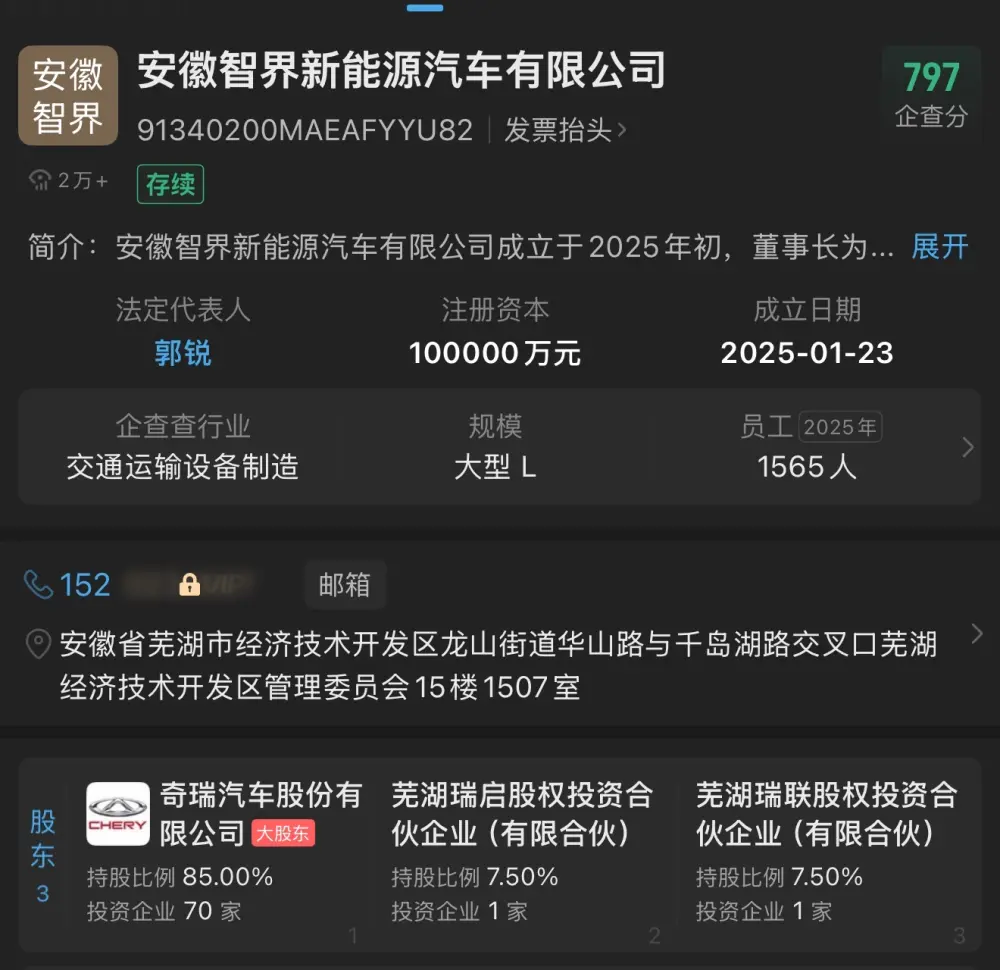
The Chinese electric vehicle landscape moves at what industry veterans call 'China-speed.' In the latest corporate shift, registry updates reveal that Chery Automobile is no longer the sole 100% shareholder of Anhui Luxeed New Energy Vehicle Co., Ltd. This restructuring marks a major evolution in the Huawei Chery Luxeed partnership, highlighting how legacy Chinese OEMs are restructuring their joint ventures with tech giants to better scale operations and share financial exposure.
Decoding the Equity Shift: What Changed?
According to Chinese corporate database Qichacha, Anhui Luxeed New Energy Vehicle Co., Ltd. underwent a major equity change on June 30. Previously a wholly-owned subsidiary of Chery Automobile, the entity's shareholder structure has diversified. While Chery remains the primary industrial manufacturing anchor, the entry of state-backed investment platforms and strategic partners dilutes Chery's direct 100% holding.
This move is typical of high-growth Chinese EV projects. By moving away from a single-parent ownership model, Luxeed can tap into local government industrial funds (specifically around Anhui province's massive NEV hub) and strengthen its capital reserve without putting the entire financial burden on Chery's balance sheet.
Strategic Drivers Behind the Restructuring
To understand why this equity shift matters to global investors, we must look at the structural mechanics of Huawei's automotive business model. Luxeed is a prime pillar of Huawei's HIMA (Harmony Intelligent Mobility Alliance), alongside Aito (with Seres), Stelato (with BAIC), and Maextro (with JAC).
1. Risk Mitigation and Financial Flexibility
Developing high-end smart EVs requires capital expenditure on a massive scale. By shifting Luxeed from a closed 100% Chery-owned subsidiary to a joint investment structure, Chery shares the financial risk of scaling production, especially as the brand rolls out the Luxeed S7 sedan and the Luxeed S9 SUV. This allows Chery to maintain its core operations while ensuring Luxeed has the capital runway to compete with Tesla and NIO.
2. Strengthening the HIMA Ecosystem
Under HIMA, Huawei controls the 'brains' of the vehicle (including the ADS 3.0 autonomous driving system and HarmonyOS cockpit) as well as the sales channels. Legacy OEMs like Chery handle the hardware, manufacturing, and supply chain. Diversifying the equity structure of the joint operating company makes it easier to align interests between Chery, regional state-backed investors, and Huawei's retail ecosystem, ensuring long-term corporate stability.
The HIMA Landscape: How Luxeed Compares
To put this in perspective, here is how the primary partnerships within Huawei's HIMA ecosystem are structured:
| HIMA Brand | OEM Partner | Primary Vehicle Segment | Key Value Proposition |
|---|---|---|---|
| Aito | Seres | Premium SUVs (M5, M7, M9) | Market volume leader, EREV technology |
| Luxeed | Chery | Smart Sedans & Coupes (S7, R7) | High-performance EV architecture, Chery manufacturing scale |
| Stelato | BAIC | Executive Luxury Sedans (S9) | Chauffeur-driven luxury segment |
| Maextro | JAC | Ultra-Luxury MPVs / Sedans | Million-RMB ultra-premium segment |
The Analyst's Perspective: Why Western OEMs Should Pay Attention
As an analyst monitoring China's EV export strategies, this restructuring is a clear signal that the Huawei Chery Luxeed partnership is preparing for a long-term global play. Chery is China's largest passenger vehicle exporter, with massive market shares in Europe, Latin America, and the Middle East. By solidifying Luxeed's corporate foundation, Chery and Huawei are positioning this brand not just for domestic competition, but as a premium technological export.
Western legacy OEMs must recognize that Huawei's collaborative model allows it to iterate at a pace traditional automakers cannot match. When an equity change like this occurs, it isn't a sign of weakness; it is a strategic recalibration to optimize capital efficiency and unlock rapid scalability.