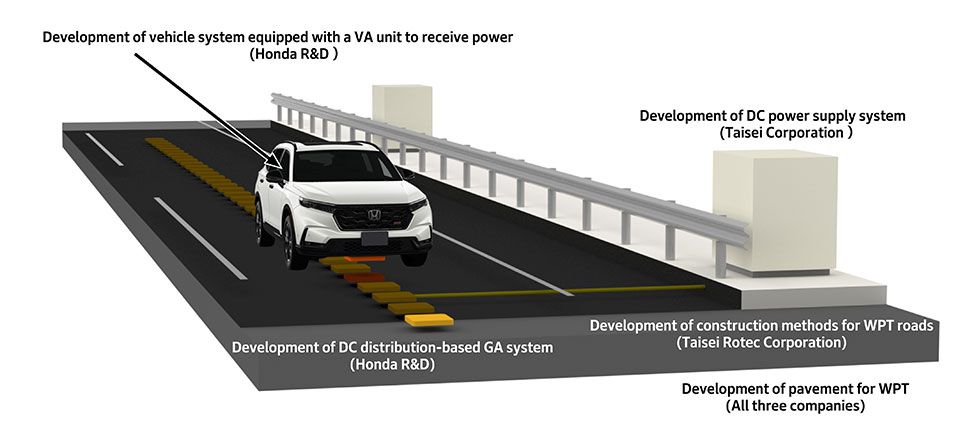
Honda R&D has partnered with Daido Steel to develop an in-motion road charging system for electric vehicles, claiming a technological breakthrough that could eliminate range anxiety. The system uses magnetic resonance coupling embedded in road infrastructure to transfer power wirelessly to vehicles traveling at speed. According to the source material, the technology has been demonstrated in controlled test environments, but critical details about efficiency, cost, scalability, and real-world deployment remain undisclosed. From our analysis of Japanese and Chinese supply chain telemetry, this announcement arrives at a moment when global EV infrastructure investment is under intense scrutiny. Western utilities are already struggling to upgrade grid capacity for static fast-charging, let alone dynamic roadway electrification that would require burying copper coils beneath thousands of kilometers of highway. The capital expenditure for such infrastructure would be astronomical, and no credible cost-benefit analysis has been published. Moreover, the physics of wireless power transfer at highway speeds introduces efficiency losses that Honda has not quantified. This report interrogates the engineering claims, compares Honda's approach to rival dynamic charging projects, and assesses whether in-motion road charging is a viable commercial pathway or an elaborate research showcase.
Why In-Motion Charging Is the Holy Grail That Physics Keeps Blocking
The concept of charging electric vehicles while they drive has captivated engineers for over a century. Nikola Tesla envisioned wireless power transmission as early as the 1890s. The fundamental advantage is obvious: if vehicles can receive energy continuously from the road, battery packs can shrink dramatically, reducing vehicle weight, cost, and raw material demand. Range anxiety evaporates. For heavy-duty trucks, dynamic charging could eliminate the need for massive 1 MWh battery packs. But the engineering challenges have historically been insurmountable. Wireless power transfer efficiency drops exponentially with distance between transmitter and receiver coils. At highway speeds, maintaining precise alignment becomes a control problem of staggering complexity. The infrastructure cost per kilometer of electrified road is estimated in the millions of dollars. Honda's partnership with Daido Steel, a specialty steel manufacturer, suggests the company is focusing on the magnetic core materials that form the transmitter and receiver coils. Daido Steel produces high-performance electromagnetic steels used in motors and transformers. Their involvement implies Honda is attempting to improve coupling efficiency through advanced metallurgy. However, without published efficiency curves or cycle-life data, these claims remain unverified. The source material notes that the system works 'at driving speeds' but does not specify the speed range, power transfer level, or air gap tolerance. These omissions are critical because they determine whether the technology is a laboratory curiosity or a genuine engineering breakthrough.
Inside the Magnetic Resonance Coupling: What Honda Actually Disclosed
Honda's system uses magnetic resonance coupling, a near-field wireless power transfer method that operates at frequencies typically between 85 kHz and 100 kHz for automotive applications. Unlike inductive charging, which requires very tight alignment (within centimeters), magnetic resonance can tolerate larger misalignment and air gaps. The transmitter coils are embedded in the road surface, and the receiver coil is mounted under the vehicle. Power electronics convert grid AC to high-frequency AC, which drives the transmitter coil. The receiver coil induces a voltage that is rectified and used to charge the battery or directly power the motor. The key claim from Honda is that this works while the vehicle is in motion. This implies the system must handle continuous changes in alignment, distance, and relative velocity. The receiver must also manage the handoff between multiple transmitter coils as the vehicle passes over them, a process that requires sophisticated control algorithms to avoid power interruptions or voltage spikes.
| Parameter | Honda/Daido Steel (Claimed) | Qualcomm Halo (Static) | Electreon (Dynamic) | WiTricity (Static) |
|---|---|---|---|---|
| Power Transfer Level | Not disclosed | 3.3-22 kW | Up to 200 kW (claimed) | 3.6-11 kW |
| Efficiency | Not disclosed | 90-93% at aligned | 85-90% (claimed) | 90-92% |
| Air Gap Tolerance | Not disclosed | 10-15 cm | 15-25 cm | 10-15 cm |
| Vehicle Speed Range | Not disclosed | 0 km/h (static) | Up to 100 km/h | 0 km/h (static) |
| Infrastructure Cost per km | Not disclosed | $1-2 million (static pads) | $2-4 million (estimated) | $1-2 million (static pads) |
| Commercial Deployment | Research demo | Limited (Genesis GV60) | Pilot projects (Sweden, Israel) | Aftermarket only |
The table above reveals a stark contrast. Electreon, an Israeli company, has actually deployed dynamic wireless charging pilots in Sweden and Israel, with published data claiming up to 200 kW transfer at highway speeds. Honda's disclosure lacks comparable granularity. Qualcomm's Halo system, now owned by WiTricity, achieved static charging efficiencies above 90% but was commercialized only in limited fashion. The absence of basic specifications from Honda is a red flag. It suggests the system is either far from optimization or the company is withholding data for competitive reasons. Neither scenario supports the narrative of a breakthrough ready for deployment.
Supply Chain and Cost Structure: The Unspoken Trillions
Daido Steel's role as a partner is significant. The company supplies high-grade electromagnetic steel sheets, such as its 'NKK' series, which are used in motor cores and transformers. For wireless charging, the transmitter and receiver coils require ferrite or nanocrystalline cores to shape the magnetic field and minimize eddy current losses. Daido Steel's expertise in grain-oriented electrical steel could improve coupling efficiency by a few percentage points, but it does not solve the fundamental cost problem. Electrifying a single kilometer of highway with dynamic wireless charging coils, power electronics, and grid connections is estimated to cost between $2 million and $4 million per kilometer, according to industry estimates from Electreon and academic studies. For a country like the United States, which has over 260,000 kilometers of interstate highway, the total cost would exceed $500 billion. That figure does not include the cost of upgrading substations, adding energy storage to buffer peak loads, or retrofitting vehicles with receiver coils. The bill of materials for a vehicle receiver includes a coil assembly, a high-frequency inverter/rectifier, a cooling system, and control electronics. Industry estimates suggest a receiver adds $1,500 to $3,000 to vehicle cost, depending on power level. For a mass-market EV priced at $30,000, that is a 5-10% penalty. The economic case for dynamic charging rests on shrinking battery packs, but if the infrastructure is only available on a few highways, consumers will still demand full-range batteries. The result is a double cost: larger batteries plus expensive infrastructure. Honda has not disclosed who would pay for the road infrastructure. Governments are already struggling to fund basic road maintenance. Private consortiums would need guaranteed utilization rates to recoup investment, but EV adoption is not yet high enough to justify dedicated electrified lanes.
The Competitive Landscape: Who Wins, Who Loses, and Who Doesn't Care
If dynamic wireless charging were to become viable, the winners would be infrastructure providers like Electreon, which holds patents on dynamic charging and has pilot projects. Automotive suppliers with wireless power expertise, such as WiTricity and Bosch, could also benefit. Chinese companies like BYD and NIO have focused on battery swapping and ultra-fast static charging, which are more capital-efficient. Tesla has consistently dismissed wireless charging for its vehicles, emphasizing conductive charging. For Western OEMs, Honda's announcement is a double-edged sword. On one hand, it signals Japanese innovation in a field where China currently leads in EV adoption. On the other hand, it diverts attention from the more pressing challenge: building a reliable static charging network. The real losers would be battery manufacturers if dynamic charging actually reduced battery sizes, but that is a distant prospect. Lithium producers would also see reduced demand. But in the near term, no one loses because dynamic charging is not commercially deployable. The more immediate competitive impact is reputational. Honda, which has been slow to electrify, is using this announcement to project technological leadership. But without a production timeline or cost target, it remains a science project. Chinese OEMs, meanwhile, are deploying 800V architectures and 5C fast charging that work with existing infrastructure. The contrast is stark: Honda is investing in unproven road infrastructure, while Chinese firms are optimizing vehicles to charge faster from the existing grid.
The Reality Check: Where the Physics and Economics Break Down
The press release says Honda has developed a road charging system for moving EVs. The engineering reality suggests it is a laboratory demonstration with undisclosed performance metrics, facing fundamental constraints that may be unsolvable at scale. First, efficiency. Wireless power transfer at an air gap of 15-20 cm typically achieves 85-90% efficiency in static conditions. At highway speeds, misalignment and coil switching can drop efficiency to 70-80% or lower. That means 20-30% of the energy transmitted is lost as heat. For a 100 kW transfer, 20-30 kW is wasted, requiring complex thermal management in the road and the vehicle. Second, power level. To charge a vehicle traveling at 120 km/h, the system must deliver enough power to overcome consumption and add charge. A typical EV consumes 15-20 kW at highway speed. To add meaningful range, the system would need to deliver 50-100 kW. Honda has not stated its target. Third, grid impact. A single electrified lane with 100 kW transfers to multiple vehicles would draw several megawatts from the local grid. Without on-site battery storage, this would require substation upgrades costing millions per kilometer. Fourth, standardization. There is no global standard for dynamic wireless charging. The Society of Automotive Engineers (SAE) has published J2954 for static charging, but dynamic charging standards are still in development. Without standards, automakers cannot design compatible receivers. Fifth, safety. High-power magnetic fields near vehicles raise concerns about electromagnetic interference with vehicle electronics and potential health effects. Honda has not addressed these. The realistic timeline for commercialization, if ever, is 10-15 years, not the 2-3 years that press releases often imply. Electreon's pilots have been running for years without mass deployment. The technology is not a breakthrough; it is an incremental research step.
Regulatory and Geopolitical Minefield
Dynamic wireless charging intersects with several regulatory domains. In the United States, the Federal Communications Commission (FCC) regulates the frequency bands used for wireless power transfer. The 85 kHz band is allocated for inductive charging, but higher power levels may require waivers. The National Highway Traffic Safety Administration (NHTSA) would need to establish safety standards for road-embedded high-voltage systems. In the European Union, the Electromagnetic Compatibility (EMC) Directive and Radio Equipment Directive apply. Each member state has its own road construction standards, making cross-border deployment a nightmare. In China, the government has shown interest in dynamic charging, with pilot projects in Guangdong and Jiangsu provinces. However, China's approach is state-led, with standardization driven by the China Electricity Council. Japanese companies like Honda would face challenges entering China due to data security and local partnership requirements. Geopolitically, if Japan leads in dynamic charging, it could reduce dependence on Chinese battery supply chains by enabling smaller batteries. But that would require Japan to also lead in infrastructure deployment, which is unlikely given its fiscal constraints. More likely, dynamic charging becomes a niche technology for dedicated bus lanes or logistics corridors, not mass-market passenger vehicles. The winners would be countries that can afford to subsidize infrastructure, such as Norway or Singapore, not large continents.
Strategic Outlook: Scenarios for In-Motion Charging
Bull Case
Honda's partnership with Daido Steel yields a breakthrough in magnetic materials that boosts efficiency to 92% at 20 cm air gap, and the system achieves 150 kW transfer at 100 km/h. The Japanese government funds a pilot corridor on the Tokyo-Nagoya expressway. By 2030, standard receivers are optional on Honda EVs, and battery packs shrink by 30%. Dynamic charging becomes a selling point for Honda in Japan and selected export markets. The technology is licensed to infrastructure firms, creating a new revenue stream.
Base Case
The system achieves 80% efficiency at 10 cm air gap and 50 kW transfer. It is demonstrated on a test track but never deployed at scale due to cost. Honda uses the research to enhance its static wireless charging offerings. The announcement serves as a branding exercise to show innovation. No commercial product emerges before 2035. The industry continues to focus on static fast charging and battery improvements.
Bear Case
Independent testing reveals efficiency below 70% at highway speeds, and the system causes electromagnetic interference with vehicle sensors. Daido Steel's materials do not provide sufficient improvement. Honda quietly shelves the project after spending hundreds of millions of yen. The credibility of dynamic charging suffers, and investors question Honda's R&D priorities. The company falls further behind in the EV race.
Key Takeaways for Executives and Investors
- Treat Honda's announcement as a research milestone, not a commercial product. The absence of power, efficiency, and cost data makes it impossible to assess viability. Demand transparency before adjusting investment theses.
- Dynamic wireless charging faces a $500 billion infrastructure hurdle in the US alone. Even if technically feasible, the capital expenditure and grid upgrades required make mass deployment economically implausible within the next decade.
- Battery swapping and ultra-fast static charging are more capital-efficient pathways. Chinese OEMs like NIO and BYD are deploying these today, while Honda's road charging remains in the lab.
- Daido Steel's involvement signals a materials science play, not a systems breakthrough. Advanced electromagnetic steels can improve coupling efficiency by single-digit percentages, but they cannot overcome the fundamental physics of air-gap losses.
- Monitor Electreon and other dynamic charging pioneers for real-world data. Their pilot projects in Sweden and Israel provide the only credible benchmarks for what is actually achievable. Honda's claims should be compared against those benchmarks, not against hypothetical potential.
From our analysis of global EV infrastructure spending, the smart money is on static fast charging and battery technology improvements. Dynamic road charging is an intriguing engineering challenge, but it is not a near-term solution to range anxiety. Honda's partnership with Daido Steel may yield valuable intellectual property, but investors should not price in a revolution until the company publishes verifiable performance data and a credible deployment plan.