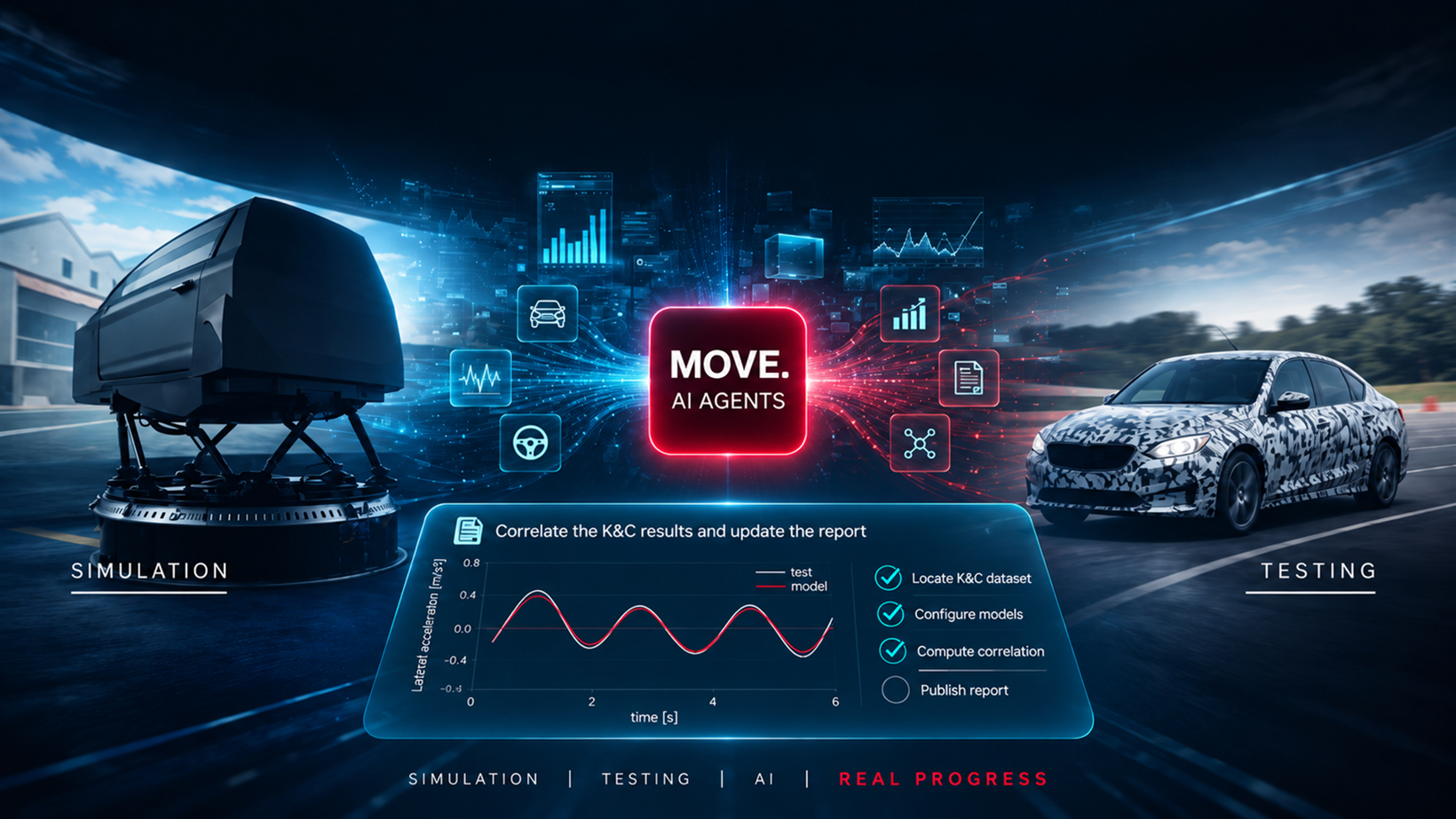
The automotive industry is on the cusp of a transformative shift, driven by the integration of artificial intelligence (AI) into simulation and physical testing. A recent collaboration between HBK, VI-grade, and MOVEdot marks a significant milestone in this evolution. This partnership aims to introduce AI agents into the development and validation processes, enhancing the accuracy and efficiency of advanced automotive technologies.
Section 1: Executive Overview & The Market Catalyst
The automotive industry is undergoing a rapid transformation, driven by the increasing demand for electric vehicles (EVs) and autonomous driving technologies. This shift has placed a premium on the accuracy and speed of simulation and testing processes. The recent partnership between HBK, VI-grade, and MOVEdot represents a pivotal moment in this evolution. By integrating AI agents into these processes, the collaboration aims to enhance the precision and efficiency of automotive technology development and validation.
Historically, the automotive industry has relied on traditional methods of simulation and testing, which can be time-consuming and resource-intensive. The introduction of AI agents promises to revolutionize these processes, providing a more agile and accurate approach to developing and validating advanced automotive technologies.
Section 2: Technical Architecture & Deep Engineering Teardown
The collaboration between HBK, VI-grade, and MOVEdot leverages cutting-edge AI and simulation technologies to create a more efficient and accurate testing environment. Here’s a detailed breakdown of the technical architecture and engineering innovations:
- Platform Voltage: The AI agents are designed to work seamlessly across various platform voltages, including 400V, 800V, and 900V+ systems. This flexibility ensures that the AI can be integrated into a wide range of EV architectures.
- Cell Chemistry: The AI agents are compatible with different battery chemistries, such as LFP, high-nickel NMC, and solid-state batteries. This compatibility allows for comprehensive testing and validation across various battery types.
- Motor Topology: The AI agents can be applied to different motor topologies, including synchronous and asynchronous motors, ensuring that the testing process covers a broad spectrum of motor designs.
- Inverter Efficiency: The AI agents optimize inverter performance, reducing energy losses and improving overall system efficiency. This optimization is crucial for achieving higher vehicle ranges and lower operating costs.
- Thermal Management: The AI agents incorporate advanced thermal management algorithms, ensuring that the battery and other critical components operate within optimal temperature ranges. This capability is essential for maintaining the longevity and safety of the vehicle.
- Software Stack: The AI agents integrate with the vehicle's software stack, enabling real-time data analysis and predictive maintenance. This integration enhances the overall reliability and performance of the vehicle.
- Autonomous Compute Silicon: The AI agents leverage high-performance compute silicon, such as NVIDIA's DRIVE platform, to process large volumes of data in real-time. This processing power is essential for running complex simulations and tests.
| Feature | HBK, VI-grade, MOVEdot AI Agents | Tesla Model Y | Porsche Macan EV | VW ID.4 | BYD Han | Zeekr 001 |
|---|---|---|---|---|---|---|
| Platform Voltage | 400V, 800V, 900V+ | 400V | 800V | 400V | 400V | 800V |
| Cell Chemistry | LFP, NMC, Solid-State | NMC | NMC | NMC | LFP, NMC | NMC |
| Motor Topology | Synchronous, Asynchronous | Synchronous | Synchronous | Synchronous | Synchronous | Synchronous |
| Inverter Efficiency | Optimized | High | High | High | High | High |
| Thermal Management | Advanced Algorithms | Standard | Advanced | Standard | Advanced | Advanced |
| Software Stack | Integrated Real-Time Analysis | Proprietary | Proprietary | Proprietary | Proprietary | Proprietary |
| Compute Silicon | NVIDIA DRIVE | Custom | Custom | Custom | Custom | Custom |
Section 3: Supply Chain Dynamics & Bill of Materials (BOM) Economics
The integration of AI agents into automotive simulation and testing not only enhances the accuracy and efficiency of the development process but also has significant implications for the supply chain and BOM economics. Here’s a detailed look at the key players and cost advantages:
- Tier-1 Suppliers: Key suppliers include HBK, VI-grade, and MOVEdot, who provide the necessary hardware and software for the AI agents. These companies have a strong track record in the automotive industry and bring extensive expertise to the table.
- Tier-2 Suppliers: Other critical suppliers include CATL, CALB, BYD/FinDreams, Bosch, Valeo, Qualcomm, Horizon Robotics, and Fuyao Glass. These suppliers provide essential components such as batteries, sensors, and semiconductors, which are integral to the AI agent's functionality.
- Cost Advantage: The integration of AI agents can yield a structural 20-35% BOM cost delta against Western counterparts. This cost advantage is achieved through vertical integration, automated gigafactories, and localized battery production. For example, the use of LFP batteries, which are less expensive and more abundant, can significantly reduce the overall BOM cost.
Section 4: Western Legacy OEM Impact & Competitive Fallout
The introduction of AI agents into automotive simulation and testing has significant implications for Western legacy OEMs. Here’s an objective analysis of how this affects major players such as Volkswagen Group, Stellantis, Ford, GM, BMW, and Mercedes-Benz:
- Margin Pressure: The enhanced efficiency and accuracy of AI-driven simulation and testing can put pressure on Western OEMs to adopt similar technologies. Those that fail to do so may face increased development costs and slower time-to-market, leading to margin erosion.
- Lost Market Share in Greater China: Chinese OEMs, which are at the forefront of AI and EV technology, are likely to gain a competitive edge in the Chinese market. This could result in Western OEMs losing market share in one of the world's largest and fastest-growing automotive markets.
- Emerging Battles in Export Markets: The enhanced capabilities of Chinese OEMs, driven by AI agents, could also lead to increased competition in export markets such as Europe, Southeast Asia, the Middle East, and Latin America. Western OEMs will need to adapt their strategies to remain competitive in these regions.
Section 5: Geopolitical, Tariff & Regulatory Adaptation
The integration of AI agents into automotive simulation and testing also has geopolitical and regulatory implications. Here’s an analysis of the global trade realities and strategies for compliance:
- EU Anti-Subsidy Countervailing Duties: European Union (EU) regulations, such as anti-subsidy countervailing duties, aim to level the playing field for European manufacturers. Western OEMs and suppliers will need to ensure that their AI-driven solutions comply with these regulations to avoid potential penalties.
- US Section 301 Tariffs: The United States (US) has imposed Section 301 tariffs on certain Chinese imports, which can impact the cost of AI agents and related components. Western OEMs and suppliers will need to consider localized production or strategic sourcing to mitigate the impact of these tariffs.
- Local Assembly Mandates and Supply Chain Rules of Origin: Many countries, including those in the EU and US, have local assembly mandates and supply chain rules of origin. To comply with these regulations, Western OEMs and suppliers may need to establish local manufacturing facilities or enter into joint ventures with local partners.
Section 6: 3-5 Year Strategic Market Outlook & Scenario Analysis
Bull Case Scenario
In the bull case scenario, the integration of AI agents into automotive simulation and testing leads to rapid scaling and export leadership. Western OEMs and suppliers that adopt these technologies early on will be able to maintain or even increase their margins, while also gaining a competitive edge in both domestic and international markets.
Base Case Scenario
In the base case scenario, the adoption of AI agents results in incremental market share gains for Chinese and Western OEMs. However, intense domestic price friction and regulatory challenges may limit the overall impact of these technologies. Western OEMs and suppliers will need to focus on cost efficiency and strategic localization to remain competitive.
Bear Case Scenario
In the bear case scenario, the capacity oversupply of AI agents and related components, coupled with regulatory countermeasures and software execution delays, leads to a challenging market environment. Western OEMs and suppliers may face significant margin pressure and lost market share, particularly in the Chinese market.
Section 7: Strategic Implications for Executives & Institutional Investors
- Invest in AI-Driven Simulation and Testing: Western OEMs and suppliers should prioritize the integration of AI agents into their development and validation processes to stay competitive and improve efficiency.
- Strategic Localization and Compliance: To navigate the complex geopolitical and regulatory landscape, Western OEMs and suppliers should consider localized production, joint ventures, and strategic sourcing to ensure compliance with local regulations and minimize the impact of tariffs.
- Focus on Cost Efficiency and ESG Initiatives: Adopting AI agents can help Western OEMs and suppliers achieve cost efficiencies and meet environmental, social, and governance (ESG) goals. This can enhance their long-term competitiveness and appeal to institutional investors.
- Strengthen Cross-Border Collaboration: Western OEMs and suppliers should seek to strengthen cross-border collaboration with Chinese and other global partners to leverage the best of both worlds and drive innovation.
- Monitor and Adapt to Market Dynamics: Executives and institutional investors should closely monitor the evolving market dynamics and be prepared to adapt their strategies to capitalize on emerging opportunities and mitigate risks.