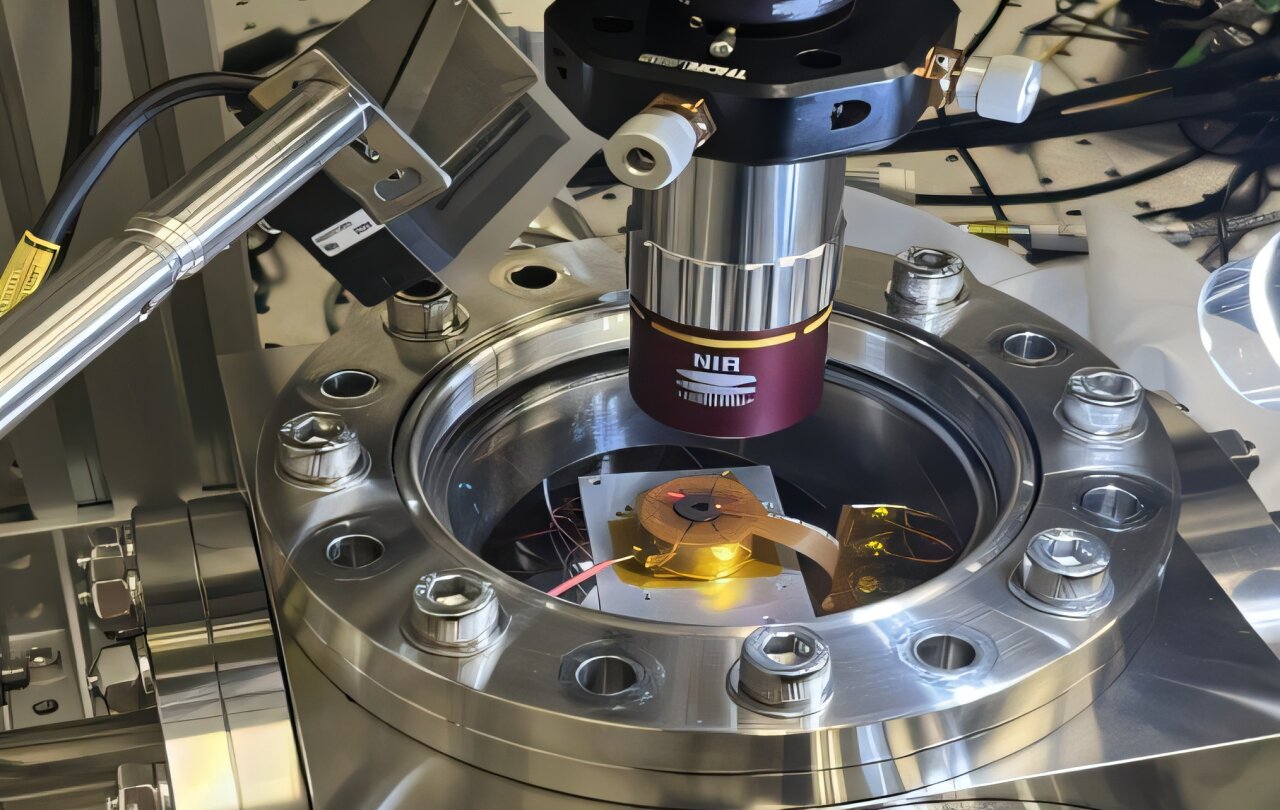
As autonomous driving technology marches steadily toward SAE Level 3 and Level 4 systems, one major safety bottleneck continues to plague developers: maintaining precise localization when satellite signals drop. To solve this critical vulnerability, researchers at Singapore's Agency for Science, Technology and Research (A*STAR) Quantum Innovation Centre (Q.InC) have developed an innovative magnetically levitating rotation device designed specifically to enable high-precision GPS-denied autonomous vehicle navigation.
The Core Challenge: Why Current ADAS Struggles in Urban Canyons
Modern Advanced Driver Assistance Systems (ADAS) and autonomous vehicles (AVs) rely heavily on Global Navigation Satellite Systems (GNSS) like GPS, BeiDou, or Galileo for localization. However, in 'urban canyons' with towering skyscrapers, underground parking complexes, long tunnels, and under dense tree canopies, these signals suffer from multi-path interference or complete outages.
When GPS fails, vehicles must rely on inertial measurement units (IMUs) containing micro-electromechanical systems (MEMS) gyroscopes and accelerometers. Unfortunately, conventional MEMS sensors suffer from 'drift'—small, accumulating errors caused by physical friction and thermal instability. Within a few seconds of signal loss, this drift can cause the vehicle's estimated position to diverge by meters, presenting a severe hazard for L3+ autonomous highway driving or urban robo-taxis.
Enter the Maglev Rotation Sensor: How A*STAR's Tech Works
The breakthrough developed by the researchers at A*STAR Q.InC under Singapore's flagship semiconductor and quantum research initiative utilizes magnetic levitation to completely eliminate mechanical friction. By levitating the rotating sensor element, the device isolates the critical inertial components from mechanical wear, structural vibrations, and friction-induced drift.
Frictionless Precision for Dead Reckoning
In classical navigation, 'dead reckoning' is the process of calculating a current position by using a previously determined position and incorporating estimates of speed and heading over time. By utilizing quantum-inspired levitation mechanics, this new sensor achieves unprecedented sensitivity to changes in angular velocity. This allows the vehicle's onboard computers to calculate precise changes in direction even at minute scales, maintaining sub-meter localization accuracy for extended periods without any external satellite reference.
Comparing Navigation Paradigms for Self-Driving Cars
To understand the strategic importance of this hardware-level breakthrough, we can compare how different localization systems perform under challenging operational environments:
| Navigation Method | Primary Relying Tech | Strengths | Weaknesses in GPS-Denied Zones |
|---|---|---|---|
| Satellite (GNSS) | GPS / BeiDou / Galileo | Excellent global coordinates, zero drift over long distances. | Fails completely in tunnels, parking garages, and deep urban canyons. |
| Standard MEMS IMU | Silicon Micro-Gyroscopes | Low-cost, compact, independent of external signals. | Suffers from cumulative 'drift'; unreliable after short intervals. |
| Levitating Sensor (A*STAR) | Magnetic Levitation & Inertial Fusion | Near-zero friction, ultra-low drift, high reliability. | Higher initial hardware complexity compared to legacy MEMS. |
Strategic Impact for Global OEMs and Tech Investors
For Western OEMs and Tier 1 auto suppliers, this research highlights a critical shift in the autonomous vehicle development paradigm. While much of the industry's focus has been on advancing computer vision and sensor-fusion software, the physical limits of hardware sensors remain a structural vulnerability.
Redundancy as a Regulatory Necessity
Regulators in both North America (NHTSA) and Europe (UN-ECE) are tightening safety standards for hands-free and eyes-off autonomous systems. To secure commercial deployment approvals, OEMs must prove that their vehicles feature 'fail-operational' architectures. Having a highly accurate, drift-free physical sensor that functions autonomously during GPS outages is no longer a luxury—it is a regulatory and safety necessity.
Cross-Border Collaboration and Tech Integration
Located at the geopolitical and technological crossroads of Asia, Singapore's research hubs are uniquely positioned. This breakthrough represents a prime opportunity for global automotive suppliers to engage in cross-border collaboration. By integrating advanced Singaporean semiconductor and hardware innovations with existing Western ADAS software stacks and advanced battery-electric platforms from major global OEMs, the industry can significantly accelerate the timeline for safe, city-wide L3+ deployment.
Ultimately, as automakers continue to optimize the balance between cost, performance, and safety, physical-layer breakthroughs like A*STAR's levitating rotation device will prove foundational in bridging the gap between theory and real-world autonomy.