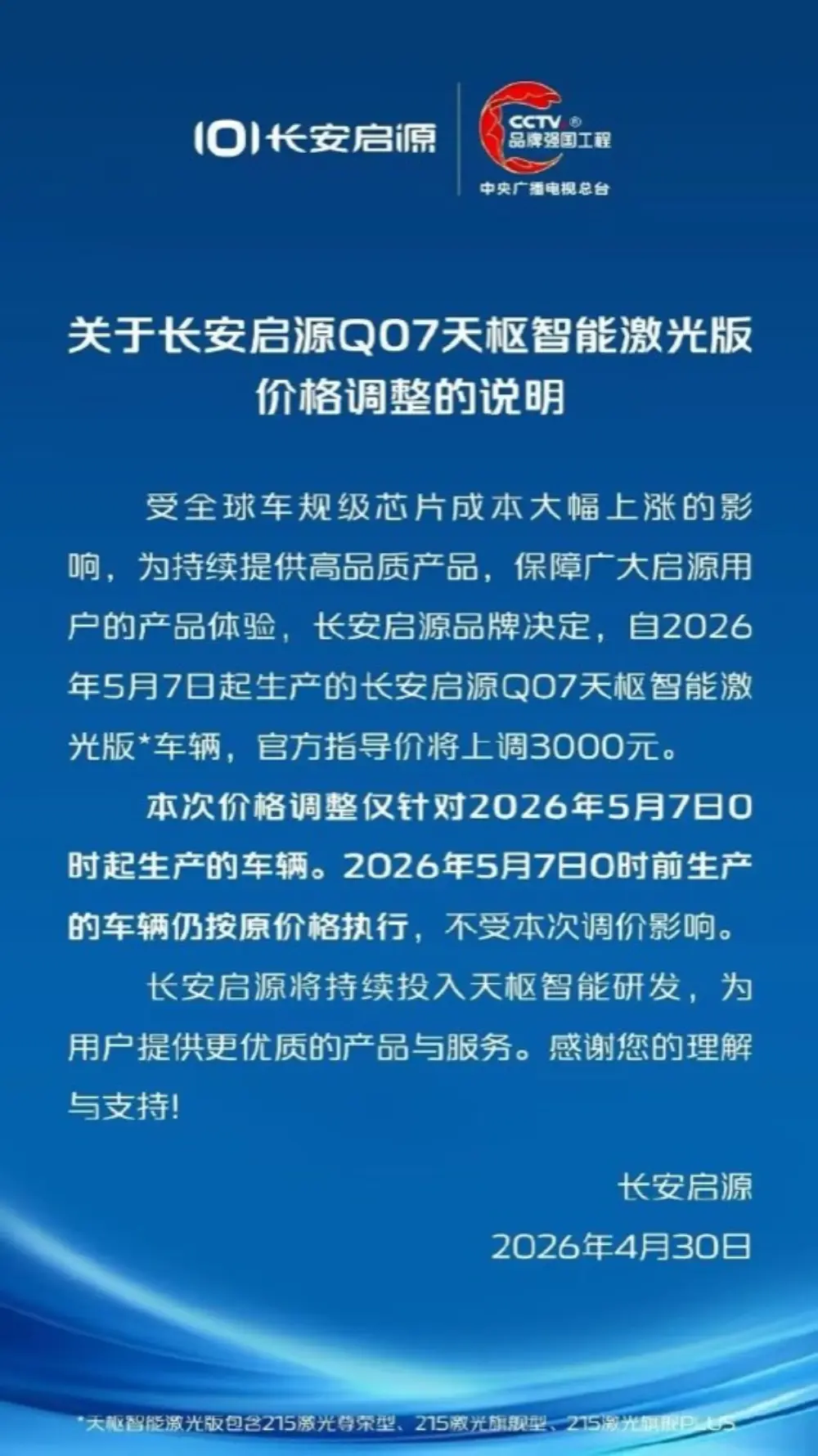
In a recent announcement, Changan Qiyuan, a prominent player in the Chinese EV market, has raised the price of its Q07 Tian Shu Intelligent Laser Edition by 3000 yuan. This price hike, effective from May 7, 2026, is a direct result of the rising costs of automotive-grade chips, which are crucial for advanced driver-assistance systems (ADAS) and autonomous driving technologies. But what does this mean for the broader EV market, and how will it impact Western investors and car buyers?
Understanding the Price Increase
The Q07 Tian Shu Intelligent Laser Edition, launched in October 2025, is a high-end model featuring advanced ADAS capabilities, including a single laser radar and the Horizon Journey 6M chip, which offers 128 TOPS of computing power. The price increase affects three models: the 215 Laser Prestige, 215 Laser Flagship, and 215 Laser Flagship PLUS, with new prices set at 15.98, 16.98, and 17.98 million yuan, respectively.
Why the Price Hike Matters
The global chip shortage, exacerbated by the AI industry’s demand, has led to a significant increase in the cost of key components like DDR5 memory chips. This trend is not unique to Changan Qiyuan; other automakers are also grappling with similar challenges. For instance, Reuters reported that several major automakers have had to cut production due to the ongoing chip crisis.
Impact on the Chinese EV Market
-
Increased Costs: Higher chip prices translate to higher production costs, which are often passed on to consumers. This could slow down the adoption of advanced EVs in China, as affordability remains a key factor for many buyers.
-
Market Competition: As more automakers face similar pressures, the competitive landscape may shift. Companies with robust supply chains and strong financial backing may be better positioned to weather the storm.
-
Consumer Behavior: Consumers may become more selective, opting for less expensive models or delaying their purchases until the market stabilizes.
What This Means for Western Investors and Car Buyers
For Western investors, the global chip shortage and its impact on the Chinese EV market highlight the importance of diversifying investments and considering the resilience of supply chains. Companies with a strong focus on innovation and strategic partnerships may be more attractive in the long term.
For Western car buyers, the implications are more nuanced. While the immediate impact may be limited, the global nature of the automotive industry means that similar price increases could occur in other markets. This underscores the need for consumers to stay informed about market trends and to consider the long-term value of their vehicle purchases.
See our analysis on EV Market Trends for more insights into the future of electric vehicles.