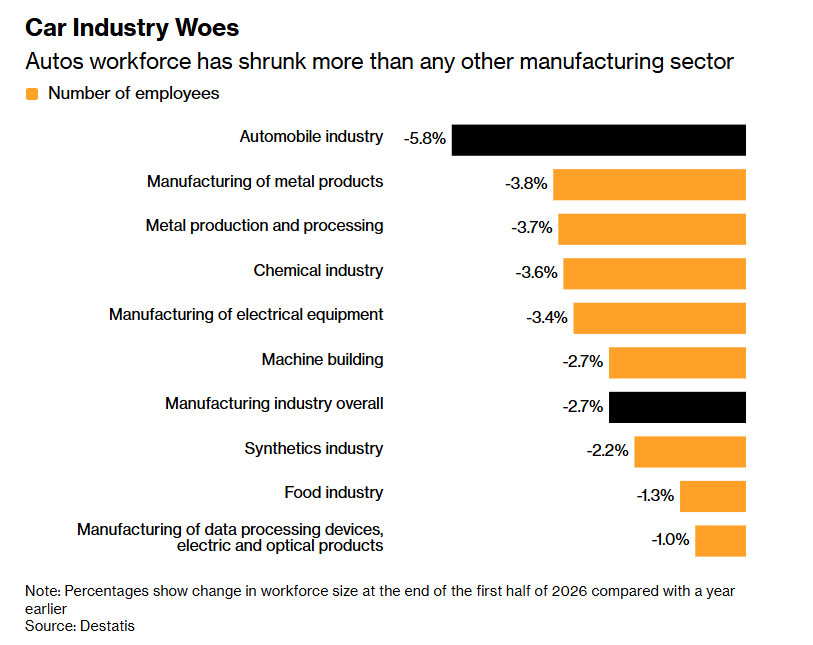
The European automotive heartland is undergoing a profound structural realignment. Recent data indicates that German automotive industry job cuts have accelerated, pushing domestic employment in the sector to its lowest level in over two decades. As legacy manufacturers and Tier 1 suppliers face intense global competition and the high-capital demands of electrification, the industry is pivoting toward leaner, software-driven operations.
The Data: German Automotive Industry Job Cuts Reach Historical Lows
According to reports from Bloomberg and Germany's Federal Statistical Office, the headcount in the German automotive sector has contracted to levels not seen since the late 1990s. This decline is not merely a cyclical downturn; it represents a fundamental transition from mechanical-heavy Internal Combustion Engine (ICE) manufacturing to highly automated, software-centric Electric Vehicle (EV) architectures.
Historically, German automotive prowess was built on complex engine assembly and precision engineering—processes requiring immense, highly skilled labor pools. However, EVs require significantly fewer moving parts, structurally reducing the baseline labor needed for assembly. When coupled with rising energy costs in Europe and intense cost pressures from agile Asian competitors, domestic restructuring has become an operational necessity.
Comparing Structural Reductions Across Key Suppliers
The impact of this transition is most visible among Germany's massive Tier 1 supplier network, which has historically acted as the backbone of the European auto supply chain. The table below outlines major restructuring initiatives announced across the sector:
| Company | Primary Structural Adaptation | Strategic Focus Shift |
|---|---|---|
| ZF Friedrichshafen | Workforce downsizing & plant consolidation | E-mobility systems & advanced chassis solutions |
| Continental AG | Administrative & R&D structural optimization | Software-defined vehicle (SDV) architectures |
| Bosch | Targeted capacity adjustments in drive divisions | Semiconductors, hydrogen fuel cells, and cloud integration |
The China-Speed Factor: Global Competitive Headwinds
While domestic labor dynamics play a role, the primary external catalyst is the rapid rise of Chinese EV manufacturers (such as BYD, Geely, and emerging tech players like Xiaomi). Operating with highly verticalized supply chains, access to domestic LFP battery ecosystems, and rapid development cycles, Chinese OEMs are setting new global benchmarks for cost efficiency and technical integration.
Rather than relying on legacy structural frameworks, global automotive players are realizing that competing purely on domestic assembly costs is unsustainable. Consequently, Western OEMs are pursuing a dual strategy: restructuring their high-cost domestic footprints while simultaneously entering into strategic sourcing alliances and cross-border technology integrations with global partners. Examples like Volkswagen's investment in XPeng and Stellantis's joint venture with Leapmotor highlight this shift toward leveraging global supplier expertise to speed up time-to-market.
Strategic Implications for Western Investors
From an investment perspective, the ongoing German automotive industry job cuts should not be viewed as a sign of terminal decline, but rather as an aggressive corporate realignment. This restructuring helps free up capital from low-margin legacy assembly lines to invest in high-margin, future-proof sectors:
- Advanced Driver Assistance Systems (ADAS): Transitioning R&D focus toward Level 2+ and Level 3 autonomy solutions.
- Localized Regional Footprints: Diversifying manufacturing hubs to optimize supply chain compliance and adapt to evolving regional trade policies.
- Battery Chemistry & Software: Partnering with global leaders to secure steady access to next-generation prismatic and solid-state batteries.
As the 'China Information Gap' narrows, Western market analysts must closely monitor these labor transitions. The companies that successfully navigate these structural headwinds and pivot their labor forces toward high-value digital IP will likely emerge as the long-term leaders of the software-defined automotive era.