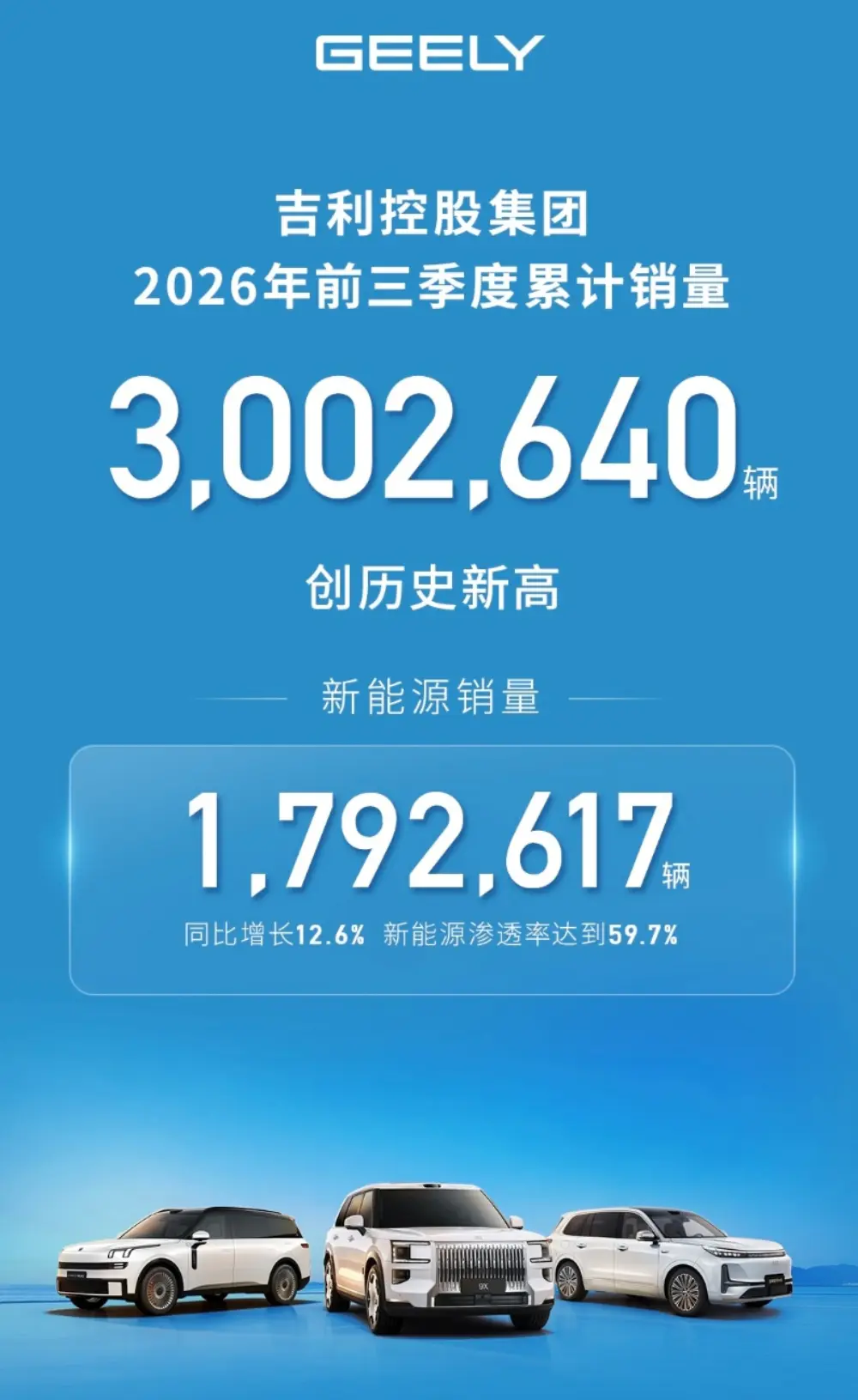
When Zhejiang Geely Holding Group confirmed it had crossed 3,002,640 cumulative vehicle sales in the first three quarters of 2026—with new energy vehicles (NEVs) representing 1,792,617 units or nearly 60% of total deliveries—financial headlines uncritically heralded the arrival of China\'s second undisputed volume titan alongside BYD. The sheer scale is undeniable: delivering three million vehicles across global brands in nine months places Geely within striking distance of the world\'s top five automotive conglomerates by volume. Yet for institutional equity analysts, Western OEM strategists, and automotive supply chain leaders, this aggregate volume milestone conceals a far more complex structural reality. Beneath the soaring electrified delivery curves lies an intricate web of overlapping platforms, aggressive intra-group brand cannibalization, sustained margin pressure, and unprecedented export headwinds across Western markets.
To understand the operational mechanics of Geely\'s milestone, one must trace the conglomerate\'s evolution from a domestic budget manufacturer into a sprawling multinational federation. Unlike BYD\'s strictly centralized, vertically integrated machine, Geely Chairman Li Shufu built an empire through serial acquisitions and bespoke brand incubations: Volvo Cars, Polestar, Lotus, Zeekr, Lynk & Co, smart, Radar, and the core Geely Auto stable (incorporating the Galaxy and Geometry sub-series). While this architecture granted Geely unprecedented agility in testing distinct market sub-segments, it also saddled the holding company with fragmented engineering overhead and dispersed sales networks. Now, as the domestic market enters a brutal war of attrition, Geely\'s consolidated volumes are testing the outer limits of capital efficiency.
Architectural Convergence: Deconstructing SEA, CMA, and NordThor Powertrains
The technical backbone enabling Geely Holding NEV sales growth is the group\'s multi-tier platform strategy, led by the Sustainable Experience Architecture (SEA) and the modular Compact Modular Architecture (CMA). Originally conceived to amortize R&D costs across both European premium brands and domestic volume players, the SEA platform exists in multiple variants: SEA1 (Zeekr 001, Polestar 4), SEA2 (smart #1, Zeekr X, Volvo EX30), SEA-M (autonomous ride-hailing platforms co-developed with Waymo and commercialized in the Zeekr Mix), and SEA-E (entry-level applications). By standardizing high-voltage battery packaging, subframe geometry, and steer-by-wire capability across these variants, Geely achieved an estimated 30% reduction in vehicle engineering lead times compared to traditional Western development cycles.
On the powertrain front, Geely\'s response to BYD\'s DM 5.0 hybrid architecture is the NordThor (Leishen) EM-i and EM-P hybrid systems. The NordThor 2.0 powertrain couples a dedicated 1.5-liter hybrid engine claiming a peak thermal efficiency of 46.5% with a dual-motor DHT (Dedicated Hybrid Transmission) utilizing P1+P3 or P1+P2 motor configurations. Paired with battery capacities ranging from 18.7 kWh to 39.8 kWh, Geely Galaxy models regularly post claimed comprehensive ranges exceeding 2,100 kilometers under the CLTC cycle. In high-performance battery-electric vehicles (BEVs), Zeekr\'s adoption of 800V and native 900V Silicon Carbide (SiC) power electronics enables sustained fast charging up to 5.5C on its in-house \'Golden Brick\' (Aegis) lithium iron phosphate (LFP) cells, capable of replenishing 10% to 80% state-of-charge (SOC) in under 11 minutes under optimal conditions.
| Metric / Specification | Geely Group (Zeekr / Galaxy) | BYD Group (e-Platform 3.0 / DM 5.0) | Volkswagen Group (MEB / PPE) | Hyundai Motor Group (E-GMP) |
|---|---|---|---|---|
| Core Dedicated EV Architecture | SEA (SEA1, SEA2, SEA-M) / GEA | e-Platform 3.0 Evo | MEB / PPE (Premium) | E-GMP / IMA (Next-Gen) |
| Maximum System Voltage | 800V - 900V (SiC MOSFET) | 800V (SiC Boost Architecture) | 400V (MEB) / 800V (PPE) | 800V (SiC Inverter Standard) |
| Peak Charging C-Rate | 4.5C - 5.5C (Golden Brick LFP) | 3.0C - 4.0C (Blade Battery) | 1.5C - 2.5C (NMC Ternary) | 3.5C - 4.5C (NMC Ternary) |
| Hybrid Thermal Efficiency (%) | 46.5% (NordThor EM-i) | 46.06% (DM 5.0 Dedicated Engine) | ~40.0% (TSI eHybrid) | ~41.0% (Smartstream Turbo Hybrid) |
| Central Compute Architecture | Dual Orin-X / Thor + SE1000 SoC | DiLink / Xuanji Architecture | ICAS 1-3 (CARIAD E3 1.1/1.2) | ccNC / PleerOS Hardware |
| Q1-Q3 2026 Electrification Share | 59.7% (~1.79M units) | 100% (~3.25M units) | ~11.5% (~750k units) | ~14.2% (~510k units) |
While the hardware specifications place Geely at parity with, or marginally ahead of, primary Chinese competitors, maintaining such diversity across disparate architectures creates significant software overhead. Unlike Tesla or BYD, which deploy uniform operating stacks across their entire fleet, Geely continues to juggle multiple human-machine interfaces (HMI) and domain control topologies. Zeekr OS operates largely on proprietary stacks integrated with Qualcomm Snapdragon 8295 chips, Lynk & Co relies heavily on the Flyme Auto system co-developed with Xingji Meizu, and Volvo/Polestar retain Android Automotive OS dependencies. This fragmentation fractures software development budgets, requiring continuous multi-branch refactoring that dilutes the group\'s operational velocity.
Supply Chain Mechanics and the True Cost of Brand Federation
Behind Geely Holding\'s low unit costs is a semi-captive component supply ecosystem. The crown jewel of this structure is VREMT (Viridi E-Mobility Technology), a wholly owned subsidiary that engineers and manufactures battery packs, electric drive units (EDUs), onboard chargers, and high-power charging infrastructure. By producing its own 800V SiC high-performance drive units in Ningbo and Quzhou, Geely isolates its premium marques from external tier-1 supplier markups. For battery cell chemistry, Geely balances equity joint ventures with CATL and CALB against its proprietary in-house Golden Brick LFP production. Industry tear-down estimates suggest that VREMT\'s localized LFP cell-to-pack integration yields a battery pack manufacturing cost between $68 and $74 per kilowatt-hour (kWh), closely shadowing BYD\'s Blade pack cost structure.
In autonomous driving silicon and intelligent cockpits, Geely operates via its affiliated technology arm, ECARX, alongside strategic partnerships with Horizon Robotics and Black Sesame Technologies. ECARX\'s proprietary \'Longying One\' (SE1000) 7nm automotive SoC provides high-volume, cost-effective computing for entry-to-mid-tier models, mitigating reliance on expensive Western silicon imports for mass-market offerings. For level 2+ and urban navigate-on-autopilot (NOA) capabilities in high-tier models, the group leverages Nvidia Drive Orin-X platforms complemented by custom perception algorithms developed across Shanghai and Gothenburg facilities.
However, the hidden vulnerability within Geely\'s supply chain is platform redundancy. While BYD produces millions of vehicles using identical structural pressings, wiring harnesses, and battery modules, Geely\'s federated approach demands separate tooling, unique exterior stampings, and bespoke interior supplier contracts for models that fundamentally occupy identical footprint categories. A Zeekr 007, a Geely Galaxy E8, and a Lynk & Co Z10 share fundamental floorpan logic and suspension mounting coordinates, yet each utilizes differentiated body-in-white structures, custom switchgear, and distinct interior cockpits. This product duplication inflates Bill of Materials (BOM) costs by an estimated 8% to 12% relative to a purely unified, single-brand manufacturing run of equivalent volume.
Competitive Impact: Who Bears the Cost of Geely\'s Volume Surge?
Geely\'s rapid push to nearly 60% NEV penetration reverberates across multiple competitive fronts, profoundly altering market share dynamics both domestically and abroad:
- Foreign Joint Ventures in China: The primary casualties of Geely\'s electrified surge remain legacy Sino-foreign ventures. SAIC-Volkswagen, FAW-Toyota, and Changan Ford have seen their core C-segment sedan and compact SUV volumes dismantled. The Geely Galaxy L6 and L7, priced aggressively between 105,000 RMB and 145,000 RMB ($14,500 to $20,000), offer plug-in hybrid economics, sub-7-second acceleration, and advanced infotainment that render comparable legacy ICE sedans virtually unsellable in Tier-2 through Tier-4 Chinese cities.
- Direct Confrontation with BYD: Geely has positioned itself as the only domestic conglomerate capable of matching BYD across every price band. While BYD retains decisive scale advantages in pure volume, Geely\'s Galaxy series has successfully clawed back share in the critical 100,000 to 180,000 RMB bracket by exploiting consumer fatigue with BYD\'s ubiquitous styling and offering perceived superiority in interior chassis refinement and ride dynamics.
- The Squeeze on European Premium Incumbents: In the premium EV tier (250,000 to 400,000 RMB), Zeekr has systematically eroded the domestic market position of the German \'BBA\' triad (BMW, Mercedes-Benz, Audi). The Zeekr 001 and Zeekr 009 luxury MPV continue to capture executive buyers who previously opted for BMW 5-Series or Mercedes-Benz E-Class sedans, delivering twice the performance and superior software responsiveness at a 25% lower MSRP.
The Reality Check: Cannibalization, Margin Dilution, and Capital Dispersion
The corporate narrative surrounding Geely Holding NEV sales depicts a frictionless transition toward electric dominance. Independent industry observation, however, reveals structural friction that tempers long-term return on invested capital (ROIC). The core dilemma confronting Chairman Li Shufu is the \'Volume vs. Profit Paradox.\' Delivering 1.79 million NEVs in nine months is an undeniable manufacturing triumph, but it has required margin-diluting retail subsidies, promotional trade-in allowances, and dealer channel financing support to keep factory utilization rates elevated during China\'s persistent domestic price war.
First, internal cannibalization has reached levels that group leadership can no longer ignore. The overlap between Lynk & Co\'s electrified offerings (such as the 07 EM-P and 08 EM-P) and the Geely Galaxy lineup has caused severe pricing confusion within the group\'s own retail network. Simultaneously, the Lynk & Co Z10 pure-electric executive sedan directly challenges the Zeekr 001 and Zeekr 007 for the exact same demographic of tech-forward urban professionals. This internal civil war recently forced Geely Holding into a comprehensive operational restructuring—consolidating Lynk & Co under Zeekr\'s corporate umbrella to halt redundant capital expenditure and rationalize product cadences. The restructuring is an implicit admission that managing ten disparate passenger car brands in a cutthroat market is economically unsustainable.
Second, the financial health of Geely\'s overseas-listed satellite marques remains fragile. Polestar continues to battle severe cash burn, requiring repeated equity infusions and debt refinancing, while Lotus Technology\'s ultra-luxury lifestyle BEVs have posted delivery figures well below original capital-raising projections. While Volvo Cars provides solid balance sheet support and healthy operational margins from its legacy SUV line, its aggressive pure-electric transition has faced software-related delivery delays on the EX90 and margin erosion on the entry-level EX30.
Finally, engineering claims surrounding ultra-fast charging infrastructure warrant rigorous scrutiny. While Zeekr promotes its V3 \'supercharging\' network delivering peak outputs of up to 800 kW, real-world deployment of these stations is severely bottlenecked by municipal grid capacity. Without multi-megawatt dedicated battery energy storage systems (BESS) installed at every charging hub, concurrent vehicle charging rapidly throttles power delivery down to standard 120-150 kW rates. Claiming 5.5C charging performance in laboratory test cells or at isolated flagship charging plazas does not translate to everyday fleet operations, where electrochemical degradation, cell temperature disparities, and utility grid constraints strictly limit sustained megawatt-scale power transfer.
The Regulatory and Geopolitical Minefield: Tariffs and Decoupling
The geopolitical arena poses the single greatest threat to Geely\'s continued multinational expansion. Having built a significant portion of its corporate strategy on leveraging Western brand equity (Volvo, Polestar, Lotus) to market Chinese-engineered platforms globally, Geely now finds itself directly in the crosshairs of Western trade enforcement.
In the European Union, the European Commission\'s definitive countervailing duties impose an additional 18.8% to 19.3% duty on Geely-manufactured BEVs, stacked on top of the existing 10% baseline import tariff. This directly undermines the export unit economics of the Chinese-built Volvo EX30, Zeekr X, and smart #1. While Geely has initiated production mitigation strategies—such as localizing European EX30 assembly at Volvo\'s Ghent plant in Belgium—relocating supply chains and tooling into high-cost European jurisdictions permanently compresses net margins by several thousand euros per vehicle.
In North America, the regulatory blockade is virtually absolute. US Section 301 tariffs reaching 100% on Chinese-assembled electric vehicles, combined with strict Foreign Entity of Concern (FEOC) rules governing battery components and critical minerals under the Inflation Reduction Act (IRA), have effectively locked Geely\'s core brands out of the United States. Polestar has attempted to navigate these restrictions through contract manufacturing of the Polestar 3 at Volvo\'s Ridgeville, South Carolina facility, and by shifting Polestar 4 production for the North American market to Renault Korea\'s Busan plant. However, the pending US Department of Commerce rules prohibiting Chinese-connected vehicle software and hardware modules threaten to render even localized assembly impossible if vehicle operating systems, telematics control units (TCUs), or sensor suites trace their origins to Chinese entities.
Strategic Outlook and Investor Scenarios
As Geely Holding enters the final stretch of the decade, institutional investors and automotive executives must weigh three diverging trajectories for the Hangzhou-based conglomerate:
Bull Case: Synergy Realization and Regional Manufacturing Hegemony
Geely successfully integrates Lynk & Co under Zeekr, eliminating 30% of overlapping R&D and administrative overhead. The SEA platform achieves supreme economies of scale across 4 million combined group vehicles. The company\'s localized assembly hubs in Ghent, Belgium, and Busan, South Korea, successfully circumvent Western tariff barriers, allowing Geely to sustain 55-60% global NEV penetration while expanding operating margins to 7.5%. NordThor hybrid systems capture dominant market share in Southeast Asia, the Middle East, and Latin America, establishing Geely as the leading multi-market competitor to Toyota and BYD.
Base Case: Margin Compression and Protracted Consolidation
Group volumes continue to climb past 4 million units annually, with NEV sales stabilizing around 60% of total deliveries. However, intense domestic price discounting caps operating margins between 3.5% and 4.8%. Brand restructuring yields operational efficiencies, but integration friction between Gothenburg and Hangzhou delays next-generation vehicle architectures. European market expansion generates positive cash flow but yields limited net margin due to localized manufacturing costs and persistent regulatory compliance spending. Cash burn at Polestar and Lotus continues to absorb a disproportionate share of parent company free cash flow.
Bear Case: Geopolitical Quarantine and Sub-Brand Failures
Western regulatory authorities enact comprehensive bans on Chinese connected-vehicle hardware and software architecture, forcing Geely into an expensive structural decoupling of its European and domestic engineering teams. Polestar requires substantial debt restructuring or equity write-downs, while Lotus Technology fails to achieve profitability. In China, renewed price aggression from BYD in the hybrid segment forces Geely to choose between market share surrender and negative operating margins. High debt leverage across holding subsidiaries triggers strategic retrenchment and asset disposals.
For market analysts and automotive executives, five operational conclusions emerge from Geely Holding\'s milestone:
- Scale is Not an Antidote to Margin Attrition: Crossing 3 million units and approaching 60% electrification proves Geely\'s manufacturing capability, but without structural cost unification across its fragmented brand portfolio, volume growth does not translate to enterprise-level shareholder value.
- The Multi-Brand Strategy Demands Rationalization: The merger of Zeekr and Lynk & Co marks the end of Geely\'s era of uncontrolled brand proliferation. Expect further consolidation or sunsetting of underperforming sub-brands (e.g., Radar, Geometry) over the next 24 months.
- Architectural Modularity Has Reached Its Limit: The SEA architecture has delivered remarkable variety, but diverging software branches and unique sheet metal requirements are eroding theoretical platform savings. Geely must converge on a unified software and compute stack to match Tesla\'s or BYD\'s unit economics.
- Western Brand Shelters Are Crumbling: Owning Volvo and Polestar no longer provides an automatic diplomatic passport past Western protectionism. Regulators in Brussels and Washington are targeting capital ownership, supply chains, and code bases rather than badge heritage.
- Hybrid Powertrains Are the Bridge to Global Survival: In markets where pure BEV adoption has slowed and trade barriers penalize Chinese battery supply chains, Geely\'s NordThor EM-i and EM-P hybrid powertrains represent its most potent and resilient export commodity for emerging and mature markets alike.