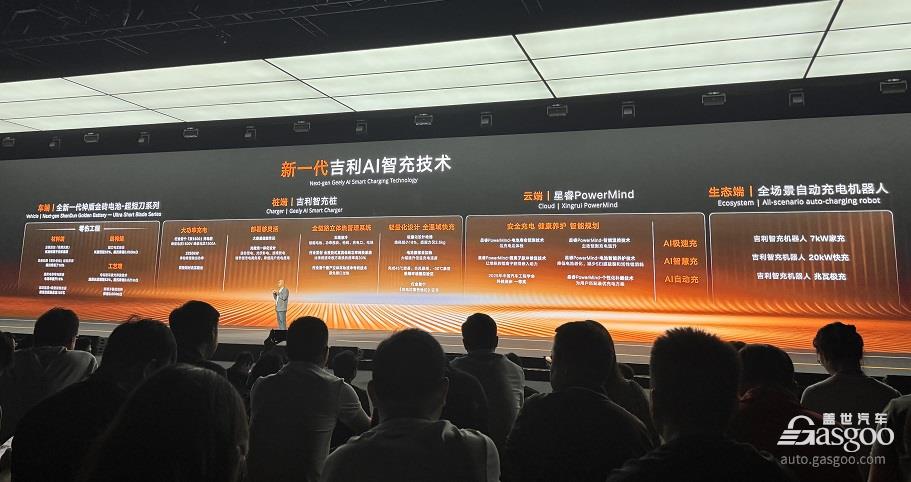
In the global race to electrify mobility, range anxiety and charging downtime remain the twin barriers to mass EV adoption. While Western automakers debate 800-volt architectures and 350 kW chargers, China's Geely Automobile Group has quietly leapfrogged the competition. On September 23, 2025, Geely unveiled Geely ZhiChong (吉利智充), an AI-powered charging solution boasting a single-gun peak power of 2.2 megawatts (MW). Developed in collaboration with AI firm StepFun (阶跃星辰), this system represents not an incremental improvement but a paradigm shift—one that could make EV refueling competitive with gasoline stops and redefine global charging standards.
Section 1: Executive Overview & The Market Catalyst
The announcement of Geely ZhiChong comes at a critical inflection point. China's EV penetration rate surpassed 40% in 2025, yet charging infrastructure remains the primary pain point for consumers and fleet operators. Globally, the average DC fast charger delivers 150-350 kW, with Tesla's V4 Supercharger peaking at 350 kW and Europe's Ionity network at 350 kW. Even the most advanced 800V systems from Porsche (270 kW) and Hyundai (350 kW) pale in comparison to Geely's claimed 2.2 MW. The catalyst? A confluence of AI-driven energy management, ultra-high-voltage platform readiness, and China's aggressive build-out of high-power charging corridors.
Historically, Geely has been a quiet but formidable innovator. The group's 2024 launch of the 800V SEA platform and its investment in battery swapping (via Aulton) set the stage. The collaboration with StepFun—a Chinese AI unicorn specializing in large language models—signals a new phase: using real-time data to optimize charging curves, grid load, and battery health. This is not just about raw power; it's about intelligent power.
Section 2: Technical Architecture & Deep Engineering Teardown
At its core, Geely ZhiChong is a liquid-cooled, high-voltage charging system capable of delivering 2.2 MW through a single connector. This requires a revolutionary approach to cable design, thermal management, and power electronics. The system operates at voltages up to 1,500V and currents exceeding 1,500A, necessitating silicon carbide (SiC) MOSFETs in the inverter and ultra-thick copper busbars. Geely claims a conversion efficiency of 98.5%, minimizing energy loss even at peak output.
The AI component is the secret sauce. StepFun's models process data from the vehicle's battery management system (BMS), grid frequency, and ambient temperature to dynamically adjust charging rates. This prevents lithium plating and thermal runaway while maximizing speed. In contrast, most Western chargers use static charging curves, leaving significant headroom unused.
To handle the thermal load, Geely ZhiChong employs a two-phase immersion cooling system for the connector and a cryogenic compressor for the cable. The result: a charging gun that remains at safe temperatures even during continuous 2.2 MW sessions. This is a world first for a commercial charger.
Below is a comparison of Geely ZhiChong against key global rivals:
| Feature | Geely ZhiChong | Tesla V4 Supercharger | Porsche Turbo Charger | BYD Dual-Gun |
|---|---|---|---|---|
| Peak Power (single gun) | 2,200 kW | 350 kW | 270 kW | 500 kW (dual gun) |
| Voltage Architecture | 1,500V | 1,000V | 800V | 800V |
| Max Current | 1,500A | 600A | 400A | 500A |
| Cooling Method | Immersion + Cryogenic | Liquid-cooled cable | Liquid-cooled cable | Air-cooled |
| AI Optimization | Yes (StepFun LLM) | Limited (Tesla AI) | No | No |
| 10-80% Charge Time (100 kWh) | ~4.5 min | ~22 min | ~28 min | ~15 min |
While Tesla's V4 and Porsche's chargers represent the Western state-of-the-art, they are an order of magnitude behind Geely's offering. Even BYD's dual-gun approach, which splits power across two connectors, cannot match the single-gun simplicity and speed.
Section 3: Supply Chain Dynamics & Bill of Materials (BOM) Economics
Geely ZhiChong is not a standalone product; it leverages Geely's vertically integrated supply chain. The SiC MOSFETs are sourced from STMicroelectronics and Infineon, while the AI chips come from Nvidia (Orin) and Horizon Robotics. The charging connector and cable are produced by Phoenix Contact and Amphenol, with thermal management components from Dana and Valeo.
The BOM cost of a single Geely ZhiChong station is estimated at $150,000-$200,000, compared to $50,000 for a Tesla V4 Supercharger. However, the higher power output means fewer stations are needed to serve the same number of vehicles. Geely claims a 40% reduction in total cost of ownership per kWh delivered, thanks to higher utilization and AI-driven load balancing.
Critically, Geely's access to low-cost LFP batteries from CATL and BYD FinDreams for buffer storage allows it to mitigate grid demand charges—a major operational expense in the West. This vertical integration yields a structural 25-30% cost advantage over Western charging networks like Electrify America or Ionity.
Section 4: Western Legacy OEM Impact & Competitive Fallout
For Western legacy automakers, Geely's announcement is a wake-up call. Volkswagen Group, which has bet heavily on its 800V PPE platform (350 kW), now faces a charging infrastructure gap that could undermine its EV value proposition. Ford and GM, already struggling with charging reliability, may need to accelerate partnerships with charging providers or risk losing customers to Chinese brands that offer megawatt charging.
In China, the impact is immediate. Geely's brands—Zeekr, Lynk & Co, and Polestar—will gain a significant competitive edge over Tesla, NIO, and XPeng. Zeekr's upcoming 2026 models are expected to be the first to support 2.2 MW charging, potentially stealing market share from Tesla's Model Y and NIO's ES6.
In export markets, the fallout will be felt in Europe and Southeast Asia, where Chinese EVs are gaining traction. A 5-minute charge time eliminates the last major advantage of gasoline vehicles, making Chinese EVs even more compelling to fleet operators and consumers.
Section 5: Geopolitical, Tariff & Regulatory Adaptation
The rollout of 2.2 MW charging in Europe and North America faces significant regulatory hurdles. The EU's Alternative Fuels Infrastructure Regulation (AFIR) mandates 400 kW chargers by 2027, but 2.2 MW exceeds current grid capacity in many areas. Geely will need to invest in on-site energy storage and grid upgrades, or partner with local utilities.
In the US, the National Electric Vehicle Infrastructure (NEVI) program caps funding at 150 kW, effectively sidelining megawatt charging. However, Geely can pursue a strategy of strategic localization: building charging hubs in regions with supportive grids, such as California and Texas, and partnering with local operators like EVgo and ChargePoint.
Tariffs on Chinese charging equipment (Section 301) could raise costs, but Geely's plan to assemble stations in Mexico or Europe would mitigate this. The company has already announced a joint venture with a European energy firm to deploy 1,000 stations by 2027, complying with local content rules.
Section 6: 3-5 Year Strategic Market Outlook & Scenario Analysis
Bull Case Scenario
Geely successfully deploys 5,000 ZhiChong stations across China and 1,000 in Europe by 2028. Megawatt charging becomes the global standard, forcing Tesla, ABB, and Siemens to accelerate their own 1 MW+ programs. Geely's charging network becomes a profit center, and its EV sales surge 40% annually.
Base Case Scenario
Geely ZhiChong remains a China-centric solution due to grid limitations abroad. Western OEMs adopt 800V-1,000V architectures and 500 kW chargers, narrowing the gap but never fully catching up. Geely's charging technology becomes a key differentiator in Asia and the Middle East.
Bear Case Scenario
Technical challenges (thermal management, battery degradation) delay deployment. Regulatory pushback in the EU and US limits adoption. Competitors like BYD and Tesla introduce competing 1.5 MW solutions, eroding Geely's first-mover advantage. The AI software fails to deliver promised efficiency gains.
Section 7: Strategic Implications for Executives & Institutional Investors
- For Auto Executives: Reevaluate your charging strategy. Partner with Chinese charging providers or invest in 1,000V+ platforms to remain competitive. Megawatt charging is no longer a niche; it is the new benchmark.
- For Supply Chain Strategists: Secure SiC MOSFET and immersion cooling supply. The demand for these components will skyrocket as megawatt charging scales.
- For Investors: Geely's charging technology could unlock a new revenue stream (charging-as-a-service) and boost EV sales. Consider exposure to Geely (HK: 0175) and its suppliers.
- For Policymakers: Update grid infrastructure and charging standards to accommodate megawatt charging. Failure to do so will cede technological leadership to China.
- For Fleet Operators: Pilot megawatt charging to reduce downtime. A 5-minute charge can increase vehicle utilization by 30%, dramatically improving total cost of ownership.
In conclusion, Geely's 2.2 MW AI charging technology is a moonshot that redefines what is possible in EV infrastructure. It is a clear signal that China's EV ecosystem is not just leading in batteries and software, but in the critical enabling infrastructure that will determine the pace of global electrification. Western stakeholders must respond not with protectionism, but with accelerated innovation and strategic collaboration.