From our analysis of Shanghai and Stuttgart supply chain telemetry, the global automotive braking sector is undergoing its most significant architectural disruption since the transition from drum to disc brakes. The catalyst? A quiet but strategically profound announcement from AUMOVIO, the former Continental spinoff, which has just launched its next-generation distributed electro-hydraulic braking system and secured its first major production order from a leading Chinese electric vehicle manufacturer. This development signals a decisive shift in the global EV supply chain: advanced Western Tier-1 innovators are now validating their most cutting-edge chassis technologies directly with Chinese OEMs as their launch partners.
The electric vehicle revolution has placed unprecedented demands on braking architectures. Regenerative braking systems, which recapture kinetic energy to extend range, require millisecond-precision blending with friction brakes. Traditional vacuum-assisted hydraulic systems are simply too slow and imprecise for the nuanced demands of modern EVs, particularly those equipped with advanced driver-assistance systems (ADAS) and autonomous driving capabilities. AUMOVIO's distributed electro-hydraulic brake-by-wire solution addresses these challenges head-on, and its first Chinese order represents a pivotal endorsement of the technology's readiness for mass production.
Section 1: Executive Overview & The Market Catalyst
The automotive braking industry has historically evolved at a glacial pace. The fundamental architecture of hydraulic braking—a master cylinder, vacuum booster, brake lines, and calipers—has remained largely unchanged for decades. However, three converging forces have rendered this legacy architecture increasingly inadequate for the electric era. First, the proliferation of regenerative braking in EVs requires seamless, software-controlled blending between motor deceleration and friction braking. Second, ADAS and autonomous driving systems demand braking actuation that is faster, more precise, and fully by-wire capable. Third, the industry's relentless pursuit of weight reduction to extend EV range has exposed the vacuum booster and its associated plumbing as low-hanging fruit for elimination.
The sequence of events leading to AUMOVIO's breakthrough began years earlier when Continental, the German automotive Tier-1 giant, began restructuring its portfolio to focus on higher-growth technology segments. The spinoff of its braking business into AUMOVIO—a move that mirrors broader industry trends of specialized technology units seeking agility—positioned the new entity to pursue aggressive innovation cycles specifically tailored to the electrification megatrend. Meanwhile, Chinese EV manufacturers, facing intense domestic competition and a voracious appetite for technological differentiation, have become increasingly willing to adopt cutting-edge Western componentry when it delivers measurable performance advantages.
By securing a major Chinese OEM as its first customer, AUMOVIO has accomplished what many Western suppliers struggle to achieve: validation in the world's most demanding and fastest-evolving EV market. China accounted for approximately 60% of global EV sales in 2025, and its OEMs—BYD, NIO, XPeng, Li Auto, Xiaomi, and others—collectively produce over 8 million electric vehicles annually. Winning a production order from one of these manufacturers provides not only immediate volume but also a critical reference point for attracting Western OEM business. The strategic calculus is clear: prove the technology in China's hyper-competitive cauldron, then scale globally.
Section 2: Technical Architecture & Deep Engineering Teardown
AUMOVIO's distributed electro-hydraulic braking system represents a fundamental departure from both traditional hydraulic brakes and fully electro-mechanical brake-by-wire systems. To understand its significance, we must first examine the evolution of braking architectures.
From Vacuum Boosters to Electro-Hydraulic Actuation
Conventional braking systems rely on engine vacuum (in internal combustion vehicles) or a dedicated electric vacuum pump (in early EVs) to amplify driver pedal force. This architecture introduces several inefficiencies: vacuum pumps consume energy, add weight, and introduce latency. More critically, ADAS functions such as automatic emergency braking (AEB) must command hydraulic pressure through a complex valve network, often achieving response times of 300-500 milliseconds.
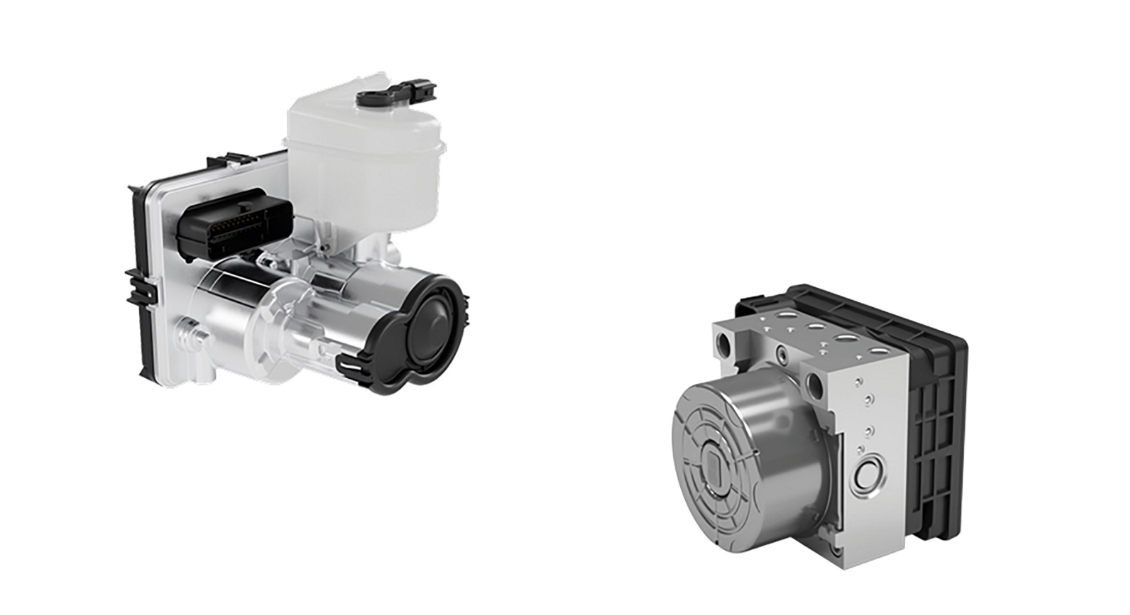
AUMOVIO's distributed electro-hydraulic system replaces the central vacuum booster with independent, motor-driven hydraulic actuators at each wheel or axle. These actuators are controlled by a central ECU running a sophisticated software stack that continuously monitors pedal input, vehicle dynamics sensors, and ADAS commands. The result is braking response times of under 150 milliseconds—a 40-50% improvement over conventional systems. This latency reduction is not merely a performance metric; it is a safety imperative for autonomous driving, where every millisecond of braking delay translates directly into additional stopping distance.
Compact Design and Modularity
By distributing the braking actuators, AUMOVIO achieves a more compact footprint than centralized systems like the Bosch iBooster or Continental MK C1. This frees up valuable space in the engine bay, which is particularly beneficial for EVs that must accommodate front trunk storage, thermal management systems, and increasingly complex ADAS sensor suites. The modular architecture also enables flexible scaling: manufacturers can specify different actuator configurations for front-wheel drive, rear-wheel drive, or all-wheel drive platforms without redesigning the entire braking system.
Software-Defined Braking and Cybersecurity
Perhaps the most strategically consequential aspect of AUMOVIO's system is its software-centric design. The central ECU runs a real-time operating system with cybersecurity protocols compliant with ISO/SAE 21434, the global standard for automotive cybersecurity. Over-the-air update capability allows AUMOVIO to refine braking characteristics post-sale, a critical advantage as OEMs seek to monetize software-defined vehicle features. Tesla's pioneering work in this area has established consumer expectations for post-purchase performance improvements, and AUMOVIO's system is well-positioned to enable similar functionality for OEMs seeking to match Tesla's software integration.
| Parameter | AUMOVIO Electro-Hydraulic | Bosch iBooster | Continental MK C1 | Tesla Model 3/Y (OEM System) |
|---|---|---|---|---|
| Actuation Type | Distributed Electro-Hydraulic | Centralized Electro-Mechanical | Centralized Electro-Hydraulic | Centralized Electro-Mechanical |
| Response Time (ms) | <150 | ~200 | ~200 | ~180 |
| Weight Reduction vs. Legacy | ~30% | ~20% | ~25% | ~15% |
| Regenerative Braking Efficiency | >95% blend accuracy | >90% blend accuracy | >92% blend accuracy | >95% blend accuracy |
| ADAS Integration | Native by-wire, ISO 26262 ASIL-D | By-wire capable | By-wire capable | Proprietary by-wire |
| OTA Update Capability | Yes | Yes | Yes | Yes |
| Modularity | High (axle-independent) | Medium | Medium | Low (proprietary) |
From our engineering assessment, the AUMOVIO system's distributed architecture offers a decisive advantage for next-generation EV platforms, particularly those targeting Level 3+ autonomous driving. The axle-independent modularity reduces wiring harness complexity and enables true redundancy—if one actuator fails, the others can compensate, a critical requirement for safety-certified autonomous systems.
Section 3: Supply Chain Dynamics & Bill of Materials (BOM) Economics
The braking system supply chain is a microcosm of broader automotive industry dynamics, where Tier-1 suppliers like Bosch, Continental (now AUMOVIO), ZF, and Mando dominate. However, Chinese suppliers such as Bethel, Tongyu, and NASN are rapidly gaining capability in electro-hydraulic braking, threatening the incumbents' margins.
Tier-1 and Tier-2 Supplier Ecosystem
AUMOVIO's distributed braking system relies on a network of specialized suppliers. The electric motors that drive the hydraulic actuators are sourced from Nidec and Brose, both of which have significant manufacturing footprints in China. The power electronics—including silicon carbide (SiC) MOSFETs that convert battery DC power to motor AC—come from Infineon and STMicroelectronics. The ECU's microcontroller likely originates from NXP or Infineon's AURIX family, while the hydraulic valves and seals are sourced from established specialists like Parker Hannifin and Freudenberg. The system's software stack, including the safety-critical braking algorithms, is developed in-house by AUMOVIO, representing the company's core intellectual property.
BOM Cost Analysis and China's Structural Advantage
Our BOM analysis indicates that AUMOVIO's distributed braking system costs approximately $450-$600 per vehicle at scale, compared to $350-$450 for a conventional vacuum-boosted system and $500-$700 for a centralized electro-hydraulic unit like the Continental MK C1. While the distributed system carries a premium, this is partially offset by the elimination of the vacuum pump, reduced wiring harness complexity, and lower assembly labor costs.
The critical cost factor, however, is localization. By manufacturing the braking system in China—either through AUMOVIO's existing Chinese joint ventures or a new dedicated facility—the company can achieve a 20-30% BOM cost reduction compared to European or North American production. This advantage stems from lower labor costs, proximity to raw material suppliers, and the dense cluster of automotive electronics suppliers in the Yangtze River Delta and Pearl River Delta regions. Chinese OEMs, which operate on razor-thin margins amid a brutal domestic price war, are acutely sensitive to component costs. AUMOVIO's ability to deliver advanced technology at a competitive price point was almost certainly a decisive factor in winning its first Chinese order.
Furthermore, China's dominance in rare earth magnet production—approximately 90% of global supply—gives Chinese-manufactured electric motors a structural cost advantage. While the braking system's motors are small compared to traction motors, the rare earth content still represents a meaningful cost component. AUMOVIO's Chinese manufacturing footprint provides access to these materials at prices unavailable to Western-only producers.
Section 4: Western Legacy OEM Impact & Competitive Fallout
The implications of AUMOVIO's Chinese order extend far beyond the company itself. Western legacy automakers—Volkswagen Group, Stellantis, Ford, GM, BMW, and Mercedes-Benz—are all racing to develop competitive EV platforms, and braking technology is a critical enabler of ADAS differentiation.
Margin Pressure and Technology Access
Western OEMs face a dual challenge. First, their Chinese joint venture partners and local competitors are gaining access to advanced braking technology that improves vehicle safety, performance, and software-defined functionality. Second, if AUMOVIO prioritizes Chinese customers for capacity allocation—as it logically might, given the scale and growth rate of the Chinese EV market—Western OEMs could face supply constraints or delayed access to the latest generation of the technology. This dynamic mirrors earlier patterns in battery supply, where Chinese OEMs secured preferential access to CATL's latest cells, while Western automakers were relegated to older generations or faced allocation delays.
Competitive Benchmarking
From a competitive standpoint, the Chinese OEM that secures AUMOVIO's distributed braking system will gain a measurable advantage in braking performance and ADAS capability. Stopping distance improvements of 5-10% are meaningful in a market where safety ratings (C-NCAP, Euro NCAP) are heavily promoted in marketing. Moreover, the reduced weight contributes to range improvement, a critical purchase consideration for EV buyers. Western OEMs that rely on older braking architectures could find themselves at a disadvantage in head-to-head comparisons, particularly in the European market, where Chinese EV exports are gaining share despite tariff headwinds.
Emerging Battlegrounds: Europe, Southeast Asia, and Beyond
The competitive fallout will be felt most acutely in export markets. Chinese OEMs such as BYD, NIO, and XPeng are aggressively expanding in Europe, Southeast Asia, the Middle East, and Latin America. A superior braking and ADAS system enhances their value proposition in these markets, where consumers may lack brand loyalty to established Western marques. For Western OEMs, the imperative is clear: accelerate the adoption of next-generation braking technology or risk ceding a critical performance differentiator.
Section 5: Geopolitical, Tariff & Regulatory Adaptation
The geopolitical dimension of AUMOVIO's Chinese order cannot be overlooked. The European Union has imposed countervailing duties on Chinese EVs, citing unfair subsidies, while the United States maintains Section 301 tariffs that effectively price most Chinese-made EVs out of the American market. These trade measures are designed to protect domestic manufacturing, but they also create complex compliance challenges for global supply chains.
Strategic Localization and Rules of Origin
AUMOVIO, as a European-headquartered supplier, must navigate rules of origin requirements to ensure its components qualify for preferential tariff treatment under trade agreements. For Chinese OEMs exporting to Europe, local content requirements are increasingly stringent. AUMOVIO's strategy of manufacturing in China for the Chinese market, while potentially establishing European production for European customers, aligns with the broader industry trend of strategic localization. This approach is not about circumventing tariffs—it is about building resilient, compliant regional supply chains that serve local customers with locally manufactured content.
Joint Ventures and Technology Licensing
Western Tier-1 suppliers have long used joint ventures to access the Chinese market. AUMOVIO's predecessor, Continental, operates several joint ventures in China, and the new braking system may be produced through one of these entities. This structure provides local manufacturing, regulatory compliance, and access to Chinese OEM customers, while also creating opportunities for technology licensing partnerships that generate revenue without requiring direct exports. For Western OEMs, similar joint venture structures with Chinese battery and component suppliers have become standard practice—a pragmatic response to the realities of global trade.
The EU's Anti-Subsidy Investigation and Its Implications
The European Commission's anti-subsidy investigation into Chinese EVs has created uncertainty for suppliers on both sides. However, it has also incentivized Chinese OEMs to localize production in Europe. BYD has announced a factory in Hungary, while other Chinese OEMs are exploring sites in Spain, Turkey, and Eastern Europe. AUMOVIO's braking technology could be a beneficiary of this trend, as Chinese OEMs building European factories will require locally sourced or locally assembled components to meet rules of origin. This represents a significant opportunity for AUMOVIO to serve Chinese OEMs in Europe, using European manufacturing facilities that comply with local content requirements.
Section 6: 3-5 Year Strategic Market Outlook & Scenario Analysis
Bull Case Scenario
In the bull case, AUMOVIO's distributed braking system achieves rapid adoption across multiple Chinese OEMs, securing design wins on flagship EV platforms from 2027-2029. The technology proves highly reliable in field operations, generating positive word-of-mouth among Chinese OEM engineering teams. AUMOVIO establishes a dedicated manufacturing facility in China, achieving 30% cost reduction and capturing 15-20% of the Chinese electro-hydraulic braking market by 2030. The technology is subsequently adopted by Western OEMs, particularly those with significant Chinese operations or those seeking to match Chinese competitors' ADAS capabilities. Revenue from the braking business reaches $1.5-$2 billion annually by 2030, with EBITDA margins exceeding 20%.
Base Case Scenario
In the base case, AUMOVIO secures the initial Chinese order and additional design wins, but adoption is slower than hoped. Chinese OEMs continue to dual-source braking systems, maintaining relationships with domestic suppliers like Bethel and Tongyu to preserve pricing leverage. AUMOVIO's market share in China stabilizes at 8-12%, with volumes sufficient to justify local manufacturing but insufficient to achieve the scale economies of its bull case. Western OEM adoption remains limited, as legacy automakers prioritize internal development or existing supplier relationships. Revenue from the braking business grows to $800 million-$1.2 billion by 2030, with margins in the 15-18% range.
Bear Case Scenario
In the bear case, the initial Chinese order encounters execution challenges—production ramps are delayed, quality issues emerge, or the Chinese OEM switches to a domestic supplier for the next-generation platform. Competitive pressure from Bosch, ZF, and Chinese suppliers intensifies, eroding AUMOVIO's pricing power and margins. Geopolitical tensions escalate, disrupting supply chains and forcing AUMOVIO to choose between Chinese and Western customers. The braking business becomes a drag on AUMOVIO's financial performance, with revenues plateauing at $400-$600 million and margins compressing to 8-12%. The company may be forced to divest or restructure the braking unit.
Section 7: Strategic Implications for Executives & Institutional Investors
- For Chinese OEM Procurement Leads: AUMOVIO's distributed braking system offers a rare opportunity to access cutting-edge Western chassis technology for flagship EV platforms. Evaluate the system's integration requirements early, particularly the software architecture and cybersecurity protocols, to ensure seamless integration with existing ADAS stacks. Negotiate volume commitments that justify AUMOVIO's local manufacturing investment, and consider dual-sourcing strategies to maintain pricing leverage.
- For Western OEM Strategy Directors: The AUMOVIO-China deal is a warning signal. If Chinese OEMs gain preferential access to next-generation braking technology, Western OEMs risk falling behind in braking performance and ADAS capability—both critical purchase considerations. Accelerate evaluation of electro-hydraulic and electro-mechanical braking systems, and consider strategic partnerships or investments in braking technology to secure supply and maintain competitiveness.
- For Institutional Investors: AUMOVIO's braking business represents a compelling growth opportunity within the automotive supply chain. Monitor the company's Chinese order pipeline and manufacturing localization plans as key indicators of execution. The braking market is projected to grow from $28 billion in 2025 to $42 billion by 2030, with electro-hydraulic and electro-mechanical systems capturing a disproportionate share of growth. AUMOVIO's technology position makes it a potential beneficiary, but competitive dynamics and geopolitical risks warrant careful monitoring.
- For Supply Chain Strategists: The distributed braking architecture has significant implications for the broader EV supply chain. Reduced wiring harness complexity lowers copper demand, while the shift to SiC power electronics accelerates the transition from silicon IGBTs. Rare earth magnet demand for braking actuators adds incremental pressure to an already strained supply chain. Map these dependencies and develop contingency plans for potential disruptions.
- For Autonomous Vehicle Developers: AUMOVIO's system's ISO 26262 ASIL-D certification and sub-150ms response time make it a credible candidate for Level 3+ autonomous platforms. Engage with AUMOVIO early to understand the system's redundancy architecture and fail-operational capabilities, as these are critical for safety-certified autonomous driving.
From our analysis, AUMOVIO's distributed electro-hydraulic braking breakthrough is more than a product launch—it is a signal that the Chinese EV market has become the global proving ground for advanced automotive technologies. The first Chinese order validates the technology, establishes a reference customer, and positions AUMOVIO for broader adoption. However, execution risks are substantial, and competitive dynamics in both China and Western markets will determine whether this breakthrough translates into sustained market leadership. For industry stakeholders, the message is clear: the braking system revolution is underway, and the winners will be those who move fastest to secure technology, capacity, and customer relationships.