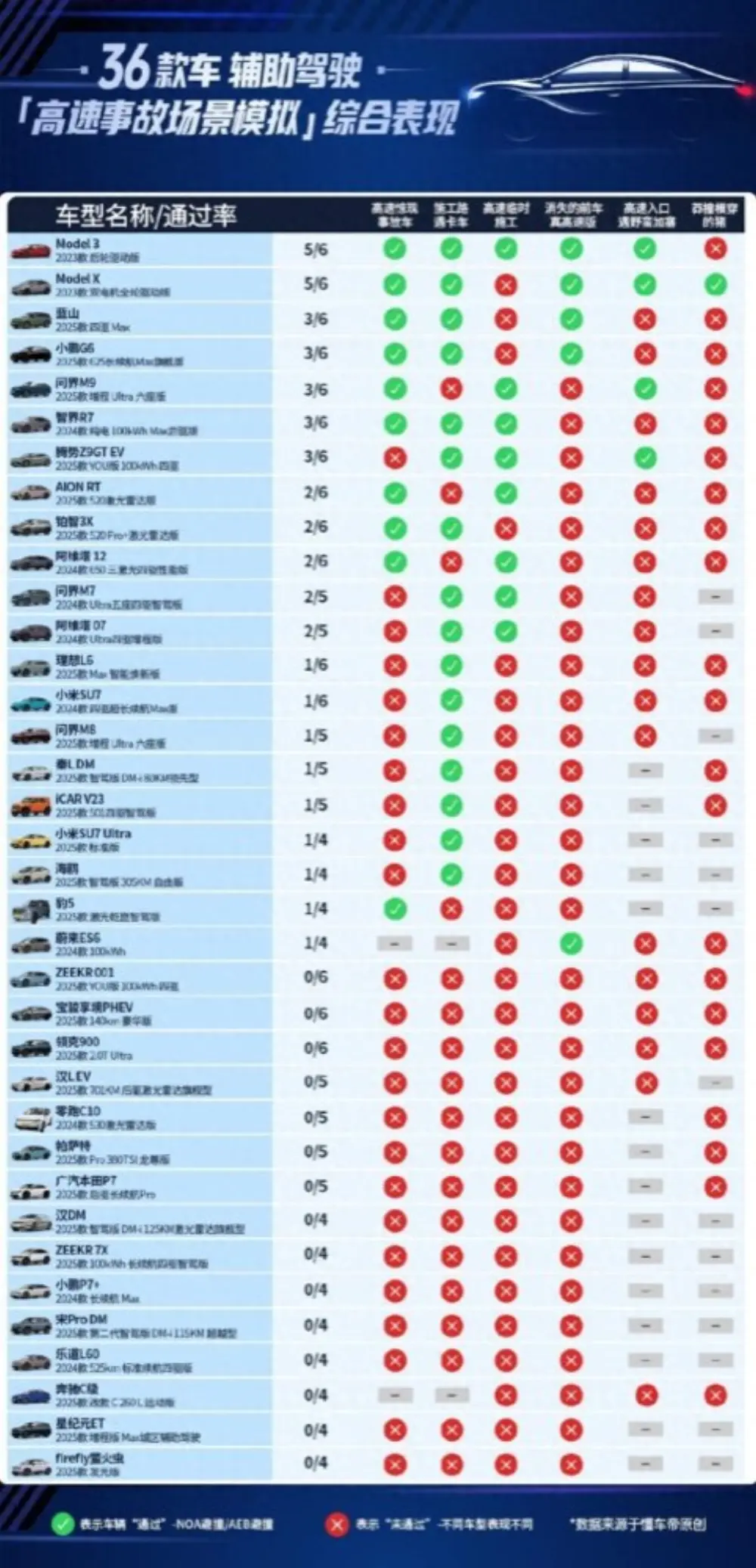
The recent Advanced Driver-Assistance Systems (ADAS) test conducted by Chinese automotive platform Dongchedi has generated significant discussion globally. The centerpiece of this discussion is a comprehensive chart detailing the performance of 36 vehicles in simulated high-risk scenarios.
This page provides a clear breakdown of that chart, explaining the test scenarios and presenting the key results for context.
**The Six Critical Scenarios Explained**
The test was not about everyday driving comfort. It was a stress test designed to evaluate how a vehicle’s ADAS handles sudden, life-threatening situations on the highway. Each car was evaluated across six distinct scenarios:
- Sudden Accident Vehicle: Simulates encountering a stationary vehicle in a lane after cresting a hill or rounding a bend, a common cause of high-speed collisions.
- Construction Truck Encounter: Tests the system’s ability to identify and safely navigate around a large, slow-moving or stationary construction truck partially obstructing the lane.
- Temporary Highway Construction: Evaluates performance when navigating a makeshift construction zone with cones and temporary lane changes, testing object recognition and path planning.
- Disappearing Lead Vehicle (Ghost Cut-out): A crucial test where the car you are following abruptly swerves out of the lane, revealing a stationary obstacle directly ahead. This tests the system’s reaction time.
- Aggressive Highway Merge/Cut-in: A vehicle aggressively cuts into the lane from a highway on-ramp with little warning, testing the system’s predictive braking and avoidance capabilities.
- Sudden Animal Crossing (“The Pig Test”): Simulates a large animal (represented by a realistic dummy) suddenly running across the highway, a notoriously difficult scenario for many sensor systems to classify and react to in time.
**Key Results and Observations**
The chart ranks vehicles by their “Pass Rate,” or the number of scenarios they successfully navigated out of the total tested.
- Top Performers (5/6):
- Tesla Model 3 and Tesla Model X were the clear leaders, successfully passing five of the six critical tests, showcasing the robustness of their vision-only system in high-stakes situations.
- Second Tier (3/6):
- A distinct group of vehicles managed to pass half of the scenarios. This group includes models like the WEY Lanshan, XPeng G6, and Huawei-powered vehicles like the AITO M9 and Luxeed R7.
- Underperformers (1/6 or less):
- A surprisingly large number of popular and technologically advanced models scored very poorly. This includes the Xiaomi SU7 Max (1/6), NIO ES6 (1/4), and a significant number of vehicles from brands like BYD, ZEEKR, and Leapmotor which scored 0 on all applicable tests.
This data provides a sobering, factual look at the current state of ADAS technology. While many systems excel at providing convenience, their ability to handle unexpected, critical safety events varies dramatically.
For a full analysis of what these results mean for the industry, Tesla, and the future of autonomous driving, read our main feature here: [Link back to your main blog post]