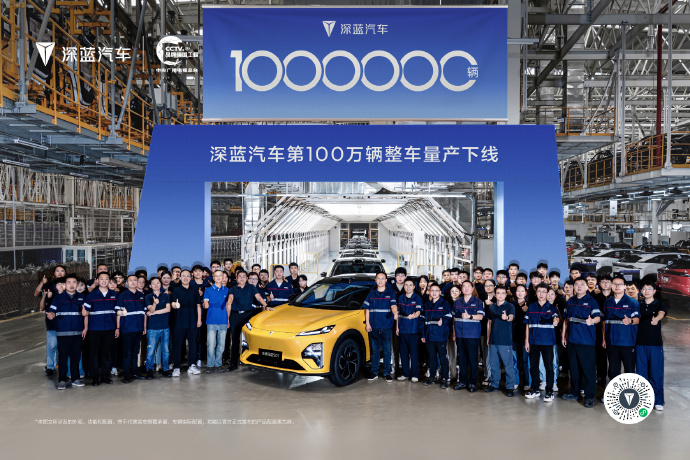
On September 28, 2026, Chongqing-based Deepal Automobile—the electric vehicle arm of state-owned Changan Automobile—announced the production rollout of its one-millionth complete vehicle. The milestone vehicle, a Deepal S07 AI Laser Edition, rolled off the line at Deepal’s Nanjing manufacturing facility. For Western observers, this is not merely a celebratory press release. It is a critical data point revealing the accelerating scale of China’s second-tier EV brands and the brutal volume-over-profit strategy that defines the world’s largest automotive market.
Deepal (Shenlan in Chinese) was launched in 2022 as Changan’s answer to Tesla and BYD. Unlike NIO or Li Auto, it operates as a volume brand, targeting the mass-market premium segment with the SL03 sedan and S07 SUV. The million-unit mark was reached in under four years—remarkable speed by global standards but increasingly common in China’s hyper-competitive EV arena. However, for institutional investors and supply chain strategists, the real questions are: What is the quality of this volume? How much of it is subsidized by state capital and supplier margin compression? And can Deepal replicate its domestic success in Western markets where regulatory walls are rising?
From Chongqing to a Million: The Historical Context of Deepal’s Rise
Changan Automobile, one of China’s “Big Four” state-owned automakers, launched Deepal in April 2022 with the SL03, a mid-size electric sedan priced from RMB 168,900 (approximately $23,400). The brand was positioned as a “digital EV” pioneer, emphasizing intelligent cockpit features and semi-autonomous driving. By 2024, Deepal had expanded to the S07 SUV and SL03 sedan, with cumulative sales reaching approximately 400,000 units. The pace accelerated in 2025–2026 as Changan injected capital, shared its EPA1 platform, and leveraged its joint-venture manufacturing expertise with Ford and Mazda.
This milestone arrives amid a broader consolidation in China’s EV sector. While BYD and Tesla dominate headlines, state-backed challengers like Deepal, GAC Aion, and SAIC Rising are scaling rapidly through aggressive pricing and government procurement. Deepal’s millionth vehicle is the first for a Changan sub-brand and signals that China’s “second tier” is now a formidable force. Yet, as we analyze below, the economics of this volume are far from healthy.
Inside the Deepal S07 AI Laser Edition: Engineering Realities and Specs
The milestone vehicle, the S07 AI Laser Edition, is a mid-size electric SUV built on Changan’s EPA1 platform. It features a 79.97 kWh LFP battery pack supplied by CATL, providing a CLTC range of 620 km (approximately 385 miles). The rear-mounted permanent magnet synchronous motor delivers 190 kW (255 hp) and 320 Nm of torque. DC fast charging is rated at 3C, allowing a 30–80% charge in roughly 25 minutes under ideal conditions. The “AI Laser” moniker refers to a roof-mounted LiDAR unit from Hesai (AT128) paired with a Qualcomm Snapdragon 8155 cockpit chip and Changan’s proprietary ADAS software, which claims L2+ capabilities.
Pricing for the S07 AI Laser Edition in China starts at RMB 189,900 (approximately $26,300). This undercuts the Tesla Model Y RWD (RMB 249,900) by 24% and the BYD Song Plus EV (RMB 169,800) is cheaper but offers a smaller 71.8 kWh battery. The table below compares key specifications against global rivals.
| Specification | Deepal S07 AI Laser Edition | Tesla Model Y RWD (China) | BYD Song Plus EV | Volkswagen ID.4 Crozz |
|---|---|---|---|---|
| Battery Capacity (kWh) | 79.97 (LFP) | 60 (LFP) | 71.8 (LFP) | 84.8 (NMC) |
| CLTC Range (km) | 620 | 554 | 605 | 600 |
| DC Fast Charging (C-rate) | 3C (30–80% in ~25 min) | 2.5C (30–80% in ~27 min) | 2C (30–80% in ~30 min) | 2.5C (30–80% in ~28 min) |
| Motor Power (kW) | 190 | 220 | 150 | 150 |
| ADAS Hardware | Hesai LiDAR + 5 radars, Qualcomm 8155 | Camera-only (Tesla Vision) | Camera + radar (no LiDAR) | Camera + radar (no LiDAR) |
| Starting Price (RMB) | 189,900 | 249,900 | 169,800 | 219,900 |
| Starting Price (USD est.) | $26,300 | $34,700 | $23,600 | $30,500 |
While the S07’s specs are competitive, the use of LFP chemistry limits cold-weather performance and energy density (approx. 160 Wh/kg at pack level) compared to NMC packs used by Volkswagen. The 3C charging rate, while impressive, still trails the 4C–5C claims from premium Chinese brands like Li Auto and Zeekr. More importantly, the LiDAR-based ADAS, while hardware-rich, has not been independently validated for regulatory compliance in Western markets.
Supply Chain and Cost Structure: The Tier-1 Web Behind Deepal’s Scale
Deepal’s cost structure relies heavily on Changan’s vertically integrated supply chain and partnerships with Chinese Tier-1 suppliers. The S07’s battery cells come from CATL (LFP) and possibly BYD’s FinDreams as a secondary source. The electric motor and inverter are produced in-house by Changan’s subsidiary, while the LiDAR unit is supplied by Hesai, a Shanghai-based company that has become a global leader in automotive-grade LiDAR. The cockpit domain controller uses Qualcomm’s Snapdragon 8155, though newer models are transitioning to the 8295 for higher compute.
Industry estimates suggest the Bill of Materials (BOM) cost for the S07 AI Laser Edition is approximately RMB 120,000–130,000 ($16,600–$18,000). This implies a gross margin of roughly 30–35% at the retail price of RMB 189,900, before accounting for R&D, marketing, and distribution. However, Deepal’s net margin is likely negative or near-zero due to aggressive pricing and high fixed costs. The company does not disclose separate financials, but Changan’s overall EV segment reported an operating loss in 2025, according to its annual report.
From a supply chain perspective, Deepal’s reliance on CATL for LFP cells exposes it to the same overcapacity and price volatility that has squeezed margins across the industry. CATL has been slashing prices to maintain market share, which benefits Deepal’s BOM but pressures CATL’s profitability. Moreover, the use of Chinese LiDAR and chips could trigger compliance issues under US and EU regulations that restrict Chinese software and hardware in connected vehicles.
Competitive Impact: Who Gains, Who Loses in the Global EV Race?
Deepal’s million-unit milestone intensifies competition in two arenas: the domestic Chinese market and the emerging export battlegrounds. In China, Deepal competes directly with BYD’s Song and Yuan families, Tesla’s Model Y, and GAC Aion’s V series. Its aggressive pricing puts pressure on all players, but especially on weaker state-owned brands like BAIC and Dongfeng. For BYD, Deepal’s rise is a minor threat—BYD sold over 3 million NEVs in 2025—but it signals that the low-cost segment is becoming crowded, which could accelerate price wars.
For Western OEMs, Deepal represents a different challenge. Volkswagen, which has a joint venture with Changan, may face internal competition as Deepal’s EVs cannibalize sales of the ID.4 Crozz. Similarly, Ford, which partners with Changan in China, could see its market share eroded. However, Deepal’s current focus is domestic; its export volumes are negligible. In 2025, Deepal exported fewer than 20,000 units, primarily to Southeast Asia and the Middle East. Scaling to Western markets will require overcoming regulatory hurdles and building brand recognition, which is a multi-year effort.
Chinese competitors like NIO and XPeng are less affected because they target a higher-price, tech-focused demographic. Deepal’s volume strategy is more akin to BYD’s, but without BYD’s vertical integration in batteries and semiconductors. This makes Deepal vulnerable to supply chain shocks and margin compression.
The Reality Check: Why Volume Does Not Equal Profitability
The press release celebrates one million vehicles, but the engineering and economic reality suggests a more nuanced picture. First, the profitability paradox: Deepal’s volume is achieved through aggressive pricing that likely yields negative or negligible net margins. Changan’s EV business has been loss-making, and Deepal’s contribution to group profit is minimal. The millionth vehicle is a symbolic achievement, but it does not indicate financial health.
Second, the LFP trap: Deepal relies on LFP batteries for cost reasons, but this limits its ability to compete in premium segments where NMC and solid-state batteries are required for cold-weather performance and fast charging. The 3C charging rate, while decent, is not independently verified for cycle life. LFP cells degrade faster under high C-rate charging, and without BESS at charging stations, the grid may not support widespread 3C deployment.
Third, the ADAS claim: The “AI Laser” edition’s LiDAR and Qualcomm 8155 chip provide L2+ capabilities, but this is not equivalent to Tesla’s FSD or even XPeng’s XNGP. Regulatory approval for LiDAR-based ADAS in Europe and the US is uncertain, and Deepal has not announced any certification efforts. The system is likely limited to domestic Chinese pilots.
Fourth, the export wall: Under US Section 301 tariffs (100% on Chinese EVs) and EU countervailing duties (up to 38%), Deepal cannot profitably export to Western markets without local production. Changan has announced plans for a European plant, but timelines are vague. Until then, Deepal’s million-unit scale is a domestic phenomenon.
Regulatory and Geopolitical Landscape: The Walls Closing In
The regulatory environment for Chinese EVs in Western markets has soured dramatically. The US Inflation Reduction Act’s Foreign Entity of Concern (FEOC) rules exclude vehicles with Chinese battery components from tax credits, effectively shutting out Deepal. The EU’s countervailing duties, imposed in 2024, add 17–38% to Chinese EV imports. Even in Southeast Asia, Thailand and Indonesia are introducing local content requirements that favor domestic production.
For Deepal, the path to global scale requires strategic localization. Changan has announced a joint venture in Thailand and is evaluating a European plant, but these are multi-year projects. In the meantime, Deepal must rely on exports to non-regulated markets like Russia, the Middle East, and Latin America, where margins are lower and competition from Japanese and Korean brands is fierce. Geopolitically, Deepal’s state-owned parentage makes it a target for Western scrutiny, potentially complicating partnerships and technology licensing.
Strategic Outlook and Investor Implications
Deepal’s one-millionth vehicle is a testament to Changan’s manufacturing prowess and China’s EV supply chain depth. But for investors, the milestone is a reminder that volume growth in China is not a proxy for profitability. The company’s next phase will determine whether it can transition from a domestic volume player to a globally competitive brand.
Bull Case
Deepal successfully localizes production in Europe and Southeast Asia, secures regulatory approvals for its ADAS, and improves margins through vertical integration. Changan’s partnership with CATL and Hesai ensures supply chain resilience. By 2030, Deepal could achieve 5% global EV market share with positive net margins.
Base Case
Deepal continues to grow domestically but faces margin pressure and export barriers. It remains a regional player with limited Western presence. Profitability remains elusive, but Changan’s state backing prevents collapse. The brand becomes a cautionary tale of volume without value.
Bear Case
A sustained price war in China erodes Deepal’s margins further, while Western tariffs and regulatory restrictions block exports. Changan is forced to restructure or merge Deepal with another state-owned EV brand. The million-unit milestone is remembered as a peak, not a stepping stone.
- For investors: Monitor Deepal’s net margin per vehicle, not just volume. The company’s financials are opaque, but Changan’s quarterly reports may reveal segment losses.
- For supply chain strategists: Deepal’s reliance on CATL and Hesai creates opportunities for Tier-1 suppliers, but also risks if US sanctions target these companies.
- For Western OEMs: Deepal’s domestic success underscores the need for cost competitiveness. Partnerships with Chinese suppliers may be necessary, but they must be structured to avoid dependency.
- For policymakers: The rise of state-backed challengers like Deepal validates the need for tariffs and local content rules, but also risks retaliatory measures.
Ultimately, Deepal’s millionth vehicle is a data point in China’s relentless EV scaling. But in an industry where profitability is scarce and competition is brutal, scale alone is not a winning strategy. The next million will be far harder.