For years, Western automakers relied on legacy European, American, and Japanese Tier-1 suppliers to power their vehicle cabins. But as software-defined vehicles (SDVs) take center stage, a massive paradigm shift is occurring. Driven by the relentless 'China-speed' of innovation, domestic Chinese smart cockpit suppliers are rapidly outstripping global giants, turning the interior cabin into the primary battleground for consumer attention and brand differentiation.
The Data Behind China's Smart Cockpit Domination
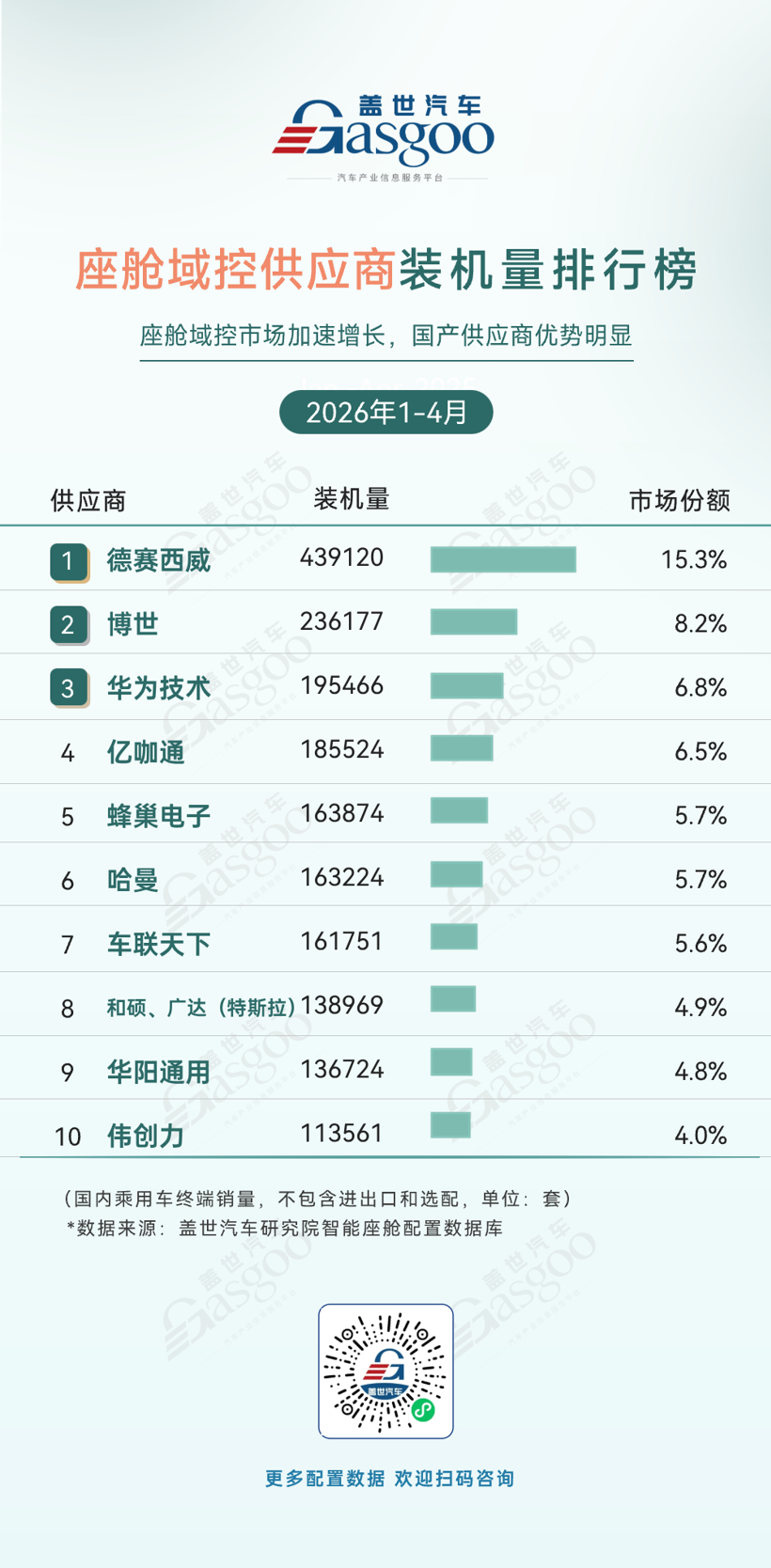
According to the latest January-April 2026 installation data compiled by the Gasgoo Auto Research Institute, domestic suppliers in China have achieved a near-total capture of high-growth segments. In the critical field of cockpit domain controllers, local players have expanded their lead, with Desay SV (德赛西威) securing the top spot with a staggering 439,000 units installed in passenger cars during this four-month window.
This success isn't limited to software integration. Across hardware segments such as Head-Up Displays (HUD), AR-HUD, and central control screens, the Chinese domestic supply chain is leading comprehensively. The market displays unique structural dynamics across different sub-sectors:
- Cockpit Domain Controllers & HUDs: Dominated heavily by mature domestic Tier-1s who offer deep vertical integration.
- Cockpit SoC Chips & Voice Systems: Defined by a highly consolidated 'one super, many strong' architecture, with players like Qualcomm maintaining a strong silicon footprint while domestic software solutions run on top.
- AR-HUD & LCD Instrument Displays: Characterized by intense, neck-and-neck competition among multiple highly capable domestic innovators.
Why Legacy Tier-1 Suppliers Are Losing Ground
As an industry analyst tracking East Asian supply chains, the displacement of legacy Western Tier-1s (such as Bosch, Continental, and Denso) in China is not a temporary fluctuation—it is structural. Legacy players have historically struggled with the rapid development cycles required by Chinese OEMs like BYD, NIO, and Xiaomi. While a traditional European platform cycle takes 36 to 48 months, Chinese EV makers demand complete cockpit iterations within 12 to 18 months.
Chinese smart cockpit suppliers excel here because they co-develop hardware and software in real-time alongside local OEMs. Furthermore, by sourcing from a localized, hyper-competitive ecosystem, they achieve cost efficiencies that Western suppliers, burdened by global overhead and legacy architectures, simply cannot match.
| Cockpit Segment | Market Dynamics (Jan-Apr 2026) | Strategic Outlook |
|---|---|---|
| Domain Controllers | Desay SV leads with 439k units installed. Domestic supply dominance. | Becoming standard in mid-to-high-end vehicles; moving toward multi-domain fusion. |
| HUD / AR-HUD | High domestic penetration; fierce competition among top 5 local brands. | Rapidly replacing traditional instrument clusters as optics costs drop. |
| Voice AI & Software | Consolidated market structure; large language models (LLMs) going live. | AI integration is shifting voice assistants from reactive to proactive agents. |
Strategic Implications for Western OEMs and Investors
For Western automakers (such as VW, Ford, and GM) operating both in China and globally, these rankings offer a stark warning. If they continue to rely on slow-moving global software stacks, their vehicles will increasingly feel outdated to tech-savvy buyers. Many Western OEMs are already enacting 'In China, for China' strategies, bypassing their traditional global supply chains to partner directly with Chinese smart cockpit suppliers like Desay SV to keep their localized vehicles competitive.
For institutional investors, the signal is clear: the high-margin electronics share of the automotive value chain is shifting eastward. Companies that successfully capture the cockpit domain controller and AR-HUD segments today are building the foundational relationships to control the autonomous driving architectures of tomorrow.