The global automotive landscape is undergoing a tectonic shift. For decades, Western OEMs entered China in 50-50 partnerships, trading their legacy internal combustion engine (ICE) technology for access to a massive, untapped consumer base. Today, the tables have completely turned. A powerful wave of Chinese EV reverse joint ventures is sweeping the industry, fundamentally altering how cars are designed, built, and branded globally.
As a Shanghai-based automotive analyst monitoring supply chain shifts, I view this trend not as a temporary tactical adjustment, but as a permanent strategic pivot. Facing aggressive tariff barriers from both the EU and the US, Chinese automakers are utilizing their absolute lead in battery tech, software integration, and digital cockpits to secure manufacturing assets and distribution networks in the West. It is no longer about 'market for technology'—it is now about trading 'technology for capacity and brand equity.'
Three Landmark Deals Defining the 2026 Reverse JV Wave
In the first five months of 2026 alone, three high-profile collaborations have demonstrated how Chinese OEMs are taking the driver's seat in international partnerships.
1. Chery and Jaguar Land Rover: The Rebirth of Freelander
In late March 2026, Chery and Jaguar Land Rover (JLR) officially launched the revitalized 'FREELANDER' brand. Unlike traditional joint ventures, this project operates on a 'Chinese-led, Western-empowered' framework. Chery provides the core EV platform, battery supply chain, and advanced driver assistance systems (ADAS), while JLR contributes brand heritage, design oversight, and European retail networks. This marks a historic transition where a Western luxury marque relies entirely on a Chinese volume manufacturer for its next-generation platform architecture.
2. Dongfeng and Stellantis: Deepening European Footprints
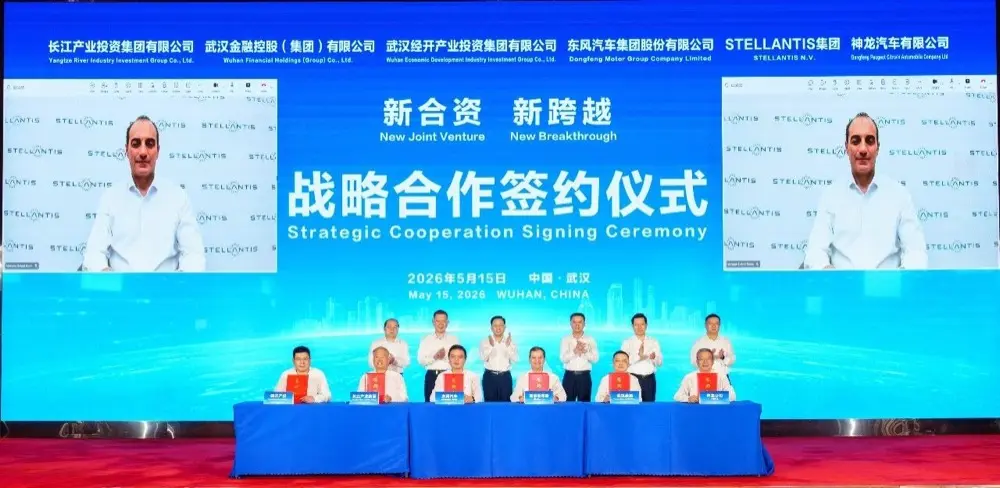
In mid-May 2026, Dongfeng Motor signed a memorandum of understanding (MoU) with Stellantis to establish a new joint venture in Europe. Accompanying this move, Dongfeng and five affiliated parties injected 8 billion RMB ($1.1 billion USD) into Dongfeng Peugeot Citroën Automobile (DPCA). This injection allows Dongfeng to actively co-manage idle or underutilized European manufacturing plants. By integrating localized production pipelines, Dongfeng can assemble software-defined EVs locally, entirely neutralizing current EU anti-subsidy tariffs on imported Chinese vehicles.
3. Huawei, JAC, and Maserati: The Luxury Tech Frontier
Whispers in the industry suggest that Huawei and JAC Motors are in advanced talks with Maserati to explore a 'one car, dual brand' (同车双标) cooperation model. While officially unconfirmed by both parties, this rumored deal highlights the ultimate ambition of Chinese players: integrating ultra-luxury Western legacy brands with cutting-edge Chinese intelligent driving systems. Under this model, Maserati would leverage Huawei's HarmonyOS Intelligent Mobility Alliance (HIMA) tech stack to save its lagging EV transition, while Huawei gains access to the pinnacle of luxury automotive branding.
The New Paradigm: Comparing Traditional vs. Reverse Joint Ventures
To understand why this matters to institutional investors and competitive OEMs, we must look at how the fundamental mechanics of these partnerships have changed:
| Dimension | Traditional Joint Venture (Pre-2020) | Reverse Joint Venture (2026+) |
|---|---|---|
| Technology Flow | West → China (ICE Engines, Gearboxes) | China → West (EV Platforms, LFP/SSB Batteries, ADAS) |
| Operational Control | Western-dominated product definition | Chinese-led engineering and software integration |
| Primary Asset Traded | Access to the Chinese domestic market | Western factories, luxury brand equity, and localized distribution |
| Tariff Impact | Not applicable (focused on localizing in China) | Key tool for circumvention of EU/US trade barriers |
Strategic Implications for Western Investors and Competitors
For global investment firms and Tier 1 suppliers, the rise of Chinese EV reverse joint ventures carries major strategic implications:
- De-risking Geopolitical Headwinds: By manufacturing vehicles inside Europe or utilizing established Western badges, Chinese OEMs are transforming 'foreign threats' into 'localized employment opportunities.' This lowers the regulatory risk profile for investors backing Chinese EV technology.
- The Cost of Survival for Western OEMs: Legacy carmakers like JLR and Stellantis are admitting that developing proprietary, competitive EV platforms from scratch is too slow and capitally intensive. Licensing Chinese platforms is the fastest way to protect their market share and hit fleet emission targets.
- Margin Pressures and Royalty Flows: Chinese companies are evolving from capital-intensive manufacturers to high-margin technology licensors, shifting their valuation models closer to software-as-a-service (SaaS) or IP-holding entities.
The message to Western automotive executives is clear: adapt or consolidate. Those who dismiss Chinese EV technology as 'unreliable' or 'copycat' risk being left behind in a market that is rapidly consolidating around Chinese-engineered platforms.