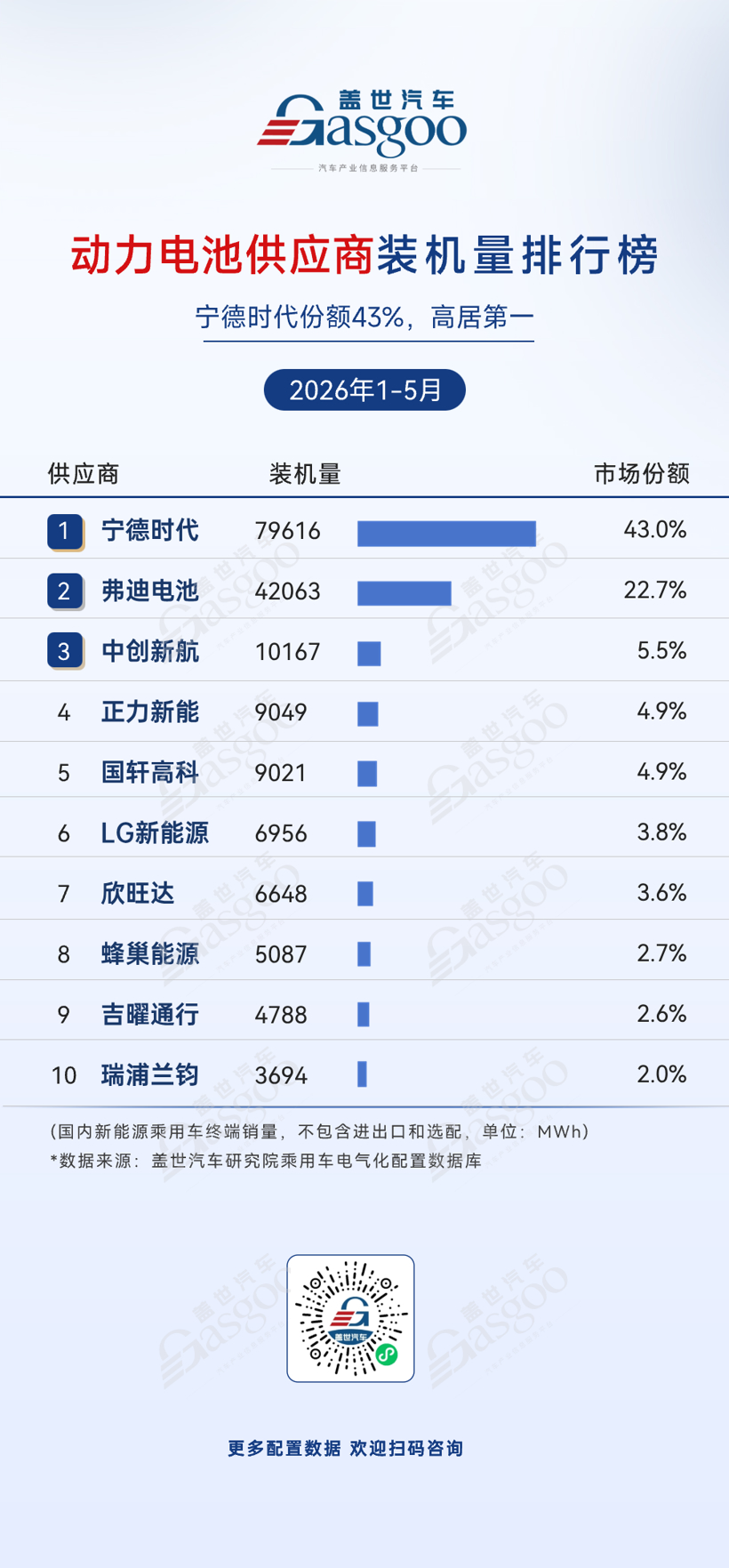
The rapid acceleration of Chinese EV powertrain vertical integration is fundamentally reshaping the global automotive supply chain. According to the latest January-May 2026 domestic New Energy Vehicle (NEV) passenger car electrification supplier installation rankings released by Gasgoo Research Institute, a major structural pivot is underway. While established tier-one suppliers maintain their grip on the highest market tiers, a surging wave of OEM self-production units is breaking through the ranks, redefining competitive dynamics for international investors and automotive professionals alike.
The Rise of OEM Self-Production: Gasgoo 2026 Data Insights
The Jan-May 2026 data highlights a highly competitive mid-tier segment where the traditional boundaries between automakers and suppliers are dissolving. Chinese OEMs are no longer merely assembling outsourced components; they are increasingly designing and manufacturing their own core electrical architectures. This trend toward Chinese EV powertrain vertical integration allows brands to capture higher margins and synchronize hardware-software development cycles at 'China-speed'.
By leveraging dedicated internal divisions—such as BYD's FinDreams, Geely's VREMT, and GAC's Juwan Technology—domestic automakers are securing their supply chains against external shocks while aggressively driving down production costs.
Strategic Breakdown: Self-Production vs. Independent Tier-1 Suppliers
The electrification supply chain is bifurcating into two distinct camps: independent megasuppliers (like CATL, BYD/FinDreams operating as an external vendor, and Huawei's Intelligent Automotive Solution BU) and dedicated in-house OEM subsidiaries. The transition is highly visible across three primary domains: electric drive systems (e-drives), battery pack assembly, and advanced thermal management.
| Electrification Domain | OEM In-House Leaders | Independent Tier-1 Leaders | Market Trend (Jan-May 2026) |
|---|---|---|---|
| E-Drive Systems | VREMT (Geely), Changan, GAC | Inovance, BorgWarner | OEMs expanding market share via modular 800V platforms. |
| Battery Packs | FinDreams (BYD), SVOLT (Great Wall) | CATL, CALB | Increased deployment of cell-to-body (CTB) in-house designs. |
| Thermal Management | BYD, Tesla (In-house) | Sanhua, Denso | Integrated heat pump systems increasingly designed in-house. |
Why Vertically Integrated Powertrains Threaten Global Tier-1 Suppliers
For decades, Western automotive giants and Tier-1 suppliers operated on a highly outsourced, capital-light model. However, the rapid evolution of the Chinese EV market has turned this playbook upside down. There are two primary reasons why this shift poses a major challenge to traditional players:
- Cost-Efficiency & Margin Shielding: By eliminating the 'supplier markup,' vertically integrated OEMs can price vehicles far more aggressively. This cost advantage is critical in the ongoing price wars dominating the global EV market.
- Rapid Iteration: When the software, battery management system (BMS), and silicon carbide (SiC) inverter are developed under one roof, engineering cycles shrink from years to months.
Navigating the New Order: Global Implications and Strategic Alliances
As Chinese OEMs advance their technology integration, international carmakers are seeking proactive ways to remain competitive. Rather than attempting to duplicate entire supply chains overnight, Western OEMs are increasingly pursuing strategic cross-border collaborations and sourcing alliances.
Furthermore, to maintain supply chain compliance and build resilience against shifting tariff regimes, global players are emphasizing localized regional footprints. Collaborating with advanced Chinese tier-one suppliers in neutral jurisdictions represents a pragmatic approach to leveraging leading-edge powertrain efficiencies while ensuring full compliance with local trade frameworks.