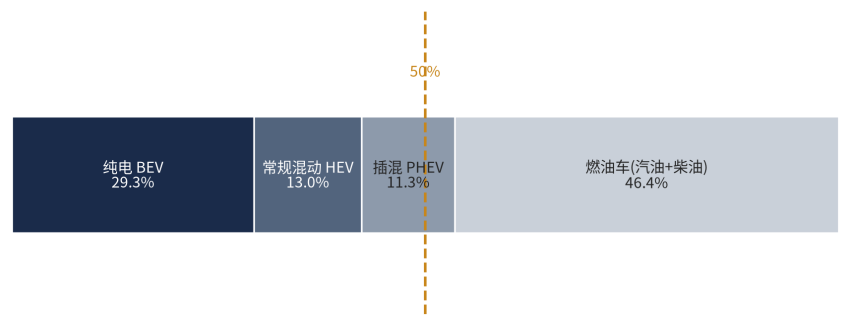
On paper, the August automotive registration data from across the European continent reads like an inflection point long anticipated by institutional desks and feared by legacy boardrooms: electrified powertrains captured over 50% of monthly sales for the first time in history, while the collective Chinese EV market share in Europe climbed to an unprecedented 11.7%. Total new passenger vehicle registrations reached approximately 835,000 units, marking a 4.6% year-on-year expansion against an otherwise sluggish macroeconomic backdrop. Yet beneath these headline deliveries lies a far more volatile commercial dynamic—one defined not by an effortless technological sweep, but by frantic pre-tariff inventory unloading, shifting powertrain arbitrage, and mounting margin compression for both domestic European champions and aggressive Chinese entrants.
For executive teams from Wolfsburg to Turin, the optics could hardly appear more threatening. Only four years ago, Chinese automotive brands barely registered a 1.5% presence in Western European registration ledgers. Today, spearheaded by SAIC Motor's MG marque, BYD's aggressive showroom rollout, and Geely's multi-brand ecosystem, Chinese-built electrified vehicles have carved out an entrenched foothold. However, analyzing these numbers through an engineering and financial lens reveals that Europe's electrified transition is fragmenting into high-stakes regulatory gamesmanship, retail discounting skirmishes, and powertrain compromises that challenge the prevailing narrative of unchallenged Chinese market capture.
The Powertrain Realignment: Inside the 50% Electrification Milestone
To understand how Chinese EV market share in Europe scaled to 11.7%, one must first interrogate the precise anatomy of Europe's electrified surge. The term 'electrified'—which surpassed 50% of the August 835,000-unit total—conflates three fundamentally distinct powertrain architectures: full battery-electric vehicles (BEVs), plug-in hybrid electric vehicles (PHEVs), and standard 48V mild/full hybrids (HEVs). When stripped of non-plug hybrids, pure BEV demand in critical bellwether markets like Germany actually experienced persistent domestic drag following the abrupt termination of the Umweltbonus subsidy scheme.
Into this vacuum, Chinese original equipment manufacturers (OEMs) altered their playbook. Rather than relying exclusively on pure battery-electric nameplates facing immediate European Commission scrutiny, Chinese manufacturers initiated a heavy push into dual-motor PHEVs and extended-range electric vehicles (EREVs). A prime example is the BYD Seal U DM-i, which pairs an ultra-high expansion ratio 1.5-liter Xiaoyun Atkinson-cycle gasoline engine (claiming 43.04% thermal efficiency) with an 18.3 kWh or 26.6 kWh Lithium Iron Phosphate (LFP) Blade battery pack. By exploiting the regulatory distinction that shields plug-in hybrids from the highest tiers of the EU's provisional countervailing duties, Chinese manufacturers preserved aggressive shelf pricing while conventional European OEMs remained heavily exposed with capital-intensive BEV programs.
| Metric / Architecture | BYD Seal U DM-i (Boost) | MG4 Electric (Standard) | Volkswagen ID.4 Pure | Hyundai Ioniq 5 (58 kWh) |
|---|---|---|---|---|
| Powertrain Type | PHEV (Dedicated Hybrid Engine + Motor) | BEV (Single Motor RWD) | BEV (Single Motor RWD) | BEV (Single Motor RWD) |
| Battery Chemistry | LFP (Blade, 18.3 kWh) | LFP (Rubik's Cube, 51 kWh) | NCM 712 (52 kWh net) | NCM 811 (58 kWh net) |
| System Voltage | ~400V Nominal | ~400V Nominal | ~400V Nominal | 800V Dedicated (E-GMP) |
| Peak Fast-Charge Rate | 18 kW DC | 88 kW DC | 115 kW DC | 180 kW DC (10-80% in 18 min) |
| WLTP Efficiency / Range | 0.9L/100km + 80km Pure EV | 350 km (BEV) | 364 km (BEV) | 384 km (BEV) |
| Starting Base Price (Germany) | ~€38,900 | ~€34,990 | ~€40,335 | ~€43,900 |
| EU Countervailing Duty Exposure | Exempt (Non-BEV) | 35.3% (SAIC Rate) + 10% Base | None (EU Domestic) | None (South Korea Sourced) |
As the comparative data indicates, the architectural divergence is pronounced. While Western legacy players like Volkswagen have doubled down on native 400V modular electric platforms (MEB) utilizing nickel-cobalt-manganese (NCM) chemistries to satisfy European high-speed motorway requirements, Chinese contenders have optimized for entry-level price brackets via LFP packs. However, South Korean players operating on native 800V architectures, such as Hyundai Motor Group's E-GMP platform, demonstrate that decoupled global OEMs can retain superior charging curve performance (180 kW sustained across an 800V bus) without incurring the geopolitical liabilities associated with Chinese state-linked supply chains.
Supply Chain Realities: Freight Rates, Margin Burn, and Tier-1 Sourcing
Achieving an 11.7% slice of European registrations has demanded an immense capital outlay from Chinese automakers, one that challenges conventional assumptions about structural low-cost dominance. The landed cost of a Chinese-assembled C-segment electric vehicle arriving at the ports of Zeebrugge, Rotterdam, or Bremerhaven is burdened by severe logistical friction. Over the past 18 months, daily charter rates for specialized Pure Car and Truck Carriers (PCTCs) fluctuated between $80,000 and $115,000, driven by global capacity shortages and Red Sea transit rerouting around the Cape of Good Hope, which adds 10 to 14 days of sailing time and hundreds of thousands of dollars in marine fuel per voyage.
To absorb these freight premiums alongside European market homologation costs (including Euro NCAP structural modifications, localized eCall implementations, and cybersecurity standard UN R155/R156 compliance), Chinese OEMs are operating on paper-thin European retail margins. While an entry-level MG4 or BYD Dolphin commands an estimated gross margin exceeding 20% within the protected domestic Chinese supply network, that margin shrinks toward the low single digits once ocean freight, distribution overhead, importer commissions, and dealer floor-plan financing are deducted.
Furthermore, the Tier-1 component topology of these vehicles reveals deep dependencies. Although power electronics and traction batteries originate predominantly from domestic Chinese giants—CATL for cell-to-pack architectures, FinDreams for BYD's Blade batteries, and Inovance for silicon-carbide (SiC) inverters—the balance of the bill of materials (BOM) relies heavily on Western tier-1 suppliers to satisfy EU consumer expectations. Braking systems, electronic stability programs (ESP), and passive occupant safety modules installed on export-spec Chinese vehicles are routinely sourced from Continental, Bosch, and ZF Friedrichshafen. Consequently, the narrative that Chinese EV market share in Europe represents an entirely indigenous Chinese component triumph ignores the high percentage of Western-engineered content required to clear European type-approval.
The Realigned Competitive Grid: Legacy Losses vs. Decoupled Resilience
The acceleration of Chinese EV market share in Europe to 11.7% has not impacted every legacy automaker uniformly. A rigorous dissection of market data illustrates that the primary casualties are the entry-to-mid market volume nameplates: Stellantis (Fiat, Peugeot, Opel), Renault Group, and the volume subsidiaries of the Volkswagen Group (SEAT/Cupra and Skoda). These manufacturers have historically relied on compact B- and C-segment hatchbacks to fulfill mandatory EU fleet-wide corporate average CO2 targets. With mass-market Chinese alternatives undercutting the European B-segment price floor by €3,000 to €6,000, legacy volume manufacturers are trapped between selling discounted EVs at a loss or facing draconian CAFE fines up to €95 per gram of excess CO2 per vehicle registered.
Conversely, premium European marques—BMW, Mercedes-Benz, and Porsche—remain largely insulated within their domestic boundaries, where corporate fleet leasing, brand equity, and residual-value algorithms heavily disfavor unproven Chinese luxury offerings like Denza or Hongqi. Yet, the most structurally resilient players in this environment are not the European incumbents, but decoupled international OEMs that proactively divested from excessive Chinese retail dependency while maintaining globally diversified production.
Hyundai-Kia serves as the quintessential institutional benchmark. By avoiding the brutal, cash-burning price war within mainland China, the South Korean conglomerate preserved its balance sheet and directed capital expenditure toward dedicated 800V platforms (E-GMP) manufactured in South Korea, the Czech Republic, and Slovakia. Unencumbered by EU anti-subsidy duties and immune to the consumer skepticism regarding Chinese software telemetry, decoupled manufacturers maintain steady operating cash flows across Europe, outperforming both stressed European volume producers and margin-diluted Chinese export operations.
The Reality Check: Interrogating the August 11.7% Registration Spike
While industry headlines tout the 11.7% figure as an irreversible conquest of Western Europe, a critical examination of automotive registration mechanics reveals substantial underlying distortions. Any automotive equity analyst familiar with European registration reporting understands the profound difference between a true consumer retail registration and a manufacturer-driven tactical pre-registration.
First, the August figures were materially influenced by artificial pull-forward effects. Following the European Commission’s announcement of provisional countervailing duties on Chinese-manufactured BEVs—imposing definitive anti-subsidy duties of up to 35.3% on SAIC, 18.8% on Geely, and 17.0% on BYD atop the standard 10% import tariff—Chinese manufacturers and their captive European dealer networks engaged in aggressive channel-stuffing. Vehicles that had already cleared customs before the implementation deadlines were pre-registered to dealer accounts, internal demonstration fleets, and short-term rental operators across Germany, Spain, and Italy. These units appear in monthly registration data as 'sales,' yet field intelligence indicates an accumulation of zero-kilometer inventory languishing on secondary retail lots.
Second, significant technical and operational trade-offs continue to impair the real-world ownership proposition of these vehicles across northern and western European climates:
- Cold-Weather Electrochemistry Penalties: The structural cost advantage of Chinese BEVs rests on LFP battery chemistry. While structurally robust and fire-resistant, LFP cells suffer from sluggish lithium-ion intercalation kinetics at temperatures below 0°C. Real-world winter testing demonstrates range degradations exceeding 38% to 44% in LFP-equipped Chinese models, compared to 22% to 28% for high-nickel NCM-equipped Western and South Korean rivals.
- DC Fast-Charging Curve Degradation: Under sustained cold temperatures, the lack of sophisticated silicon-carbide thermal pre-conditioning on budget Chinese architectures caps peak charging intake well below advertised maximums, stretching 10-80% charging durations past 45 minutes on 400V infrastructures.
- Human-Machine Interface (HMI) and Software Fragmentation: While domestic Chinese software suites excel in native voice command and local application integration, their adapted European variants frequently suffer from erratic Advanced Driver Assistance System (ADAS) calibrations. Phantom emergency braking events, intrusive lane-keep assist algorithms, and fragmented over-the-air (OTA) update schedules have triggered vocal pushback from European automotive trade federations and consumer testing bodies like ADAC.
- Residual Value Catastrophe: Fleet management companies and corporate leasing consortia—which account for upwards of 55% of all new car registrations in Western Europe—remain deeply hesitant to underwrite Chinese EV residuals. Due to relentless price-slashing by Chinese parent companies and unproven 36-to-48-month secondary market demand, projected three-year residual values for Chinese EVs lag comparable European and Korean nameplates by 800 to 1,200 basis points, driving up monthly lease costs despite lower initial retail prices.
The Regulatory and Trade Fortress: Tariffs, FEOC Parallels, and Strategic Localization
The August registration spike has accelerated a definitive geopolitical and regulatory counter-response from Brussels. The European Commission's countervailing duty framework is not merely an isolated trade defense mechanism; it represents the vanguard of a broader European industrial policy designed to prevent the total dismantling of the continent's automotive supply ecosystem. The definitive duties, locked in for a five-year period, transform the economics of importing built-in-China vehicles.
Faced with landed tariff burdens reaching 45.3% for uncooperative state-owned entities like SAIC Motor, the export-led growth model that drove Chinese EV market share in Europe to 11.7% has effectively reached its mathematical limit. Consequently, Chinese manufacturers are executing a capital-intensive strategic pivot: forced manufacturing localization within European customs borders.
BYD has committed billions of euros to construct its flagship European passenger car assembly plant in Szeged, Hungary, targeting an initial operational capacity of 150,000 units annually by late 2025, alongside a subsequent manufacturing facility in Turkey to leverage the EU-Turkey Customs Union. Concurrently, Chery Automobile has established a joint production agreement at the former Nissan facility in Barcelona, Spain, while Leapmotor has initiated semi-knocked-down (SKD) assembly of its T03 compact electric city car at Stellantis' Tychy plant in Poland. However, this localization strategy is fraught with operational headwinds. European labor costs, rigorous environmental permitting under EU industrial emissions directives, and higher collective bargaining power will inevitably inflate unit production costs, substantially closing the BOM cost differential that Chinese OEMs enjoyed when operating out of Guangdong, Anhui, or Jiangsu.
Strategic Outlook: Three Scenarios for Europe's Electrified Battlefield
As the European automotive sector approaches the mandatory 2025 fleet-wide CO2 emission target reductions (dropping from 116 g/km to roughly 93.6 g/km under WLTP), the trajectory of Chinese market penetration will dictate corporate survival and investment portfolio returns. Below are three prospective trajectories over a 24- to 36-month horizon.
Bull Case
Chinese localized manufacturing footprints in Hungary, Turkey, and Spain come online ahead of schedule with localized supply chains clearing 60% domestic value-add thresholds. Chinese OEMs successfully bypass BEV anti-subsidy duties while expanding high-margin PHEV and EREV lineups. Legacy European volume OEMs fail to launch competitive sub-€25,000 platforms, allowing Chinese brands to sustainably secure between 15% and 18% of total European electrified vehicle registrations by late 2027.
Base Case
Chinese EV market share in Europe stabilizes within the 10% to 12% corridor as the initial surge of pre-tariff inventory clears. Import duties compress operating margins, forcing Chinese brands to raise European retail MSRPs by 8% to 12%, eliminating their decisive price advantage over localized competitors like the Renault 5 E-Tech, Citroën ë-C3, and Hyundai Inster. Chinese OEMs achieve modest, localized production scale but find their growth restricted primarily to private retail buyers, remaining shut out of high-volume corporate fleets due to stubborn residual value penalties.
Bear Case
Brussels expands its regulatory scope, implementing strict data-sovereignty restrictions on connected vehicle telematics alongside heightened Foreign Subsidies Regulation (FSR) investigations into Chinese-funded European greenfield factories. Ongoing secondary-market depreciation collapses European dealer network profitability, causing independent retail groups to terminate distribution agreements. Chinese market share retreats below 8%, relegating Chinese brands to regional niche status while capitalized, decoupled global players and revitalized European domestic platforms reassert dominance.
Key Strategic Implications for Executives and Capital Allocators
- Look Beyond Top-Line Registration Metrics: Institutional investors must differentiate between organic end-consumer demand and dealer pre-registrations designed to beat countervailing duty deadlines. Inventory days-of-supply (DOS) on European dealer lots provides a far more accurate gauge of genuine brand velocity than raw monthly registrations.
- Powertrain Mix is the True Alpha Driver: Pay close attention to Chinese OEM model mixes transitioning from pure BEVs to PHEVs/EREVs. This regulatory arbitrage circumvents BEV-specific countervailing tariffs, but subjects manufacturers to internal combustion engine (ICE) maintenance liabilities and localized emissions compliance.
- The Cost Advantage Will Narrow via Localization: Sourcing intelligence indicates that building vehicles in Hungary or Spain reduces the Chinese manufacturing cost delta against European incumbents from an estimated 30-35% down to less than 10-12%, once European labor agreements, energy tariffs, and local supply chain logistics are factored in.
- Decoupled OEMs Possess the Most Defensible Margin Moats: Automakers that minimize domestic Chinese retail exposure while offering dedicated, high-efficiency EV architectures (e.g., Hyundai-Kia's 800V E-GMP platform) represent the most balanced hedge against escalating Sino-European trade conflicts and domestic European margin erosion.