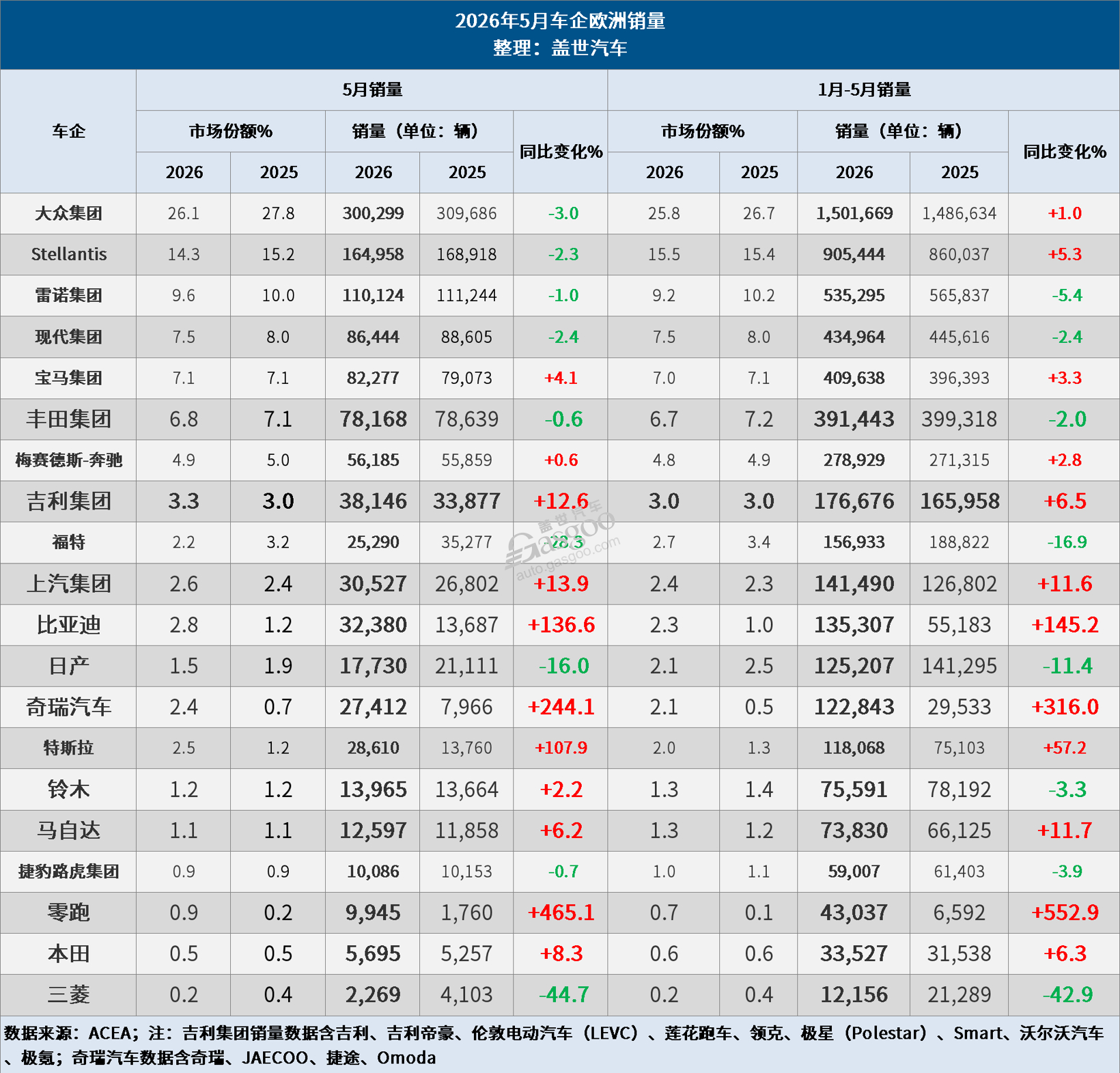
The European automotive landscape has reached a historic inflection point. In May 2026, collective sales of major Chinese automakers officially surpassed those of established Japanese legacy brands across 31 core European markets. This milestone signals a profound structural shift, highlighting how rapidly Chinese EV market share in Europe is expanding despite evolving regulatory environments and trade complexities.
The Numbers Behind the Historic Shift
According to the latest registration data from May 2026, five prominent Chinese automotive groups achieved a combined sales volume of 138,410 passenger vehicles across 31 European nations. In contrast, the six leading Japanese OEMs registered a total of 130,424 units during the same period. This represents the first time in history that Chinese automotive manufacturers have collectively outsold their Japanese counterparts in the European market.
For decades, Japanese automakers maintained a reliable, highly efficient foothold in Europe with hybrid and internal combustion engine (ICE) offerings. However, as the European transition toward electrification accelerates, the strategic agility of Chinese players is rewriting the competitive playbook.
| Automaker Region (May 2026) | Number of Core Brands Included | Total Passenger Car Sales (Europe-31) |
|---|---|---|
| Chinese Automakers | 5 Groups (BYD, Geely, Chery, SAIC, GAC) | 138,410 |
| Japanese Automakers | 6 Mainstream Brands (Toyota, Nissan, Honda, Mazda, Suzuki, Subaru) | 130,424 |
Key Drivers of Chinese EV Market Share in Europe
This demographic shift is not an overnight anomaly; it is the culmination of targeted global growth plans. Western investors and strategic planners should watch two primary execution strategies:
1. Strategic Localization & Local Value Creation
Rather than relying solely on direct exports, Chinese manufacturers are actively pursuing a localized regional footprint in Europe. By investing in regional assembly plants, manufacturing facilities in countries like Hungary and Spain, and local distribution hubs, these companies ensure supply chain compliance and long-term trade adaptability. This deep industry commitment reassures European consumers of robust after-sales support and reliable parts availability.
2. Technological Integration and Sourcing Alliances
Chinese OEMs have successfully commercialized next-generation battery architectures (such as advanced lithium iron phosphate, or LFP, chemistry) and integrated highly intuitive software architectures (including level-2+ ADAS and smart cabin systems). Instead of operating in isolation, global automotive dynamics are shifting toward cross-border collaboration. Several European legacy OEMs are entering strategic sourcing alliances with Chinese technology suppliers to integrate these advanced battery platforms into their own vehicle lineups, validating the maturity and cost-efficiency of Chinese innovations.
Strategic Implications for Western Investors
As a market analyst tracking global supply chains, it is clear that the metric of success in the European market is pivoting away from historical brand loyalty toward software competency and price-to-performance ratio. Western investment firms and strategy directors should carefully monitor the following dynamics:
- Global OEM Alliances: Joint ventures and strategic equity partnerships between European brands and Chinese EV giants will likely accelerate to co-develop localized architectures.
- The Premiumization Push: Brands like NIO and Zeekr are positioning themselves as direct premium alternatives, threatening established margin structures in Europe.
- Battery Chemistry Dominance: The rapid uptake of LFP batteries in European entry-level segments underscores the strategic necessity of secure upstream supply chains.
Ultimately, the May 2026 sales figures prove that European consumers are increasingly receptive to new technology propositions. For global automotive stakeholders, understanding this strategic shift is no longer optional—it is a critical requirement for maintaining market relevance.