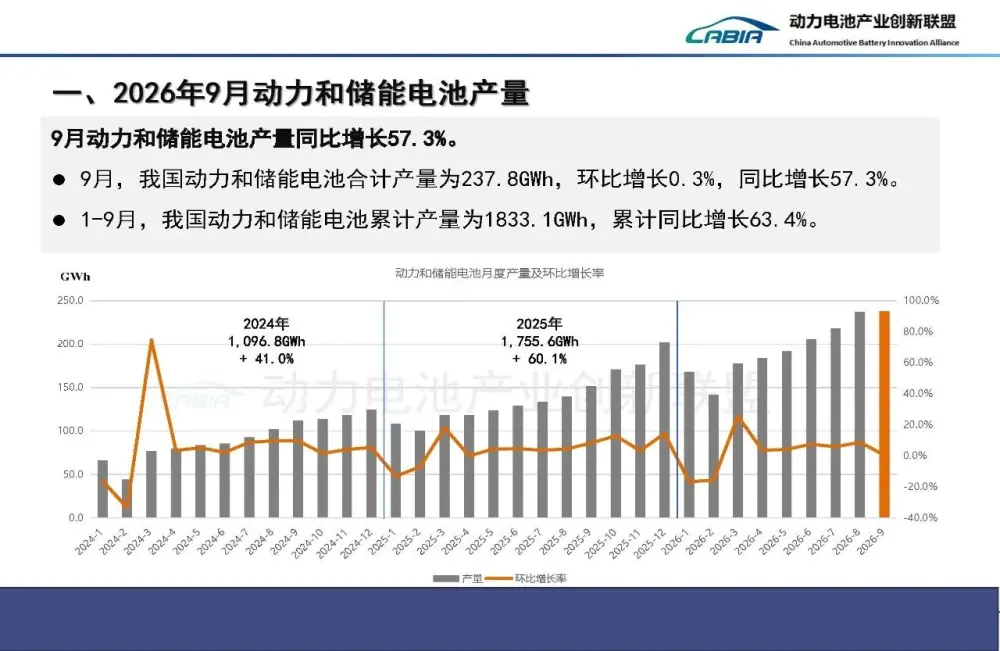
China's battery manufacturing complex reached another headline-grabbing operational milestone in September, reporting historic highs across production, vehicle installations, and outbound shipments. Monthly data published by the China Automotive Power Battery Industry Innovation Alliance (CABIA) reveals an industrial engine operating at breathtaking scale: domestic production topped 110 GWh in a single month, grid-scale energy storage shipments more than doubled year-over-year, and overseas dispatches of traction packs re-accelerated despite mounting Western regulatory frictions. To casual observers, the figures read like an unassailable display of supply-chain supremacy. Yet, beneath the veneer of parabolic volume growth lies an aggressive flight response driven by domestic margin compression, structural overcapacity, and severe sovereign market walls.
Understanding this industrial pivot requires dismantling the narrative crafted by domestic trade associations. The surge in Chinese EV battery exports is not merely an organic capture of international market share; it is an economic necessity for balance-sheet preservation. With domestic electric vehicle penetration crossing 50% in mainland China and domestic original equipment manufacturers (OEMs) engaged in an attritional price war orchestrated by BYD and Geely, upstream battery cell manufacturers have witnessed their gross margins compressed into the single digits. Consequently, Chinese cell giants are turning their capital expenditures toward two specific escape valves: stationary energy storage systems (BESS) and export-oriented supply chains across Europe, Southeast Asia, and South America.
Production Overdrive: Unpacking the September GWh Run-Rate
The gross metrics released by CABIA outline an industrial ecosystem operating on an unprecedented physical footprint. Total battery cell production across the Chinese mainland exceeded 111.3 GWh in September alone, representing a 42.8% year-over-year surge and a 9.9% month-over-month increase. Out of this total, power batteries designated for electric passenger and commercial vehicles accounted for roughly 75.8 GWh, while stationary energy storage systems (ESS) crossed 35.5 GWh, climbing 102.4% compared to September 2023. Domestic power battery installations reached 54.5 GWh, leaving a substantial monthly delta between domestic installation and manufacturing volume—a clear indicator of inventory accumulation and outbound supply pipelines.
Chemistry allocations continue to tilt decisively toward Lithium Iron Phosphate (LFP). Of the 54.5 GWh installed in domestic vehicles during September, LFP accounted for 41.3 GWh, or 75.8% of the total market, while high-nickel ternary (NCM/NCA) chemistries captured just 13.1 GWh (24.1%). The structural dominance of LFP has been accelerated by modern pack-level cell-to-chassis (CTC) and cell-to-pack (CTP) designs, which allow automakers to achieve 500-kilometer to 600-kilometer vehicle ranges without incurring the prohibitive cobalt and nickel price premiums associated with ternary formulations. However, high-nickel formulations still maintain a structural stronghold in outbound exports destined for premium European and North American vehicle segments where volumetric energy density and sub-zero temperature resilience remain non-negotiable buyer requirements.
| Manufacturer & Architecture | Dominant Chemistry | Cell-Level Energy Density (Wh/kg) | Fast-Charging Metric | Export Dependency | Primary Structural Headwind |
|---|---|---|---|---|---|
| CATL (Shenxing Plus / Qilin) | LFP / High-Nickel Ternary | 205 (LFP) / 255 (NCM) | 4C to 5C (800V SiC) | 25% - 30% of Total Revenue | US FEOC Licensing Scrutiny (Ford/Tesla) |
| BYD / FinDreams (Blade 2.0) | LFP (Prismatic Long-Cell) | 160 - 180 (LFP) | 2.5C to 3C | < 15% (Heavily Captive) | Direct EU Tariffs on Captive EV Shipments |
| LG Energy Solution (Ultium/Global) | NCMA (High-Nickel) | 280 - 300 (Ternary) | 3C to 4C (800V Dedicated) | > 70% Non-Korea Exposure | High Production Cost vs. Chinese LFP Benchmarks |
| CALB / Gotion High-Tech | LFP / Medium-Nickel NCM | 180 - 210 (LFP) | 2C to 3C | 18% - 22% and Growing | Tier-2 Cash Flow Erosion in Domestic Price War |
Export metrics for the month underscore this shifting operational balance. Total outbound shipments of Chinese traction and storage batteries reached 19.8 GWh in September, recording a 26.3% year-over-year expansion. Power battery exports accounted for 13.1 GWh, marking an 8.6% sequential uptick. This steady acceleration of Chinese EV battery exports confirms that mainland producers are leaning heavily into international distribution networks to offset domestic average selling price (ASP) declines, utilizing established overseas logistics lanes to supply commercial fleet projects, containerized stationary storage farms, and joint-venture automotive assembly hubs.
The Supply Chain Machine: Lithium Slump and Tier-1 Hegemony
The physical engine enabling these staggering delivery volumes is anchored by a domestic raw material supply chain that has decoupled itself from Western pricing mechanisms. The price of battery-grade lithium carbonate hovered between RMB 72,000 and RMB 76,000 per metric ton throughout September, representing a steep drop of more than 85% from its peak of nearly RMB 600,000 per metric ton recorded in late 2022. This protracted commodity deflation has systematically dismantled production cost floors across the Chinese manufacturing corridor.
Bill of Materials (BOM) cost modeling from Shanghai and Shenzhen supply chain channels shows that raw cell manufacturing costs for prismatic LFP cells have dropped to approximately RMB 0.31 to RMB 0.34 per watt-hour ($0.043 - $0.048/Wh). At these levels, cell manufacturers operate on razor-thin gross margins of 8% to 12%, with only fully integrated Tier-1 players such as Contemporary Amperex Technology Co. Ltd. (CATL) maintaining operating profit margins above 18% via operational automation and patent royalties. Tier-2 manufacturers, including CALB, EVE Energy, and Sunwoda, are effectively running manufacturing lines at or near cash break-even to service debts, secure supplier volume rebates, and avoid costly line shutdowns.
Crucially, cathode active material (CAM) and synthetic graphite anode suppliers are bearing the brunt of this margin compression. Companies such as Dynanonic (LFP cathode) and BTR New Material Group (anodes) have been pressured by dominant battery makers into multi-quarter price freezes. In contrast, power electronics and Silicon Carbide (SiC) MOSFET module integrators—such as BYD Semiconductor and Inovance—command slightly healthier operating margins, sustained by the aggressive adoption of 800-volt high-voltage vehicle electrical systems across domestic brands like Zeekr, XPeng, and Li Auto.
Global Market Fallout: The Divergence of Captive vs. Merchant Cell Makers
The relentless expansion of Chinese battery output has ignited an existential competitive realignment across the global automotive landscape. The competitive arena is broadly bifurcated between captive battery operations and merchant suppliers, with Western legacy OEMs caught in an increasingly precarious operational squeeze.
Captive producers, led predominantly by BYD's battery manufacturing division FinDreams, utilize vertical integration to drive passenger vehicle price deflation. BYD’s ability to produce its proprietary Blade battery at internal transfer costs estimated around RMB 0.32/Wh enables the company to retail full-featured sedans like the Qin Plus DM-i and pure-electric Seagull at retail price points between RMB 69,800 and RMB 99,800 ($9,800 - $14,000). Western competitors operating in the same segments rely on outsourced merchant battery cells from Tier-1 suppliers that typically price finished packs between $85 and $110/kWh, creating an insurmountable vehicle-level BOM gap of $3,500 to $6,000 per entry-level vehicle.
For independent merchant cell suppliers like CATL, the strategy centers on licensing and cross-border supply contracts. While CATL dominates global installed capacity with over 36% market share, it faces fierce pushback from South Korean battery champions LG Energy Solution, SK On, and Samsung SDI. The South Korean trio has capitalized on protectionist industrial policies—specifically the United States Inflation Reduction Act (IRA)—to monopolize captive joint-venture gigafactories with General Motors, Ford, Hyundai Motor Group, and Stellantis across North America.
However, decoupled automotive players like Hyundai-Kia demonstrate that non-reliance on Chinese domestic retail volume does not preclude technological competitiveness. By deploying their proprietary E-GMP 800-volt architecture with high-nickel pouches sourced from Korean tier-1s, Hyundai-Kia has captured lucrative European and American EV market share with sustained operational profitability, completely insulating their corporate earnings from the margin-crushing Chinese domestic retail bloodbath.
The Reality Check: Overcapacity, Grid Bottlenecks, and the LFP Ceiling
Corporate press releases from CABIA and Chinese state-backed industrial forums paint September's performance as an unmitigated triumph of modern industrial planning. A rigorous engineering and economic interrogation, however, reveals structural vulnerabilities that cannot be resolved through volume expansion alone.
First, the structural overcapacity crisis remains acutely unresolved. Industry-wide cell manufacturing capacity in China is estimated to exceed 1,400 GWh per annum, against a projected full-year domestic EV and ESS installation demand of roughly 550 to 650 GWh. This equates to an effective capacity utilization rate of under 50% across secondary and tertiary manufacturers. While Tier-1 automated plants from CATL run at 65% to 75% utilization, dozens of secondary gigafactories commissioned during the 2021-2022 capital boom are operating at distressed utilization levels. The surge in Chinese EV battery exports is thus less a demonstration of organic market pull than an aggressive dumping mechanism designed to export domestic industrial deflation abroad.
Second, the chemistry ceiling of LFP poses severe commercial limits. While LFP provides exceptional cycle life (3,000 to 5,000 cycles) and thermal stability, its theoretical volumetric energy density is inherently capped around 180 to 210 Wh/kg at the cell level. In extreme cold weather (-10°C to -20°C), unheated LFP pack discharge capacity degrades by 30% to 45%, requiring aggressive, energy-intensive thermal management circuits that drastically reduce winter vehicle range. This physical reality fundamentally restricts LFP's appeal in cold-climate export markets such as the Nordic nations, Canada, and the American Midwest, where high-nickel ternary chemistry remains superior.
Third, the narrative surrounding ultra-fast charging (4C to 5C rates, claiming 10-minute 10-to-80% state of charge replenishment) hits an immediate infrastructural brick wall. Delivering 400 kW to 480 kW of sustained peak power to a single passenger vehicle requires industrial-grade medium-voltage grid interconnections and liquid-cooled dispensing cables. No municipal power grid in Europe or North America can sustain clusters of 4C-enabled charging plazas without multi-million-dollar dedicated Battery Energy Storage Systems (BESS) acting as localized power buffers. When battery manufacturers advertise hyper-fast charging speeds, they are promoting a laboratory optimization that remains completely unviable across 95% of real-world public charging infrastructure.
The Engineering Gap: From Lab Benchmarks to Mass-Production Reality
While CATL advertises 5C charging rates, real-world deployment faces a critical grid bottleneck; delivering sustained 400kW+ power requires industrial-grade medium-voltage interconnections and localized BESS buffering that municipal grids cannot support. Furthermore, LFP's theoretical energy density ceiling of ~210 Wh/kg creates a hard physical limit on range in cold climates (-20°C), where discharge capacity degrades by 35-45% without aggressive thermal management systems. These specs are often validated only under controlled lab conditions, masking the degradation risks and yield losses inherent to mass production at gigafactory scale.
The structural overcapacity (1,400 GWh vs ~600 GWh demand) suggests these exports are a balance-sheet necessity rather than organic market pull. Western OEMs counter this by relying on Korean high-nickel supply chains for IRA/EU compliance and superior volumetric density in premium segments. For Chinese manufacturers to maintain global competitiveness, they must prove that localized gigafactories can meet carbon accounting standards while delivering cost parity against established Tier-1 competitors like LG Energy Solution.
Strategic Outlook: Three Scenarios for Global EV Battery Dynamics
As the fourth quarter unfolds, market participants must look beyond headline installation figures to evaluate the financial durability of the global battery supply chain. The trajectory of Chinese EV battery exports and domestic capacity will unfold under three distinct market scenarios:
Bull Case
Under this scenario, global lithium raw material pricing stabilizes near current lows, allowing Chinese LFP manufacturers to solidify their global manufacturing cost dominance. Western OEMs, struggling to achieve positive operating margins on entry-level EVs, capitulate on domestic sourcing purity and aggressively sign technology-licensing joint ventures with CATL, Gotion, and Envision AESC. Energy storage exports continue expanding at triple-digit annual rates, absorbing excess Chinese factory capacity and subsidizing corporate balance sheets. In this environment, Chinese cell makers capture over 65% of the total ex-China merchant battery market, driving Western gigafactory projects into consolidation or state-subsidized bailouts.
Base Case
China's domestic battery production run-rate stabilizes at high levels (100–120 GWh/month), but domestic pricing remains ruthlessly suppressed. Tier-2 and Tier-3 cell makers face accelerating insolvencies and consolidation, with CATL and BYD expanding their combined domestic market share past 80%. Chinese EV battery exports to non-aligned markets (Southeast Asia, Latin America, Middle East) expand rapidly, while European and North American volumes face progressive deceleration due to stringent carbon accounting audits and FEOC restrictions. Western OEMs establish a two-track sourcing strategy: localized high-nickel cells from Korean suppliers for regulated Western markets, and Chinese LFP technology for unhedged emerging economies.
Bear Case
Escalating geopolitical confrontation leads the European Union to expand punitive countervailing tariffs beyond finished vehicles to include direct imports of Chinese-manufactured lithium-ion cells and stationary BESS containers. Simultaneously, a sharp contraction in Western consumer EV demand leads legacy automakers to delay electrification capital expenditures, stranding Chinese-backed greenfield plants in Eastern Europe with sub-scale utilization. A wave of domestic battery defaults hits the Chinese banking sector as underutilized Tier-2 gigafactories default on syndicated local government debts, triggering an aggressive, state-mandated capacity rationalization across mainland manufacturing hubs.
Executive Takeaways and Capital Allocation Mandates
- Volume Is Not Margin: Record September output and export metrics obscure severe domestic overcapacity. Investors must differentiate between highly profitable, IP-protected operators like CATL and distressed Tier-2 players facing cash-flow exhaustion.
- The Stationary Storage Pivot: The doubling of ESS battery shipments (35.5 GWh in September) represents a structural hedge by cell producers against slowing domestic automotive growth rates, emerging as a critical corporate earnings driver.
- LFP Chemistry Limits: Low-cost LFP dominates Chinese installations (75.8% share) but faces intrinsic thermal and energy-density physical limits that preclude it from entirely displacing high-nickel chemistries in cold-climate, high-performance export markets.
- Regulatory Exclusion Accelerates: Direct exports from mainland China face an increasingly hostile Western tariff and carbon-accounting framework, rendering overseas greenfield localization the only viable pathway for sustained global market participation.