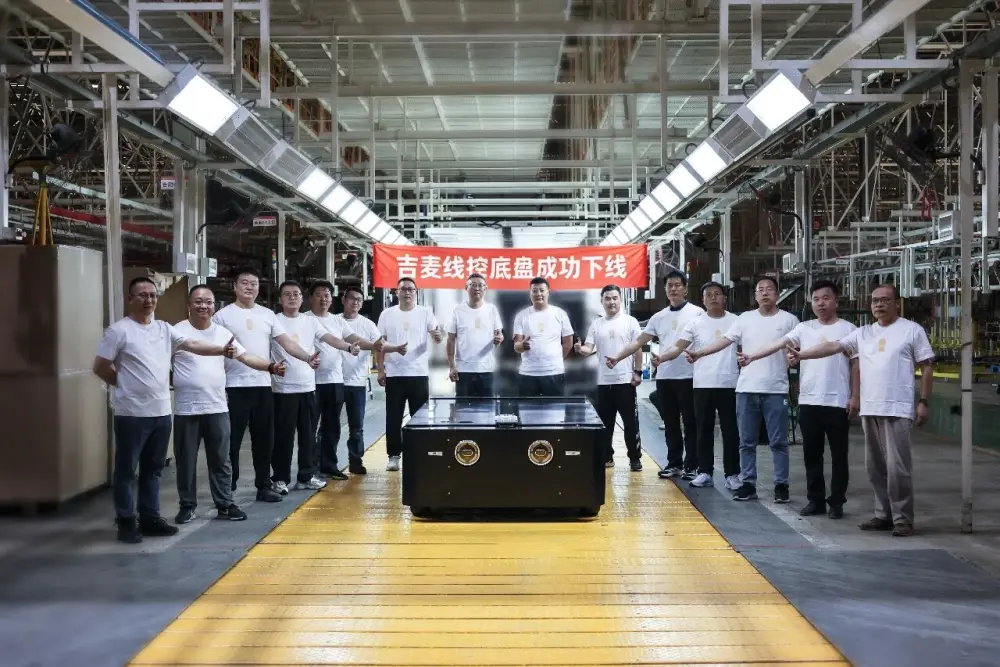
The global race for autonomous driving dominance is rapidly shifting from software algorithms to physical integration. On June 17, Chinese EV manufacturer Jimai New Energy announced that its self-developed, universal smart Chinese drive-by-wire chassis technology has officially rolled off the production line. Positioned as the foundational structural block for smart unmanned vehicles, this rollout highlights a major technological leap forward in China's domestic supply chain capabilities.
The Breakthrough: What is Jimai's Smart Drive-by-Wire Chassis?
At its core, drive-by-wire (DbW) technology replaces traditional mechanical connections (such as steering columns and hydraulic brake lines) with electronic signals. Jimai's new platform is a 'universal' smart chassis, meaning it can be adapted for multiple vehicle configurations—from unmanned last-mile delivery pods to municipal sweeping robots and robotaxis.
By bypassing mechanical latency, this chassis enables autonomous driving computers to command steering, braking, and drive torque with millisecond-level precision. As a Shanghai-based supply chain analyst, I view this localization as a direct threat to the premium pricing historically enjoyed by Western automotive giants.
Why Drive-by-Wire is the Holy Grail of L3+ Autonomy
For Level 3 (conditional) and Level 4 (high) automation to function safely, redundancy and instantaneous response times are non-negotiable. Traditional mechanical linkages cannot react fast enough to avoid collisions when an algorithmic system detects an obstacle at high speeds.
By deploying Chinese drive-by-wire chassis technology, developers achieve:
- Decoupled Control: Independent management of each wheel's torque and angle.
- Sub-Millisecond Latency: Immediate execution of collision avoidance maneuvers.
- Simplified Vehicle Architecture: Fewer mechanical components, leading to a lighter chassis and increased room for battery packs.
Supply Chain Shift: Western Tier-1s Under Pressure
Historically, the drive-by-wire market has been dominated by legacy Western Tier-1 suppliers like Bosch (with their Integrated Power Brake systems), Continental, and ZF. However, Chinese suppliers are localizing these components at an unprecedented 'China-speed,' stripping out unnecessary costs while optimizing systems for rapid software integration.
| Feature | Traditional Mechanical Chassis | Chinese Drive-by-Wire Chassis (Jimai) |
|---|---|---|
| Control Signal | Physical hydraulic/mechanical lines | Digital signals via CAN/Ethernet |
| Latency | 100–300 milliseconds | Under 20 milliseconds |
| Adaptability | Rigid, vehicle-specific designs | Universal, modular software-defined design |
| Key Suppliers | Legacy Tier-1 OEMs | Localized Chinese EV innovators |
For global investors, this represents a crucial pivot point. Companies that successfully localize drive-by-wire components will capture the lion's share of the booming autonomous delivery and robotaxi infrastructure markets across Asia and Europe.
Strategic Outlook for Western OEMs
Western automakers cannot afford to ignore this shift. If Chinese OEMs can build and deploy autonomous vehicle chassis at a fraction of the cost of Western counterparts, the barrier to scale will heavily favor Chinese exports in neutral markets. Partnering with, or tracking the progress of, companies like Jimai New Energy is no longer optional—it is a strategic necessity for survival in the software-defined vehicle era.