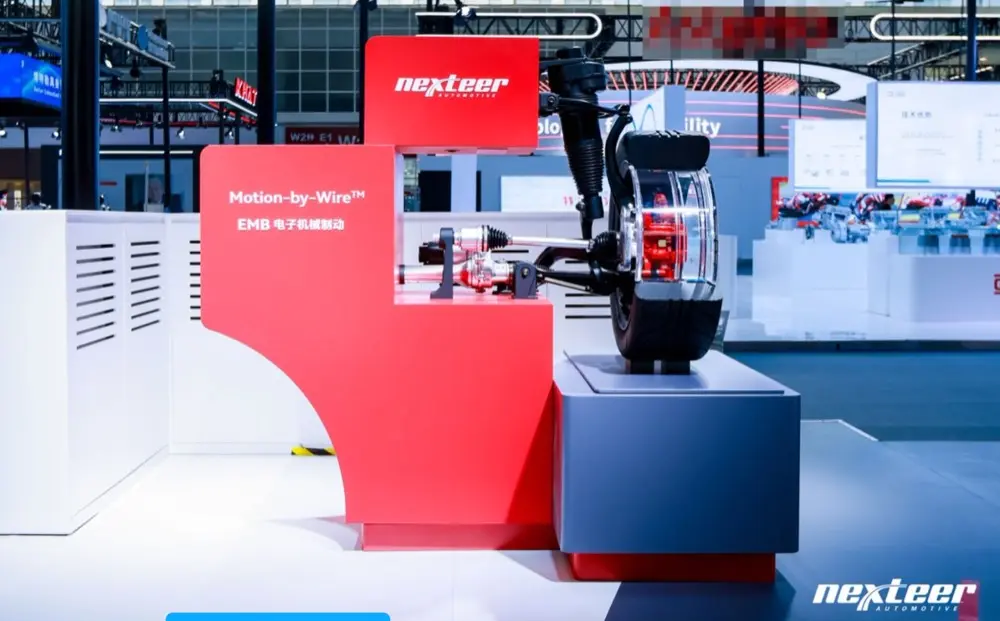
China steer-by-wire technology has officially moved from engineering concept to production reality, creating an immediate threat to legacy automotive suppliers in Detroit and Stuttgart. At the 2026 Beijing Auto Show, Nexteer Automotive unveiled the industry’s first fully integrated ‘Motion-by-Wire’ platform—combining production-ready steer-by-wire with Electronic Mechanical Braking (EMB)—effectively declaring the end of the hydraulic steering and braking era.
This is not concept car fantasy. Nexteer has confirmed that its steer-by-wire technology enters mass production within 12 months, with EMB systems completing validation for 20-plus global OEMs. For Western Tier 1 suppliers like Bosch, Continental, and ZF, this represents an existential inflection point that could redefine the $400 billion automotive chassis market.
The Death of the Mechanical Linkage
Nexteer’s Motion-by-Wire™ suite represents a fundamental architectural shift from hydraulic to fully electric vehicle control. The system integrates four critical domains:
- Steer-by-Wire (SbW): Completely eliminating physical steering shafts and hydraulic assistance
- Electronic Mechanical Braking (EMB): Replacing brake fluid with electric actuators and motor-driven calipers
- Rear Wheel Steering: Integrated motion control for enhanced maneuverability
- Motion IQ™ Software: Cross-domain functional safety redundancy enabling ‘Brake-Steer Fusion’
The critical innovation lies in the software-defined coordination. Unlike conventional separated chassis systems, Nexteer’s platform enables millisecond-level synchronization between steering and braking—a prerequisite for L3 and L4 autonomous driving that legacy architectures cannot achieve.
Why Western Investors Should Watch Nexteer
Nexteer’s 120-year heritage (originally spun from General Motors’ steering division) gives it unique credibility with Detroit and European OEMs. Yet the company’s strategic pivot reveals how Chinese EV supply chains are capturing high-value ‘brain’ functions, not just commoditized manufacturing.
The L3 Autonomy Bottleneck
Current Level 2+ systems rely on mechanical backups that create latency, weight penalties, and design constraints. Nexteer’s full x-by-wire architecture removes these limitations, offering the precise motion control necessary for unsupervised highway driving. As Li Jun, Nexteer’s Global SVP and Chief Strategy Officer, stated: “Fusion is not simple addition—it is the inevitable evolution based on electromechanical integration logic.”
Threat to Legacy Chassis Suppliers
Western Tier 1s have treated steer-by-wire as a 2030+ technology due to regulatory caution and legacy platform constraints. Nexteer’s aggressive 12-month production timeline—accelerated by China’s regulatory sandbox approach—creates a first-mover advantage that could lock Western OEMs into dependency on Chinese x-by-wire platforms for next-generation EV architectures.
Production Reality: Beyond the Prototype
Unlike CES demonstrations, Nexteer’s EMB system has completed winter extreme-cold validation and bench testing within one year of its Shanghai Auto Show debut. The company leverages shared actuator modules and manufacturing lines across steering and braking divisions, achieving economies of scale that Western competitors struggle to match.
Twenty-plus customers have completed deep-drive evaluations, with multiple projects entering technical cooperation phases. This suggests adoption across both domestic Chinese brands and potentially Western OEMs seeking faster time-to-market for L3 vehicles.
The ‘M³’ Strategy: Motion, Millisecond, Mastery
Beijing Auto Show’s theme ‘Leading the Era, Intelligent Future’ provided the backdrop for Nexteer’s ‘M³’ positioning. The Motion X interactive demonstration showcased EMB’s four-wheel independent control and millisecond response times—capabilities impossible with hydraulic architectures.
For Western automotive executives, the message is clear: the chassis domain controller—the nervous system of the software-defined vehicle—is being commoditized faster than anticipated. Companies relying on incremental hydraulic upgrades risk obsolescence by 2027.
See our analysis on how Western Tier 1 suppliers are losing ground in the EV transition for additional context on this strategic shift.
Sources:
- Reuters Automotive News - Global supply chain analysis
- Bloomberg - Chinese EV technology acceleration reports