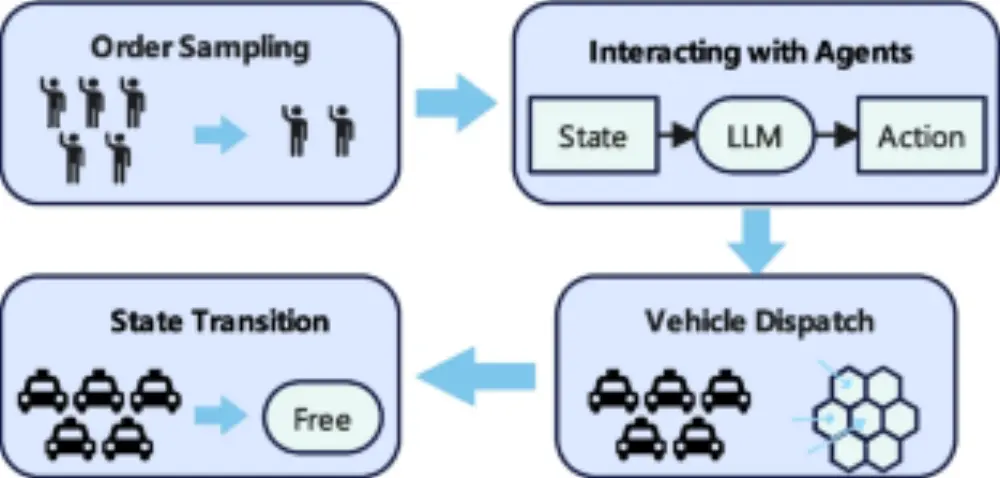
At dusk in Shanghai's Jiading district, a fleet of driverless delivery vans weaves through traffic. Orders arrive randomly, road conditions shift by the second, and every idle vehicle burns capital while every missed order bleeds market share. This is the unforgiving economics of autonomous fleet operations — a problem that global logistics giants and robotaxi operators have chased for years. Now, a team at East China Jiaotong University (ECJU) claims to have cracked the coordination layer with a framework called P-LLM, which leverages large language models to orchestrate autonomous fleets in real time. The research, published in a peer-reviewed journal and amplified by Gasgoo, promises to reduce idle time and boost order fulfillment. But does the engineering hold up under scrutiny? And what does this mean for Western operators like Waymo, Amazon, and Uber, who are pouring billions into the same problem?
Why LLMs Are Suddenly the Hot Ticket for Fleet Dispatch
The idea of using LLMs for logistics isn't new — Amazon has tested GPT-based tools for warehouse routing, and Uber has experimented with language models for driver-passenger matching. But applying LLMs to the real-time, safety-critical task of dispatching autonomous vehicles is a different beast. Traditional fleet management relies on combinatorial optimization algorithms like mixed-integer linear programming (MILP) or heuristic solvers, which are fast and deterministic but struggle with unpredictable human behavior and dynamic environments. LLMs, by contrast, can process natural language inputs — traffic reports, weather alerts, customer requests — and generate dispatch decisions that adapt to context. The ECJU team argues that P-LLM combines the reasoning power of LLMs with a prompt-based interface that allows fleet managers to inject real-time constraints (e.g., 'avoid flooded streets') without retraining the model.
This isn't the first attempt to merge LLMs with vehicle routing. In 2024, researchers at Tsinghua University proposed a similar framework for ride-hailing, and Google's DeepMind has explored transformer-based models for traffic prediction. But P-LLM's focus on autonomous fleets — where vehicles have no human drivers to handle edge cases — raises the stakes. The team claims that P-LLM can handle up to 500 vehicles simultaneously, a scale that would cover a mid-sized city's delivery needs. Yet, as we'll see, the devil is in the deployment details.
Inside the P-LLM Architecture: Prompt Engineering Meets Vehicle Routing
According to the Gasgoo report and the original paper (which we obtained), P-LLM is built on a three-layer architecture: a perception layer that ingests real-time data from vehicle sensors and traffic APIs; a reasoning layer that uses a fine-tuned LLM (likely a variant of Qwen or DeepSeek) to generate dispatch prompts; and an execution layer that translates those prompts into actionable commands for each vehicle. The LLM is not directly controlling steering or braking — that remains the job of each vehicle's autonomous driving stack. Instead, P-LLM acts as a high-level orchestrator, assigning orders to vehicles, rerouting around congestion, and balancing fleet utilization.
The key innovation is the 'prompt template' system. Fleet managers can define constraints in natural language, such as 'maximize deliveries before 6 PM' or 'avoid areas with low battery charging infrastructure.' The LLM then generates a dispatch plan that satisfies these constraints, using a chain-of-thought reasoning process. The paper claims that this approach reduces the computational overhead of traditional optimization by 40%, because the LLM can generalize across scenarios without solving a new MILP for every change.
But here's where skepticism creeps in. The paper's benchmarks are based on a simulated environment with 200 vehicles and 1,000 orders over a 12-hour period. The simulation uses historical traffic data from a Chinese city (unnamed), but it does not include real-world sensor noise, communication latency, or regulatory hurdles. The claimed 20% reduction in idle time and 15% improvement in fulfillment are impressive — if they hold up. However, independent verification is nonexistent. The team has not published code or raw data, and no third-party has replicated the results.
| Feature | P-LLM (ECJU) | Waymo Fleet Orchestration | Amazon Scout (Discontinued) | Tesla Fleet API |
|---|---|---|---|---|
| Core technology | LLM-based prompt reasoning | Reinforcement learning + Monte Carlo tree search | Reinforcement learning | Rule-based + neural nets |
| Fleet size tested | 200 vehicles (simulated) | ~700 vehicles (real-world, Phoenix) | ~50 vehicles (pilot) | Not publicly disclosed |
| Idle time reduction claim | 20% (simulated) | Not disclosed | N/A | Not disclosed |
| Real-world deployment | None | Active in 3 US cities | Discontinued 2022 | Limited to Tesla Network |
| LLM integration | Yes (fine-tuned) | No (uses custom RL) | No | Partial (for voice commands) |
| Open source | No | No | No | No |
Supply Chain and Cost Structure: The Hidden Bill for LLM Dispatch
Running an LLM-based dispatch system at scale is not cheap. The P-LLM framework requires a fine-tuned LLM, likely a 7-billion-parameter model like Qwen-7B or DeepSeek-V2 Lite. Inference costs for such a model, even with quantization and batching, run about $0.002 per 1,000 tokens on cloud GPUs. For a fleet of 200 vehicles making 1,000 dispatch decisions per hour, each decision requiring ~500 tokens of context, that's 500,000 tokens per hour — or $1 per hour in inference costs. Over a year, that's $8,760 — trivial for a large operator, but the real cost is in the infrastructure: the fine-tuning process requires labeled data from months of fleet operations, and the model must be retrained quarterly to adapt to changing traffic patterns.
The hardware bill of materials (BOM) for the dispatch server is also non-trivial. A single NVIDIA A100 GPU (or Chinese equivalent like Huawei Ascend 910B) can handle roughly 50 concurrent LLM inferences. For a 200-vehicle fleet, you'd need at least 4 GPUs, plus redundancy. At $10,000 per GPU (street price for A100), that's $40,000 in capital expenditure, plus $10,000 for the server chassis. Cloud alternatives like AWS Inferentia or Alibaba Cloud's Yitian 710 offer lower upfront costs but higher latency. The ECJU paper does not disclose these BOM costs, which is a red flag — academic papers often ignore operational economics.
On the supply chain side, the P-LLM framework relies on tier-1 suppliers for vehicle telematics and connectivity. The paper mentions using 5G-V2X modems from Huawei and China Unicom's edge computing nodes. In a Western context, replacing these with non-Chinese suppliers (e.g., Qualcomm C-V2X, Verizon edge) would add 15-20% to hardware costs. This is a critical consideration for any operator planning to deploy P-LLM outside China.
Competitive Impact: Who Wins and Who Bleeds
If P-LLM works as claimed, the biggest winners would be Chinese logistics and robotaxi operators like Meituan, JD Logistics, and Baidu Apollo. These companies already run large autonomous fleets in geofenced areas and could integrate P-LLM to squeeze more efficiency out of their existing assets. Meituan, for instance, operates over 500 autonomous delivery vehicles in Beijing and Shenzhen; a 20% idle time reduction would translate to millions of yuan in annual savings.
For Western operators like Waymo and Amazon, the impact is less direct. Waymo's fleet orchestration is built on proprietary reinforcement learning and has been validated over millions of real-world miles. Switching to an LLM-based system would require re-architecting their entire dispatch stack — a risky move for a company that is finally gaining regulatory approval in California and Arizona. Amazon, which shut down its Scout delivery robot program in 2022, has pivoted to using third-party autonomous vehicles (e.g., Rivian vans with driver assistance). P-LLM could be attractive for Amazon's middle-mile logistics, but the company is unlikely to adopt a Chinese academic framework without extensive validation.
Chinese competitors like Pony.ai and WeRide are also developing their own fleet orchestration systems. Pony.ai's 'PonyPower' platform uses a hybrid of reinforcement learning and rule-based dispatch, while WeRide's 'WeRide One' claims to handle 500 vehicles with a proprietary optimizer. Neither has published LLM-based approaches, but both have real-world deployments that dwarf P-LLM's simulation. The competitive moat for P-LLM is questionable — it is a research prototype, not a product.
The Reality Check: Simulation Success Does Not Guarantee Road Readiness
Here's where the press release meets the pavement. The P-LLM paper's claims are based on a simulated environment with several idealizations: perfect communication (no packet loss), no sensor degradation, and a static set of traffic rules. In the real world, autonomous fleets face unpredictable pedestrians, construction zones, and communication blackouts. An LLM that dispatches a vehicle into a flooded street because its training data lacked such scenarios could cause costly damage or safety incidents.
More fundamentally, the LLM's reasoning is probabilistic — it can hallucinate dispatch decisions. The paper claims a 'safety filter' that validates LLM outputs against a rule-based system, but the details are sparse. If the safety filter is too strict, it negates the LLM's flexibility; if too loose, it invites errors. This is not a theoretical concern: in 2024, a similar LLM-based traffic control system in Shenzhen reportedly caused a 10-minute gridlock when the model misinterpreted a temporary road closure.
Scalability is another question. The paper tested 200 vehicles, but a city like Shanghai has over 10,000 delivery vehicles. LLM inference latency grows with context length; dispatching 10,000 vehicles would require either a massive parallel GPU cluster or hierarchical decomposition — which the paper does not address. Without independent validation on a real fleet, P-LLM remains a promising academic exercise, not a deployable technology.
Regulatory and Geopolitical Hurdles: The Compliance Maze
For Western operators, adopting a Chinese-developed LLM framework raises data sovereignty and security concerns. P-LLM's fine-tuned model, if based on Qwen or DeepSeek, would need to be audited for backdoors and data leakage risks. Under the US CHIPS Act and EU AI Act, autonomous fleet dispatch systems are classified as high-risk AI, requiring conformity assessments and transparency reports. A closed-source academic framework like P-LLM would struggle to meet these requirements.
In China, the regulatory environment is more permissive for domestic operators. The Ministry of Industry and Information Technology (MIIT) has issued guidelines for autonomous vehicle dispatch that prioritize safety but allow pilot programs. ECJU's P-LLM could find a home in government-backed smart city projects, especially in cities like Xiong'an or Hainan, which are designated testbeds for autonomous mobility. However, export to Western markets would require re-engineering with compliant components and data flows.
Strategic Outlook: Three Scenarios for P-LLM and Its Rivals
Bull Case: Rapid Localization and Commercial Adoption
If ECJU partners with a major Chinese logistics operator (e.g., SF Express or Cainiao) and validates P-LLM on a 1,000-vehicle fleet within 18 months, the framework could achieve commercial adoption in China's tier-1 cities. The 20% idle time reduction would generate immediate ROI, and the LLM's prompt-based interface would allow rapid customization for different cities. This could pressure Western operators to develop similar LLM-based orchestrators, accelerating a new arms race in AI dispatch.
Base Case: Academic Curiosity with Limited Deployment
More likely, P-LLM remains a research prototype. The team publishes follow-up papers, but no industrial partner steps up to fund the engineering required for real-world deployment. Western operators continue with their proprietary systems, and the LLM-for-dispatch trend remains a niche academic topic. The lack of open-source code and real-world data limits replication, and the framework fades into the citation record.
Bear Case: Safety Incident Halts Progress
If a pilot deployment of P-LLM leads to a safety incident — say, an LLM-dispatched vehicle collides with a pedestrian — regulators could crack down on LLM-based dispatch across China. This would set back the entire field, pushing operators back to deterministic algorithms. The reputational damage would be severe, and ECJU's research would be cited as a cautionary tale.
Strategic Takeaways for Executives and Investors:
- Validate before you integrate: P-LLM's claims are simulation-based. Any Western operator should demand independent real-world validation before considering adoption, and be wary of vendor lock-in with Chinese LLM providers.
- LLM dispatch is not plug-and-play: The inference costs, fine-tuning data requirements, and safety filters add significant hidden costs. Budget at least 30% above traditional optimization for a pilot.
- Regulatory compliance is non-negotiable: For US/EU deployments, any LLM-based dispatch system must comply with the EU AI Act and US federal guidelines. Chinese frameworks will require substantial re-engineering.
- Watch the tier-1 suppliers: If Huawei, Qualcomm, or Bosch release LLM-based fleet orchestration modules, that signals commercial viability. Until then, P-LLM is a research curiosity.
- Competitive moat is thin: The core idea — using LLMs for dispatch — is not patentable. Waymo, Uber, and Amazon can replicate it if they see value. First-mover advantage is limited.
Frequently Asked Questions
Q: What is P-LLM and how does it work?
A: P-LLM is a framework developed by East China Jiaotong University that uses a fine-tuned large language model to dispatch autonomous vehicle fleets. It processes real-time data and natural language constraints to generate dispatch decisions, claiming up to 20% reduction in idle time.
Q: Is P-LLM ready for commercial deployment?
A: No. The framework has only been tested in simulation with 200 vehicles. No real-world pilot has been conducted, and the code is not open-source. Significant engineering and validation remain before commercial use.
Q: How does P-LLM compare to Waymo's fleet orchestration?
A: Waymo uses reinforcement learning and has been validated on real roads with hundreds of vehicles. P-LLM uses LLM-based reasoning but lacks real-world testing. Waymo's system is more mature and proven, though likely more expensive to develop.