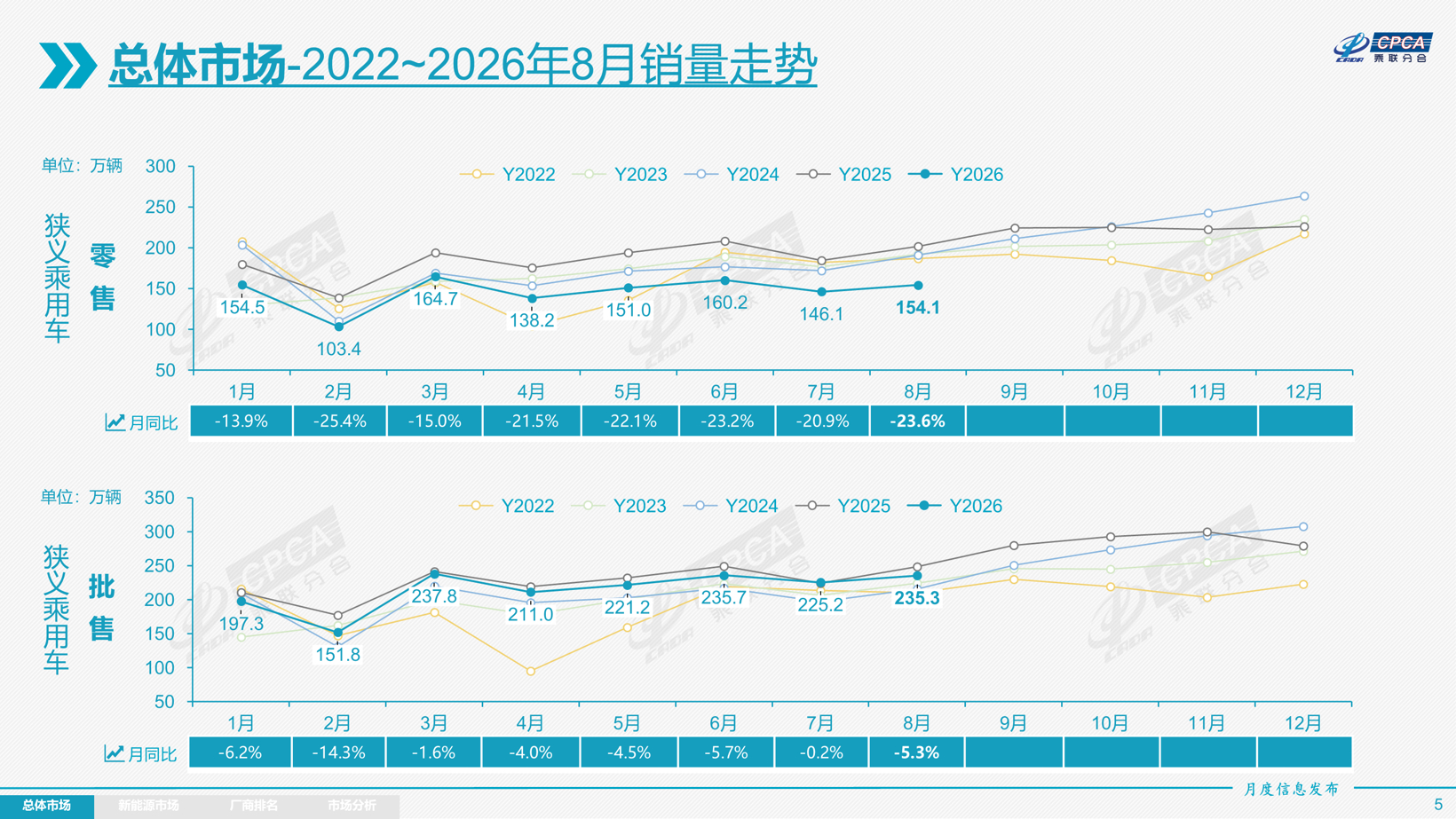
As we analyze the latest automotive retail figures from the China Passenger Car Association (CPCA) for August 2026, one macroeconomic reality stands absolute: China NEV market penetration is no longer just a future projection, but the dominant market force. The traditional internal combustion engine (ICE) sector is experiencing a structural contraction, while New Energy Vehicles (NEVs) continue their aggressive expansion, fundamentally redefining the competitive landscape of the world's largest automotive market.
August 2026 Market Breakdown: The 'Hot' and 'Cold' Realities
The CPCA data reveals a stark divergence in the Chinese automotive landscape. While overall passenger vehicle retail numbers show steady volume consolidation, the underlying dynamics tell a story of rapid technological substitution. Traditional joint-venture (JV) brands, which historically relied on ICE platforms, are facing localized demand challenges, prompting a rapid pivot toward strategic technology integration with domestic innovators.
| Market Segment (August 2026) | YoY Growth / Market Share | Strategic Outlook |
|---|---|---|
| New Energy Vehicles (NEVs) | Domestic retail share exceeding 53% | Driven heavily by plug-in hybrids (PHEVs) and extended-range electric vehicles (EREVs). |
| Traditional ICE Vehicles | Double-digit contraction YoY | Facing intense price competition and structural residual value depreciation. |
| Automotive Exports | Strong growth in South American & ASEAN regions | Transitioning towards localized regional manufacturing footprints to optimize regional supply chains. |
Why the China NEV Market Penetration is Accelerating
1. Vertical Integration and Cost Parity
Chinese OEMs have achieved remarkable cost-efficiency through deep vertical integration—especially in battery chemistry (such as advanced LFP technologies) and software-defined architectures. This integration allows NEVs to be priced at parity with, or even lower than, legacy ICE equivalents, eliminating the financial barrier for mainstream buyers.
2. Cross-Border Collaboration and Localized Alliances
Rather than withdrawing from the market, global legacy OEMs are engaging in active cross-border collaboration. By leveraging global supplier expertise and forming deep strategic alliances with Chinese technology firms, Western brands are co-developing localized platforms specifically tailored for the highly demanding Chinese consumer base. This shift toward strategic sourcing alliances highlights a mutual recognition of technology and manufacturing strengths.
Global Implications for Investors and OEMs
For Western investors, the structural shift in China highlights a critical market indicator: companies that fail to master localized software ecosystems and rapid development cycles risk losing ground. The global automotive sector is shifting away from simple export-led strategies toward localized regional footprints and supply chain compliance. Many Western automakers are successfully adopting 'In China, For China' sourcing models, which not only ensures alignment with localized standards but also provides invaluable R&D insights that can be integrated into their global product lines.