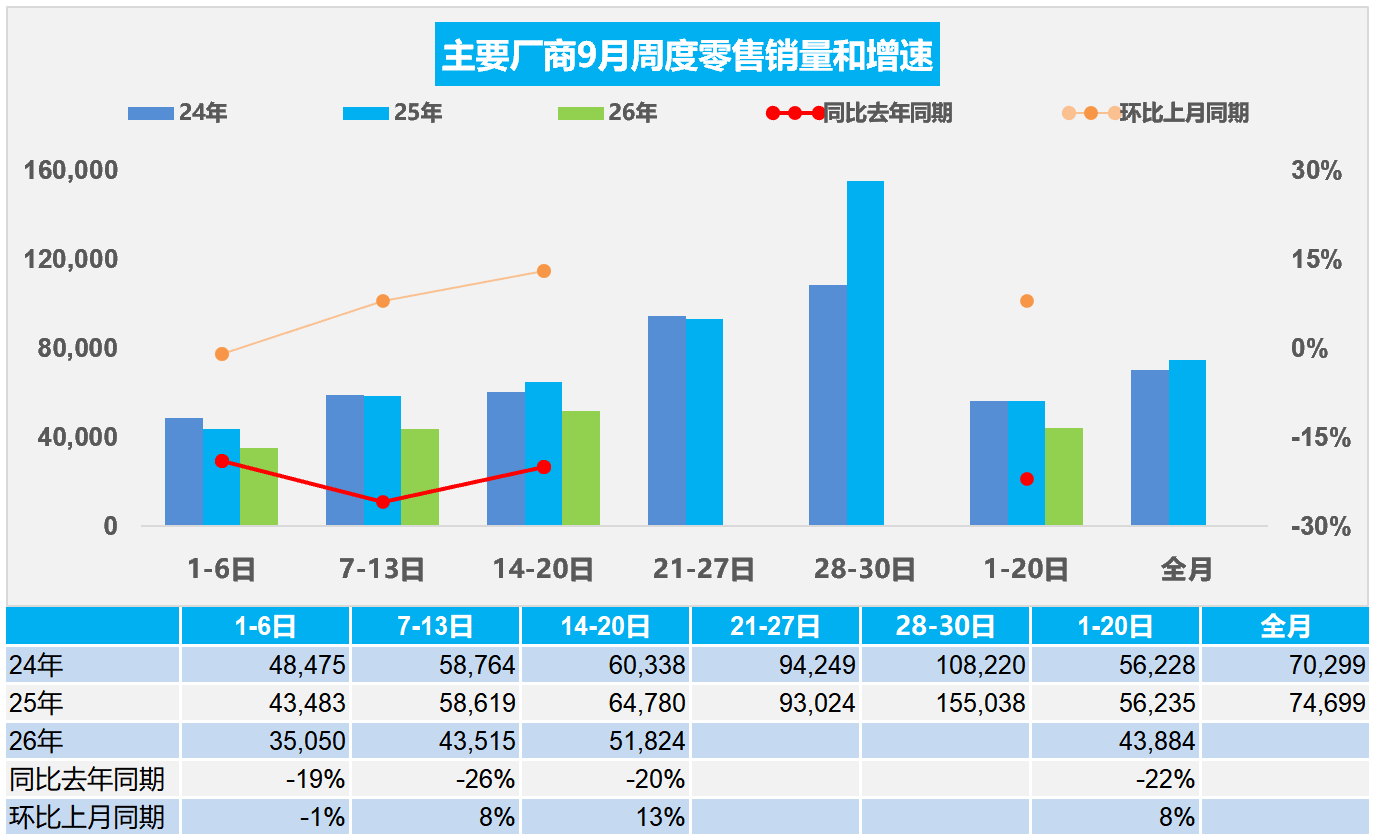
China's automotive sector has entered an unprecedented phase of structural recalibration. For decades, the industry relied on the traditional autumn buying surge—domestically celebrated as 'Golden September, Silver October' (金九银十)—to deliver the peak volume that offsets mid-year seasonal lulls and cements full-year margin targets. However, preliminary weekly retail telemetry from the China Passenger Car Association (CPCA / 乘联分会) paints a drastically different picture for early autumn 2026. Across the September 1–20 reporting window, nationwide retail sales of passenger vehicles reached 878,000 units, recording a sharp 22% year-on-year drop and highlighting an abrupt divergence between factory output and end-user retail conversion.
To understand the gravity of an 878,000-unit retail figure during a period traditionally earmarked for peak showroom traffic, one must look at the structural history of China's automotive cycle. Over the past three years, the domestic sector underwent an aggressive price rationalization initiated by high-scale electric vehicle (EV) leaders, forcing internal combustion engine (ICE) joint ventures and emerging New Energy Vehicle (NEV) startups into a perpetual race to lower sticker prices. While previous waves of price cuts stimulated volume, the latest CPCA data signals that price elasticity is flattening. Consumers are postponing big-ticket acquisitions, waiting for anticipated price floor stabilization and broader rollouts of advanced 800V silicon-carbide powertrains and end-to-end autonomous driving software stacks.
Technical Architecture & Deep Engineering Teardown
The macroeconomic retail contraction of 22% cannot be viewed in isolation from the accelerating technical evolution of vehicle architectures. As the overall passenger vehicle pie shrinks temporarily, the internal share held by NEVs continues to undergo extreme technological churn. Consumers are no longer satisfied with simple cabin digitalization; demand has bifurcated toward ultra-high-voltage charging infrastructures and cost-effective extended-range electric vehicle (EREV) configurations that eliminate thermal and range anxiety at a low bill-of-materials footprint.
Pure electric architectures in the 150,000 to 250,000 RMB ($21,000 to $35,000 USD) volume heartland are moving rapidly from legacy 400V distributed setups to unified 800V high-voltage platforms equipped with third-generation Silicon Carbide (SiC) power MOSFETs. The technical transition yields a 4% to 8% overall powertrain efficiency gain, reducing inverter switching losses and enabling sustained 4C to 5C fast charging. This technology allows a 10% to 80% State of Charge (SoC) replenishment in under 12 minutes when paired with Megawatt-class liquid-cooled dispensers. Vehicles stuck on 400V systems running older IGBT power modules have seen their inventory days expand rapidly, driving the bulk of the retail slowdown.
Simultaneously, the competitive baseline for intelligent driving stacks has shifted. In 2024 and 2025, highway navigation-on-autopilot (NOA) was considered a premium differentiator. By late 2026, urban point-to-point NOA governed by multi-modal end-to-end (E2E) vision-language-action (VLA) AI models has become a mandatory consumer expectation in the sub-200,000 RMB bracket. Vehicles lacking at least 200 to 500 TOPS of localized inference silicon (driven by platforms like Nvidia Drive Orin-X, Horizon Robotics Journey 6, or in-house bespoke ASICs) are facing acute residual value depreciation on dealership lots.
| Metric / Architecture | BYD Seal EV / Han EV (e-Platform 3.0 Evo) | Tesla Model 3 (Highland RWD) | Zeekr 007 / 001 (SEA Platform) | VW ID.4 Crozz (MEB Architecture) |
|---|---|---|---|---|
| Nominal System Voltage | 800V High-Voltage SiC | 400V Silicon IGBT / SiC hybrid | 800V Full SiC Architecture | 400V Silicon IGBT Architecture |
| Battery Chemistry & Pack | CTB LFP Blade Battery (61.4 - 82.5 kWh) | Prismatic LFP (60.0 kWh) | Golden Brick LFP / Qilin NMC (75 - 100 kWh) | NMC 622 Pouch/Prismatic (84.8 kWh) |
| Peak Charging C-Rate | 3.5C - 4.5C (Dual-gun boost) | 2.5C (Supercharger V3) | 4.5C - 5.5C (V3/V4 Extreme Fast) | 1.5C (Max ~135 kW peak) |
| Compute Benchmarks (TOPS) | 84 - 508 TOPS (God's Eye / Orin-X) | ~720 TOPS (HW4 / FSD Computer) | 508 TOPS (Dual Orin-X) | ~30 TOPS (Travel Assist 2.5) |
| China Retail Pricing (RMB / USD equiv.) | 179,800 RMB (~$25,300) | 231,900 RMB (~$32,600) | 209,900 RMB (~$29,500) | 193,900 RMB (~$27,300) |
| Thermal Management | Integrated Heat Pump with direct cell cooling | Octovalve unified thermal loop | Integrated micro-channel heat pump | PTC Auxiliary Heater + standard loop |
As illustrated in the comparative teardown above, the divergence between modernized 800V architectures and legacy 400V offerings explains why specific market segments are drying up faster than others. Domestic buyers are actively penalizing architectures that rely on external charging boosters or lack natively integrated cell-to-body (CTB) battery integration, rendering traditional inventory exceptionally difficult to clear without substantial dealer subsidies.
Supply Chain Dynamics & Bill of Materials (BOM) Economics
The upstream supply chain is directly feeling the reverberations of this 22% early-September retail contraction. China's Tier-1 and Tier-2 automotive suppliers have operated on tight working capital cycles designed for sustained double-digit production volume growth. When end-market retail drops during what should be the year's peak purchasing cycle, the ripple effects tear through gigafactory schedules, battery cell spot pricing, and Tier-1 shipment quotas.
Lithium Iron Phosphate (LFP) cell prices, which hovered near 0.6 RMB per watt-hour in early 2024, have stabilized in the range of 0.33 to 0.38 RMB per watt-hour ($46 to $53 per kWh) at the pack level for volume players like CATL, FinDreams (BYD), and CALB. This structural battery economics advantage creates a BOM cost delta of roughly 28% to 35% compared to North American or European battery assembly hubs. However, when factory run-rates drop due to muted retail orders, cell manufacturers are forced to temper capacity utilization rates. To maintain unit margins, battery majors are increasingly reserving their top-tier, ultra-fast charging cell lines (such as CATL's Shenxing Plus and FinDreams' second-generation Blade) for high-margin domestic flagships and overseas export consignments, leaving standard prismatic formats vulnerable to excessive discounting.
Furthermore, Tier-1 system suppliers—ranging from Horizon Robotics and Hesai (LiDAR) to Fuyao Glass and Tuopu Group (chassis structural giga-castings)—are navigating aggressive cost-down mandates. In an attempt to preserve operating margins in a contracting domestic market, OEMs are demanding annual component price reductions exceeding 10% to 15%. This squeeze has accelerated the shift toward single-box integrated braking systems, multi-in-one electric drive assemblies, and cross-domain compute controllers that consolidate autonomous driving, digital cockpit, and body controls into a singular system-on-chip (SoC) architecture, carving out hundreds of dollars in harness and connector BOM expenses.
Western Legacy OEM Impact & Competitive Fallout
While domestic Chinese EV startups and vertically integrated champions are feeling margin strain from the September retail drop, the impact on Western legacy joint ventures (JVs)—including Volkswagen Group, General Motors, Stellantis, and Toyota—is structurally more severe. Historically, Sino-foreign JVs captured over 60% of their annual net operating profit from internal combustion and entry-level luxury sales in Greater China. The 22% drop in early September retail indicates that consumer fatigue is hitting foreign-branded ICE vehicles at a catastrophic rate.
In key tier-2 and tier-3 Chinese cities, where legacy brands previously held defensible dealer network moats, showroom traffic for conventional gasoline-powered sedans and SUVs has plummeted. With overall NEV retail penetration consistently crossing the 50% threshold on a nationwide monthly basis, any general contraction in the total passenger vehicle pool accelerates the insolvency risk of legacy franchised dealership groups. Dealers are saddled with high flooring-plan interest rates and 60-to-90-day inventory backlogs of internal combustion models that can only be liquidated at negative gross margins.
Consequently, Western legacy OEMs are facing severe asset impairment risks across their Chinese assembly footprint. Production lines built for high-volume gasoline vehicle manufacturing are operating at capacity utilization figures estimated well below 45%. To stem financial bleeding, European and American automakers are fundamentally altering their strategic positioning. Rather than attempting to maintain market share at all costs via unprofitable price wars, legacy manufacturers are rationalizing their footprint, restructuring JVs, and reorienting their surviving Chinese engineering centers into global export nodes and localized software R&D hubs designed to serve emerging markets in Southeast Asia and Latin America.
Geopolitical, Tariff & Regulatory Adaptation
With domestic retail demand exhibiting cyclical exhaustion and intensifying price friction, Chinese automotive conglomerates are urgently pivoting their growth capital toward international trade. However, this global push intersects directly with elevated geopolitical tensions, evolving regulatory frameworks, and shifting tariff structures across major trading blocs.
In the European Union, the implementation of anti-subsidy countervailing duties—layered on top of the baseline 10% import tariff—has fundamentally reshaped the economics of purely export-driven growth models. Similarly, the United States has solidified prohibitive Section 301 tariffs on Chinese-manufactured electric vehicles and lithium-ion batteries. In response to these trade measures, Tier-1 Chinese OEMs have moved past simple direct shipping strategies, executing compliant, localized industrial footprints designed to adhere strictly to regional value-add and rules-of-origin mandates.
Rather than seeking trade loopholes, leading players are actively investing in local manufacturing infrastructure. Strategic hub investments in Hungary, Spain, Turkey, Thailand, and Brazil are establishing localized stamping, welding, battery pack integration, and final assembly operations. By committing capital to European and ASEAN industrial zones, these manufacturers create regional employment, comply with domestic content regulations, and insulate their foreign business lines from unilateral border carbon or anti-subsidy adjustments. Furthermore, strategic cross-border joint ventures and technology-licensing frameworks—such as zero-emission powertrain sourcing alliances and software integration partnerships with established global brands—are emerging as standard instruments for sustained, compliant international expansion.
3-5 Year Strategic Market Outlook & Scenario Analysis
The 22% retail decline recorded by the CPCA in early September 2026 marks a turning point in China's automotive trajectory. The market is exiting its unconstrained hyper-growth era and transitioning into a mature, capital-intensive consolidation cycle. Over the next three to five years, the industry will likely diverge across three distinct paths.
Bull Case Scenario
In this scenario, the early-September dip proves to be a transitory correction caused by consumer anticipation of national trade-in subsidy updates and Q4 model line launches. Domestic retail volumes recover as macroeconomic stimulus measures take effect, stabilizing passenger car sales at a baseline 2% to 4% annual expansion. Chinese OEMs successfully deploy unified 800V architectures at sub-150,000 RMB price points, driving NEV penetration beyond 65% domestically. Concurrently, localized gigafactories in Central Europe, Southeast Asia, and South America come online on schedule, absorbing domestic supply chain output and generating sustained, high-margin export earnings that shield parent groups from domestic pricing friction.
Base Case Scenario
Domestic passenger vehicle retail growth plateaus, hovering between -2% and +1% annualized growth through 2029. The fierce price war settles into a grinding war of attrition, resulting in the orderly bankruptcy, acquisition, or restructuring of 5 to 8 marginal domestic EV startups and legacy joint-venture brands. NEV penetration steadily climbs to 60%, driven primarily by low-cost EREV platforms and LFP-based compact urban models. Overseas localized assembly operations progress steadily but encounter minor regulatory, supply chain integration, and labor onboarding frictions, yielding modest single-digit international market share gains while preserving core corporate liquidity.
Bear Case Scenario
Prolonged consumer spending conservatism deeply affects big-ticket durable goods in China, leading to sustained multi-year contractions in passenger vehicle retail sales. Tier-1 battery and component overcapacity triggers systemic deflation across the domestic automotive supply chain, driving gross vehicle margins to near-zero levels across all volume segments. Stricter regional supply chain compliance rules, tightening rules-of-origin audits, and escalating trade barriers across North America, Europe, and select emerging economies slow global expansion plans. OEMs face severe capital expenditure write-downs on unutilized domestic manufacturing facilities, forcing major state-owned and private automotive groups to seek extensive state-led restructuring programs.
Strategic Implications for Executives & Institutional Investors
For global automotive executives, procurement leadership, and institutional equity analysts tracking mobility markets, the early autumn retail contraction delivers definitive strategic takeaways:
- Re-evaluate Price Elasticity Assumptions: The 22% year-on-year retail drop demonstrates that continuous price cuts are no longer yielding proportional sales volume increases in mainland China. Financial models that assume infinite demand elasticity must be recalibrated downward to account for consumer saturation and platform obsolescence.
- Monitor 800V and E2E Software Deprecation Cycles: Inventory holding legacy 400V electrical architectures and fragmented ADAS compute stacks represents acute balance-sheet risk. Sourcing teams and investors must audit OEM portfolios to ensure rapid transition to integrated 800V SiC and end-to-end multi-modal autonomous architectures that meet current consumer benchmarks.
- Anticipate Accelerating Export Diversification: With the domestic market entering a consolidation squeeze, Chinese OEMs will allocate disproportionate capital to overseas markets. Western legacy OEMs must prepare for intensified competition not merely within China, but across key third-party battlegrounds including Europe, Southeast Asia, the Middle East, and Latin America.
- Audit Supply Chain Working Capital Health: The structural margin squeeze exerted on Tier-1 and Tier-2 component suppliers creates solvency and operational continuity risks. Procurement directors should conduct rigorous stress-testing on China-based single-source vendors, assessing debt maturity profiles, working capital reserves, and capacity utilization ratios.