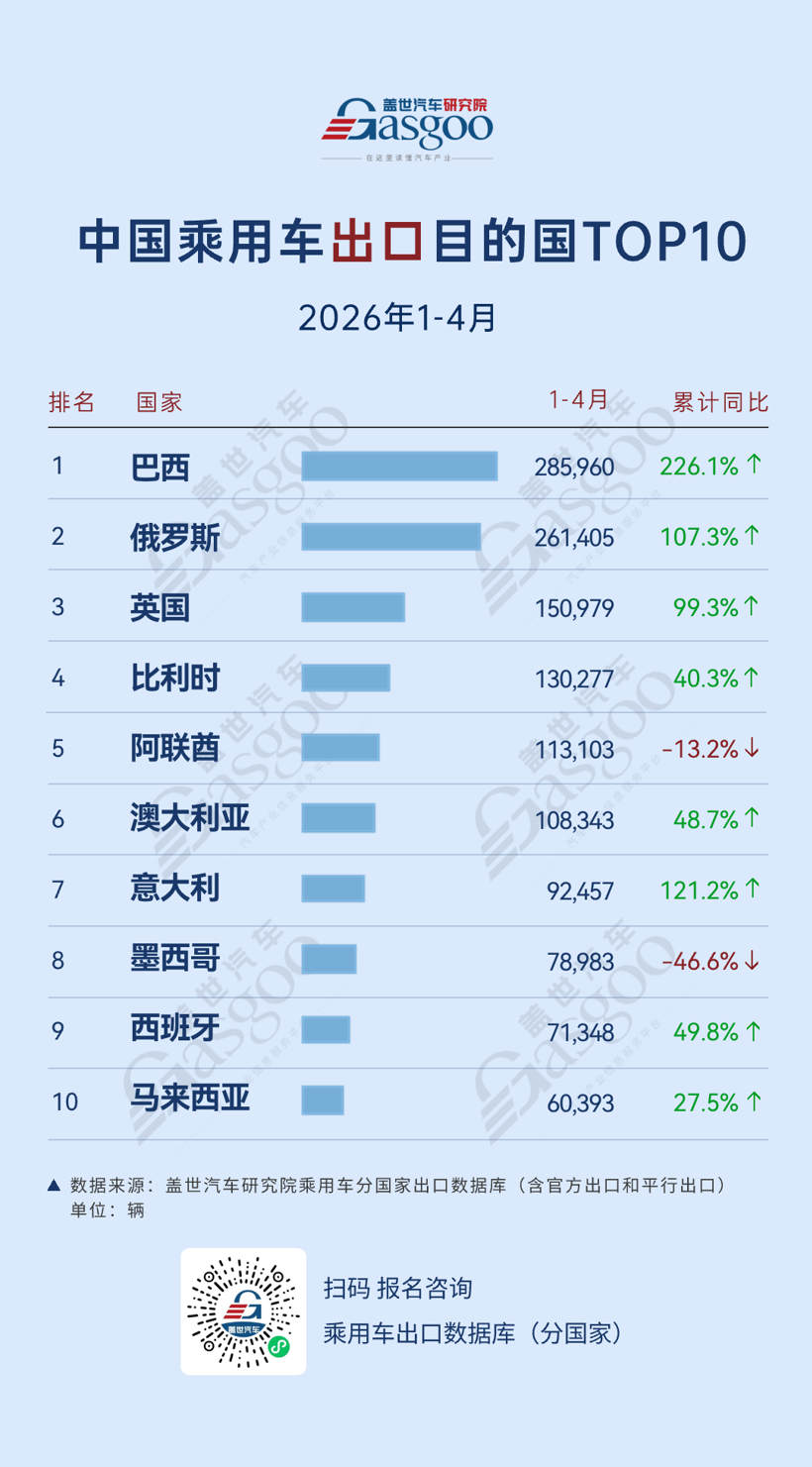
As the global automotive landscape undergoes its most volatile transition in decades, the latest data for China EV export markets 2026 reveals a dramatic restructuring of trade flows. For Western investors and auto executives watching the 'China-speed' expansion, the first four months of 2026 have shattered previous assumptions. Rather than retreating under the weight of geopolitical friction and looming Western tariffs, Chinese OEMs are executing a highly coordinated, multipolar pivot.
The Great Pivot: Brazil Overtakes Russia as the New Gateway
For the past two years, Russia served as a massive, low-friction market for Chinese combustion engine vehicles. However, the dynamics of China EV export markets 2026 have shifted the gravity southward. Brazil has officially overtaken Russia as the leading destination for overall Chinese passenger car exports, registering a staggering 286,000 units—a YoY explosion of 226.1%.
In the New Energy Vehicle (NEV) sector specifically, Brazil is virtually peerless. Importing 218,000 NEVs (+220.9% YoY) from January to April, Brazil has established itself as the primary proving ground for Chinese mass-market EVs. Driven by aggressive localization plays from giants like BYD—who are currently accelerating their manufacturing footprint in Camaçari—and Great Wall Motor (GWM), Brazil acts as both a high-volume consumer and a strategic Latin American hub to bypass future regional trade barriers.
Europe Under Siege: Triple-Digit Surges in Traditional Powerhouses
The most shocking revelation in the 2026 data is the sheer velocity of Chinese NEV penetration into the heart of Europe. Despite the European Union's aggressive regulatory scrutiny and tariff investigations, European countries occupied five of the top ten destinations for Chinese NEVs in early 2026.
Western auto OEMs should be deeply concerned by the following growth rates:
- Germany: Grew by 295.0% YoY, signaling that even the home of Volkswagen and Mercedes-Benz is rapidly absorbing cost-competitive Chinese imports.
- Italy: Skyrocketed by an astonishing 460.7% YoY, driven by a domestic demand shift toward affordable electrification.
- United Kingdom & Spain: Maintained high-double and triple-digit growth trajectories.
This surge represents a pre-emptive volume push. Chinese OEMs are racing to flood the European market and establish consumer mindshare before more stringent tariff regimes are fully enacted. Furthermore, it highlights a stark reality: European consumers are prioritizing cost-to-spec value over traditional brand loyalty.
Data Breakdown: Core China EV Export Markets 2026
The transition from a unipolar reliance on a few friendly markets to a multipolar global network is clear in the numbers:
| Destination Country | Vehicle Segment | Volume (Jan-Apr 2026) | YoY Change | Strategic Role |
|---|---|---|---|---|
| Brazil | Passenger Cars (Total) | 286,000 units | +226.1% | New #1 overall market; Latin American manufacturing hub. |
| Brazil | NEV (New Energy Vehicles) | 218,000 units | +220.9% | Dominant global destination for Chinese EVs. |
| Germany | NEV | Top 10 Tier | +295.0% | Aggressive penetration into Europe's largest auto market. |
| Italy | NEV | Top 10 Tier | +460.7% | Explosive growth despite protectionist rhetoric. |
Strategic Implications: De-risking via Multipolar Expansion
Why are we seeing declines in previous strongholds like Mexico and the UAE? The answer lies in geopolitical de-risking. As the US puts pressure on Mexico to limit Chinese automotive influence, forward-thinking Chinese OEMs are shifting focus toward South America (Brazil) and APAC (South Korea and Australia, both showing triple-digit gains).
For Western investors, the takeaway is clear: do not underestimate the agility of Chinese EV supply chains. When one door closes, three others open at 'China-speed.' This strategy is no longer about raw export volume; it is a highly coordinated play combining early market penetration with parallel localized assembly strategies (such as BYD's upcoming Hungarian plant and SAIC's European site scouting).
To capture Alpha in the automotive sector, market analysts must monitor these structural shifts in real-time, focusing less on regional policy statements and more on actual port-of-entry shipment data.