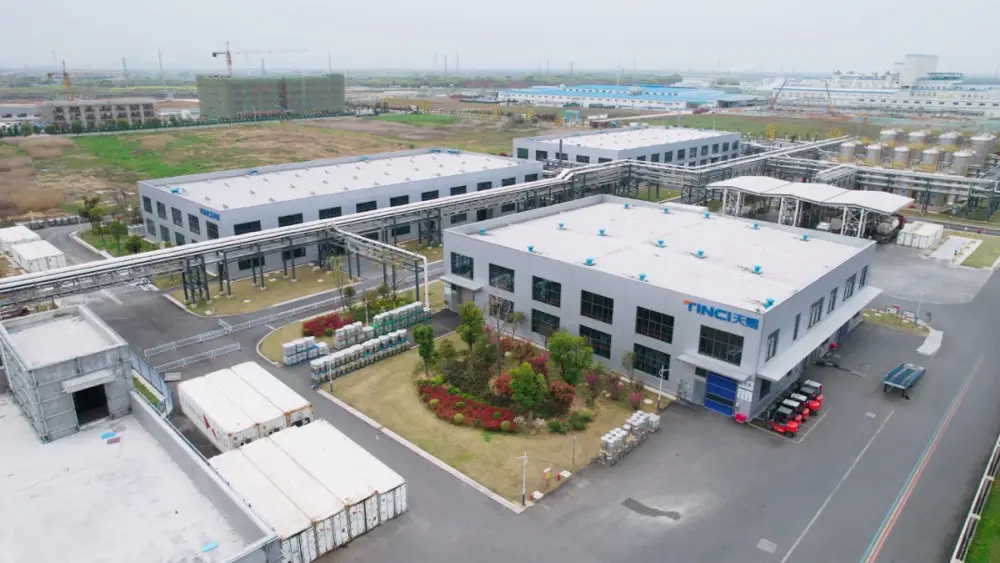
As Western automotive manufacturers scramble to build localized, inflation-resistant battery gigafactories, developments in the China EV battery electrolyte market continue to redefine the economics of scale. On June 2, 2026, Jiujiang Tinci, a wholly-owned subsidiary of global electrolyte giant Guangzhou Tinci Materials Technology, executed a massive scale-up of its supply agreement with Chuoneng New Energy. This strategic pivot highlights the massive scale gap that Western OEMs and Tier 1 suppliers face in establishing cost-parity.
The Scale of the Deal: 1.01 Million Tons of Electrolytes
Under the terms of the newly signed supplementary agreement, Jiujiang Tinci will supply Chuoneng New Energy with a cumulative total of no less than 1.01 million tons of electrolyte products. This represents a staggering 460,000-ton increase from the original contract, which targeted a minimum of 550,000 tons. The agreement remains valid through December 31, 2030.
To put 1.01 million tons of electrolyte into perspective: depending on the specific cell chemistry (typically LFP or high-nickel NCM), 1 GWh of battery capacity requires roughly 1,000 to 1,200 tons of electrolyte. This single contract is therefore capable of supporting approximately 800 GWh to 1 TWh of battery production over the next four years. This is equivalent to powering over 10 million premium electric vehicles.
Why This Matters to Western Gigafactories & Investors
As an analyst monitoring the global battery value chain, this deal exposes three critical pain points for Western automotive players:
- The Cost Advantage Paradox: Electrolytes comprise a significant portion of a battery's material cost. Tinci's massive production capacity allows it to leverage upstream integration (specifically in LiPF6 manufacturing), reducing margins to levels Western chemical firms cannot currently match.
- Chuoneng's Dual Focus (EV + ESS): Chuoneng New Energy is not just an EV battery player; they are aggressively scaling in the energy storage system (ESS) market. LFP-based grid storage requires incredibly cheap, highly stable electrolyte formulations—a segment where China currently holds a near-monopoly.
- Rapid Execution ('China-Speed'): While Western gigafactories grapple with regulatory hurdles, permitting, and feedstock delays, Chinese players are casually scaling existing agreements by hundreds of thousands of tons.
A Comparison of the Tinci-Chuoneng Partnership
The following table outlines the drastic scale-up of this strategic partnership, highlighting the aggressive capacity growth expected by both firms:
| Metric / Term | Original Agreement | Revised Supplementary Agreement | Net Change / Impact |
|---|---|---|---|
| Total Supply Volume | Min. 550,000 tons | Min. 1,010,000 tons (1.01M tons) | +460,000 tons (+83.6%) |
| Contract Expiration | December 31, 2030 | December 31, 2030 | Unchanged (Increased intensity per year) |
| Estimated GWh Supported | ~450-500 GWh | ~800-1,000 GWh | Enables massive utility-scale ESS & EV rollout |
Strategic Implications for the Global EV Market
For Western OEMs seeking to decouple from the Chinese supply chain, this transaction illustrates the steep uphill battle ahead. Electrolytes are highly sensitive to moisture and temperature, meaning shipping them transoceanically is expensive and logistically complex. Consequently, localized battery production requires localized chemical plants. However, without the colossal demand pools enjoyed by players like Tinci and Chuoneng, Western chemical companies will struggle to justify the massive capital expenditure required to build competitive localized facilities.
For strategic investors, the takeaway is clear: China's dominance in the upstream EV supply chain is not just about raw mining; it is about chemical processing scale. The 'China EV battery electrolyte market' remains the anchor of global battery pricing power.