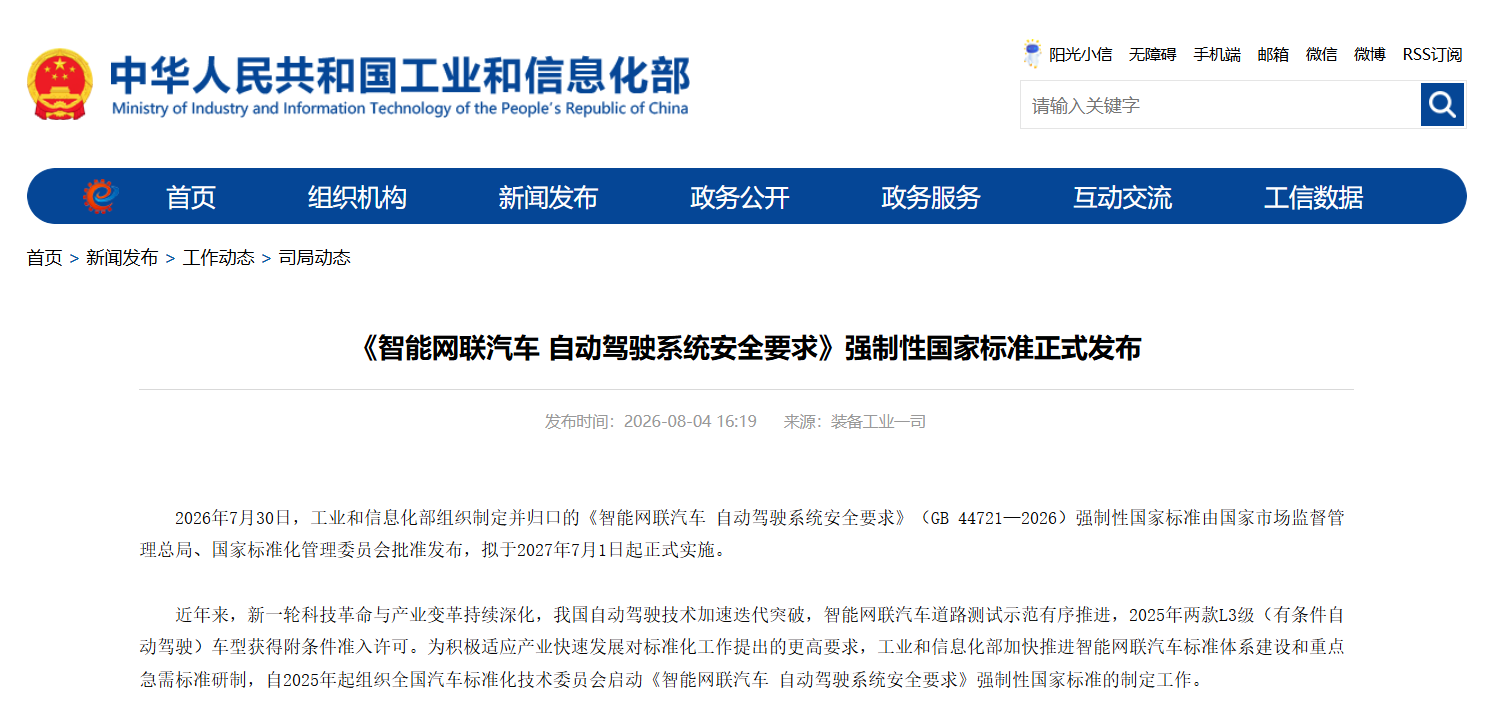
China Autonomous Driving Safety Standards: Analyzing the New 2027 Mandatory National Policy
The global race for autonomous vehicle supremacy just hit a massive regulatory milestone. The State Administration for Market Regulation (SAMR) and the Standardization Administration of China (SAC) recently approved the mandatory national standard, 'Safety Requirements for Autonomous Driving Systems of Intelligent and Connected Vehicles'. Designed to regulate Level 3 (L3) and Level 4 (L4) systems, this landmark policy establishes clear China autonomous driving safety standards that will become fully mandatory on July 1, 2027.
A Structural Shift for the World's Largest EV Market
As a Shanghai-based automotive policy analyst tracking smart mobility transitions, I view this national standard not just as another regulatory hurdle, but as the foundational framework that will accelerate safe L3 and L4 commercialization. Until now, autonomous driving tests in China operated under localized pilot programs (such as the Shenzhen and Beijing robotaxi zones). This national standard consolidates these regional rules into a single, uniform national mandate, clearing the path for mass market adoption.
By defining exactly how an autonomous vehicle must behave during system failures, transition demands, and extreme weather, the Ministry of Industry and Information Technology (MIIT) is providing global automakers—from Tesla with its planned FSD rollouts to European premium brands—with a precise roadmap for strategic compliance in the Chinese market.
Core Requirements of the New National Standard
The standard mandates comprehensive fail-safes across several operational domains. Below is a structured breakdown of the critical technical criteria that systems must satisfy before deployment:
| Technical Area | Mandatory Requirement | Strategic Objective |
|---|---|---|
| Operational Design Domain (ODD) | Continuous monitoring of environmental and operational limits; system must detect when it is exiting its safe domain. | Prevents sudden, unsafe system disengagements in unmapped or complex urban scenarios. |
| Minimal Risk Maneuver (MRM) | Vehicle must execute a safe, automated stop if the driver fails to take over after a takeover transition request. | Ensures vehicle safety in the event of driver incapacitation or unresponsive transitions. |
| Human-Machine Interaction (HMI) | Clear visual, auditory, or haptic signals determining who is in control (human vs. system) at any given moment. | Minimizes driver confusion regarding operational responsibility. |
| Data Recording & Security | Continuous logging of vehicle telemetry, sensor inputs, and handover states pre- and post-accident. | Ensures structural data compliance and aids in clear liability determination. |
Global Implications: Strategic Tech Integration and Compliance
For Western OEMs aiming to maintain market share in China, complying with these upcoming China autonomous driving safety standards is a top priority. Rather than viewing this as a barrier, leading automakers are approaching it through the lens of strategic technology integration and localized collaborative ecosystems.
To successfully integrate their advanced driver-assistance systems (ADAS) within Chinese borders, global players are increasingly establishing strategic sourcing alliances with domestic tech giants and localization partners. This cross-border technology collaboration allows international brands to leverage specialized regional map data and localized AI training models while ensuring total compliance with Chinese cybersecurity laws.
The Road to July 2027: A Transition Runway
The three-year implementation runway gives automakers ample time to refine their system architectures. Companies that have already invested heavily in redundant hardware (such as dual-redundant steering and braking systems) and robust localized cloud structures will find themselves at a competitive advantage when the mandate takes effect on July 1, 2027.