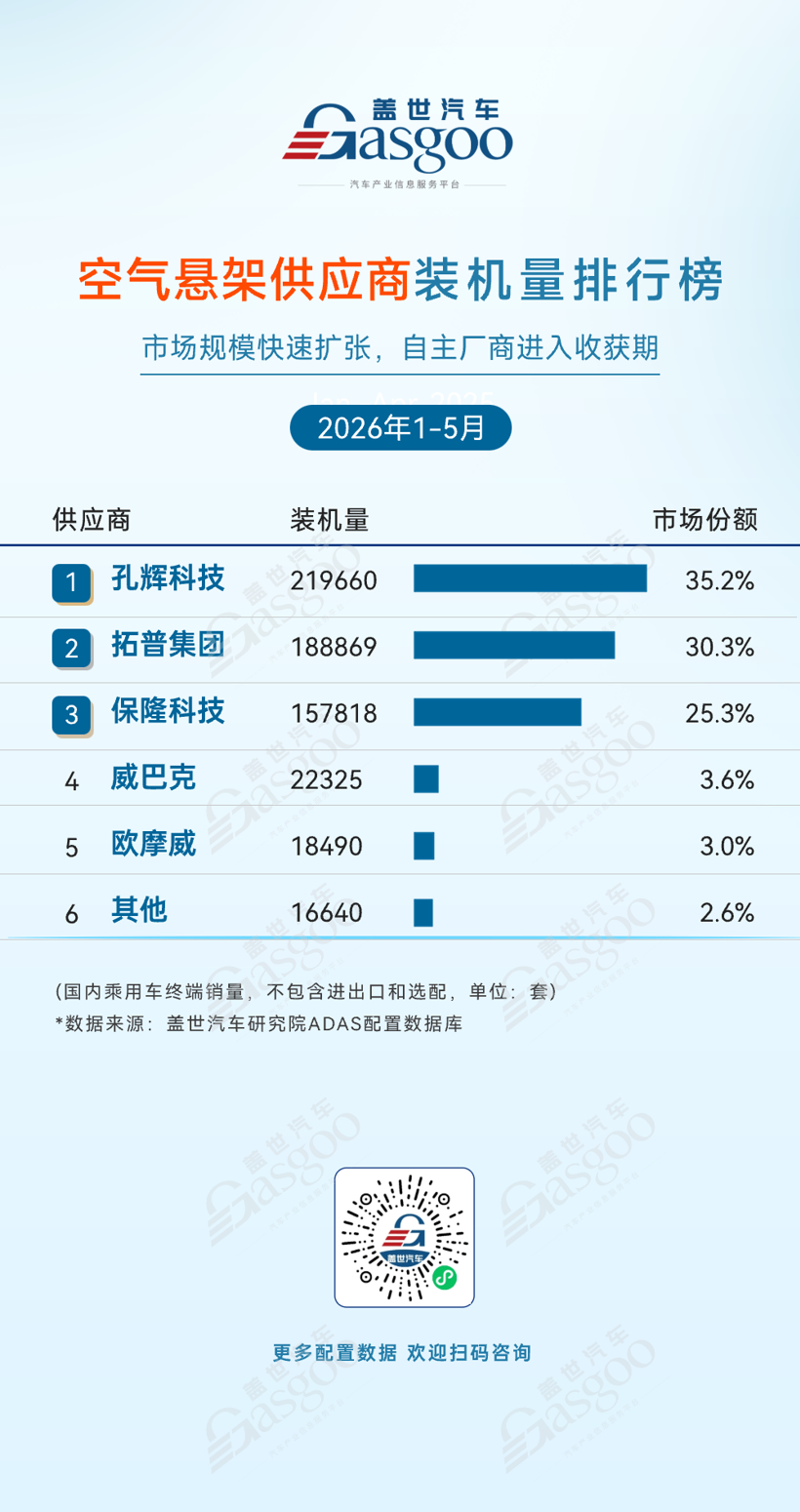
The rapid evolution of the Chinese automotive industry has reached a critical inflection point. As smart electric vehicles (EVs) dominate domestic sales, the underlying supply chain is undergoing a profound transformation. For global automotive strategists and investors, tracking the shifts in China ADAS market share is no longer just a benchmark study—it is a window into the future of global mobility. The latest data for January to May 2026 highlights a dramatic reallocation of installation volumes, with localized technology suppliers systematically gaining ground on established global Tier-1 giants.
The Strategic Pivot: Localized Dominance in China's ADAS Ecosystem
According to the latest installation volume rankings published by the Gasgoo Research Institute for the first five months of 2026, the domestic passenger vehicle core components market continues its high-speed growth trajectory. However, the most striking takeaway is the accelerated pace of domestic technology integration. Localized Chinese suppliers have claimed the top spots across multiple smart driving categories, transforming what was once a market dominated by European, American, and Japanese Tier-1 suppliers.
This structural realignment is driven by 'China-speed' development cycles. While traditional global tier-1s historically relied on global platform cycles of 3 to 4 years, Chinese ADAS specialists operate on 12-to-18-month cycles. This speed allows them to deploy generative AI, transformer-based vision models, and advanced end-to-end autonomous driving architectures directly into production vehicles ahead of global competitors.
Analyzing the 2026 Leaderboard: Key Market Segments
The transition is highly visible across various levels of Advanced Driver Assistance Systems (ADAS). While global giants maintain a legacy presence in basic L1 and L2 safety features, local innovators are sweeping the high-growth L2+ and L2++ domain controller and software stacks.
| ADAS Segment | Key Localized Leaders | Established Global Players | Primary Structural Trend |
|---|---|---|---|
| L2/L2+ Domain Controllers | Desay SV, Huawei, Joynext | Bosch, Continental, Denso | Local suppliers offer tighter silicon-to-software integration and regional customization. |
| ADAS SoC & Silicon | Horizon Robotics, Black Sesame | Mobileye, NVIDIA, TI | Rapid adoption of cost-effective local SOCs for mass-market models under $25k. |
| Perception Algorithms | Freetech, Haomo.ai, Momenta | Mobileye, Bosch | Shift toward localized BEV (Bird's-Eye-View) + Occupancy Network architectures. |
1. The Rise of Localized Domain Controllers
Domain controllers serve as the brain of modern smart cabins and driving systems. Localized suppliers like Desay SV and Huawei have managed to secure massive installation volumes because they work in tight alignment with fast-growing domestic OEMs like BYD, Geely, and Li Auto. These partnerships are characterized by strategic sourcing alliances and co-development rather than traditional transactional supply chains.
2. The Silicon Shift
In the semiconductor layer, the China ADAS market share data reveals a highly competitive landscape. Horizon Robotics has successfully positioned its Journey-series silicon as the default option for mass-market L2+ vehicles. By offering an open toolchain and superior local engineering support, they have challenged the historical dominance of legacy silicon providers.
Strategic Implications for Western OEMs and Global Suppliers
For Western OEMs operating joint ventures in China, this supplier shift presents both a challenge and an opportunity. To remain competitive in the Chinese domestic market, global brands must embrace localized technology integration. Utilizing local ADAS pipelines is no longer optional; it is a prerequisite for matching the feature-rich expectations of Chinese consumers.
Rather than viewing this transition as a threat, forward-thinking global players are engaging in strategic cross-border collaborations. By combining Western vehicle engineering excellence with highly advanced localized software stacks, global manufacturers can preserve their market presence while accelerating their own software-defined vehicle (SDV) roadmaps globally.
Conclusion: A New Era of Supply Chain Agility
The 2026 supplier rankings from Gasgoo confirm that the center of gravity for ADAS innovation has structurally diversified. As localized players top multiple segments, the global automotive supply chain must adapt to a more decentralized, agile model. For investors tracking the next wave of automotive tech leadership, keeping a close eye on the shifts in China ADAS market share is essential for identifying the next-generation global standard-setters.