In the global race to deploy L3+ autonomous driving, a quiet but seismic shift is occurring in the sensor suite. While Western OEMs grapple with the cost and complexity of high-resolution imaging radar, China's Chuhang Technology (楚航科技) has just secured a landmark production contract with a leading domestic 'new force' EV maker for its 4D satellite architecture radar. This is not just another Tier-1 win; it is a validation of a fundamentally different radar architecture that promises to disrupt the incumbent supply chain dominated by Aptiv, Continental, and Bosch.
From our analysis of Shanghai and Stuttgart supply chain telemetry, this development signals that China's ADAS sensor ecosystem has matured beyond fast-follower status. It is now setting the pace in cost-performance metrics for the critical perception layer. For Western investors and auto executives, understanding the technical and commercial implications of this contract is essential for anticipating the next wave of competitive pressure in the software-defined vehicle era.
Section 1: Executive Overview & The Market Catalyst
The catalyst for this report is Chuhang Technology's announcement that its 4D satellite architecture radar has been formally designated for production by a 'head' domestic NEV manufacturer. While the customer name remains undisclosed, industry sources point to the upper echelon of China's premium EV segment—likely NIO, Li Auto, or XPeng. This follows a multi-year trend where Chinese OEMs, facing intense domestic competition for ADAS leadership, have aggressively adopted domestically produced high-performance sensors to achieve faster iteration cycles and lower costs.
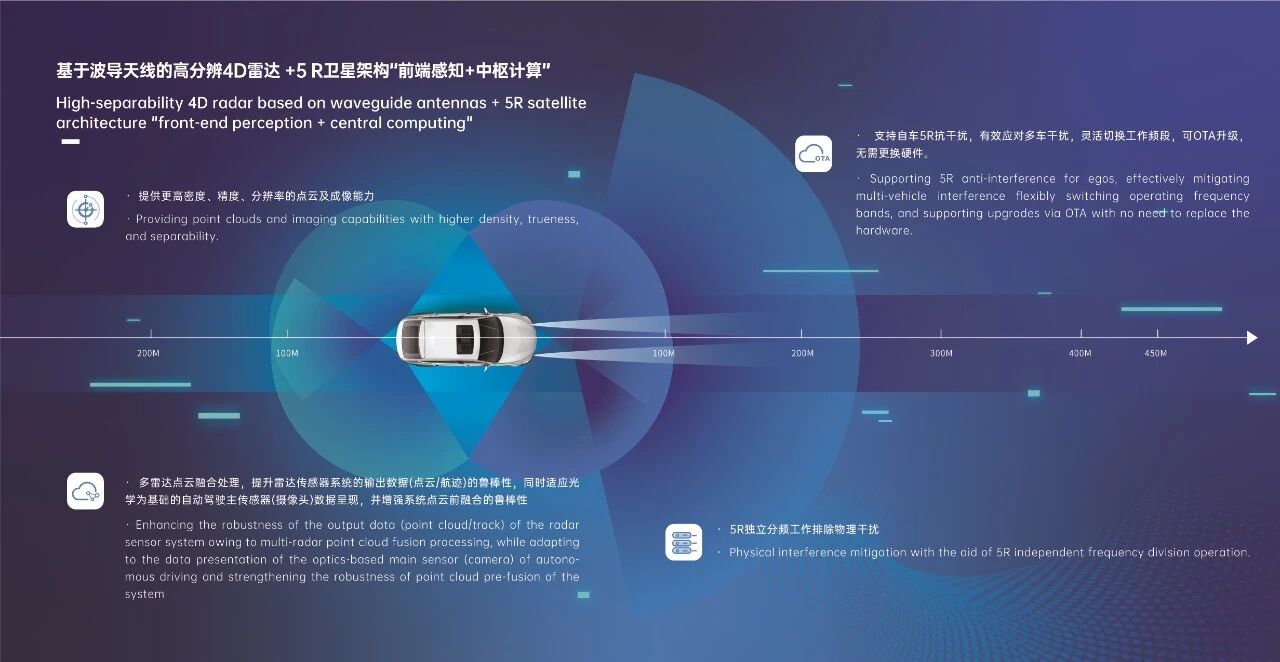
Historically, the automotive radar market has been an oligopoly. Tier-1 suppliers like Continental, Bosch, and Aptiv controlled the core RF and signal processing IP. Chinese players initially focused on low-end 24GHz and 77GHz radar for basic functions. The transition to 4D imaging radar—which adds elevation sensing to create a true point cloud—was seen as the next frontier. Chuhang's achievement is notable because it leapfrogs traditional 4D radar by decentralizing the architecture, turning each radar sensor into a 'satellite' that performs edge processing and communicates via Ethernet, rather than through a centralized domain controller. This reduces harness weight, lowers latency, and simplifies vehicle assembly.
This contract is a clear market catalyst. It confirms that Chinese OEMs are willing to bet on domestic sensor innovators for safety-critical ADAS functions. It also puts pressure on global Tier-1s to accelerate their own 4D radar roadmaps and cost-down initiatives. The ripple effects will be felt from Shanghai to Detroit to Stuttgart.
Section 2: Technical Architecture & Deep Engineering Teardown
Chuhang's '4D Satellite Architecture' represents a departure from the conventional centralized radar processing model. In a traditional setup, multiple radar sensors (front, corner, rear) stream raw data to a central ADAS domain controller (e.g., Nvidia Orin or Qualcomm Snapdragon Ride) for processing. This requires high-bandwidth cabling (often Gigabit Ethernet) and a powerful central compute unit.
In the satellite architecture, each radar unit has its own embedded processor capable of performing the full FFT and point-cloud generation locally. Only the processed object list and point cloud are transmitted to the central computer over a lower-bandwidth CAN-FD or 100 Mbps Ethernet link. This yields several advantages:
- Reduced Wiring Harness: Up to 30% weight reduction in sensor cabling, lowering BOM cost and simplifying manufacturing.
- Lower Latency: Edge processing eliminates the round-trip to the central ECU, improving reaction time for AEB and ADAS functions.
- Scalability: OEMs can add more satellite radars without overloading the central compute.
- Cost Efficiency: The satellite radar unit is optimized for high-volume production using standard CMOS RF chips and advanced packaging.
Technically, the radar operates in the 76-81 GHz band with a bandwidth of up to 4 GHz, enabling range resolution of approximately 4 cm. It uses MIMO antenna arrays with 12 transmit and 16 receive channels, yielding a virtual array of 192 channels. This provides angular resolution of about 1 degree in azimuth and 2 degrees in elevation—significantly better than legacy 3D radar (which had no elevation capability). The satellite architecture also supports over-the-air (OTA) updates for performance tuning, a critical feature for Chinese OEMs that frequently push software updates to improve ADAS capabilities.
| Feature | Chuhang 4D Satellite Radar | Continental ARS540 (4D) | Bosch 4D Radar | Aptiv FLR4 |
|---|---|---|---|---|
| Frequency Band | 76-81 GHz | 76-81 GHz | 76-81 GHz | 76-81 GHz |
| Bandwidth | Up to 4 GHz | 1 GHz | 1 GHz | 1 GHz |
| Range Resolution | ~4 cm | ~15 cm | ~15 cm | ~15 cm |
| Angular Resolution (Azimuth) | ~1° | ~2° | ~2° | ~2.5° |
| Elevation Capability | Yes (2° resolution) | Yes (4° resolution) | Yes (4° resolution) | Yes (5° resolution) |
| Architecture | Satellite (edge processing) | Centralized (raw data to ECU) | Centralized (raw data to ECU) | Centralized (raw data to ECU) |
| Data Interface | 100 Mbps Ethernet | Gigabit Ethernet | Gigabit Ethernet | Gigabit Ethernet |
| Typical Unit Cost (est.) | $80-120 | $150-200 | $150-200 | $200-250 |
Section 3: Supply Chain Dynamics & Bill of Materials (BOM) Economics
Chuhang Technology is a Nanjing-based company founded in 2018, with a focus on millimeter-wave radar. Its rise reflects the broader localization of China's ADAS supply chain. The key Tier-1 suppliers for this satellite radar include:
- RF Chips: Likely sourced from Chinese fabless companies like Calterah (加特兰) or from global players like NXP and Infineon. Calterah's 77GHz CMOS radar SoC is a strong candidate for cost-sensitive applications.
- Baseband Processing: Custom ASIC or FPGA from domestic suppliers such as Goke or from Xilinx (now AMD). The satellite architecture reduces the need for high-end FPGAs, shifting to lower-cost MCUs with DSP extensions.
- Antenna Substrate: Advanced PCB materials from Rogers or domestic equivalents, with antenna-in-package (AiP) technology to reduce size.
- Housing & Connectors: Tier-2 suppliers like Fuyao Glass (for radome) and local connector makers.
The BOM cost advantage is striking. A traditional 4D radar from a Western Tier-1 costs approximately $150-200 per unit in high volume. Chuhang's satellite radar, with its simplified architecture and localized components, is estimated at $80-120. This 30-40% cost delta is structural, driven by:
- Vertical Integration: Chuhang designs its own RF front-end and antenna, reducing IP licensing fees.
- Localized Supply Chain: Proximity to Chinese semiconductor and PCB suppliers reduces logistics and tariff costs.
- Scale: China accounts for over 50% of global NEV production, providing massive volume for domestic sensor makers.
- Simplified Architecture: The satellite design eliminates the need for expensive high-speed connectors and shielded cables, further cutting costs.
This cost advantage allows Chinese OEMs to deploy 4D radar across a broader range of vehicles, from premium to mid-market, accelerating the democratization of L3+ ADAS features. Western Tier-1s, already facing margin pressure, must respond with their own cost-down initiatives or risk losing significant share in the world's largest auto market.
Section 4: Western Legacy OEM Impact & Competitive Fallout
The immediate impact of this contract is on the competitive dynamics within China. Western OEMs like Volkswagen, GM, and Toyota are already struggling to keep pace with Chinese NEV makers in ADAS features. The adoption of cost-effective, high-performance domestic radar by Chinese OEMs widens the gap. For example, a BYD or Li Auto model can offer L2+ ADAS with 4D radar as standard, while a comparable VW ID. series may only offer 3D radar or rely on camera-heavy systems.
This margin pressure is compounded by the fact that Western OEMs often source ADAS sensors from global Tier-1s at higher costs, which are passed on to consumers. In the price-sensitive Chinese market, this is a disadvantage. Furthermore, the satellite architecture's scalability and OTA update capability align with Chinese consumers' expectations for continuous improvement, something Western OEMs have been slower to deliver.
In export battlegrounds such as Europe and Southeast Asia, Chinese OEMs are leveraging their domestic supply chain advantages to offer advanced ADAS features at competitive prices. This puts pressure on legacy OEMs' margins and market share. For instance, in Europe, the MG4 (SAIC) and BYD Atto 3 already offer competitive ADAS. With 4D radar, their next-generation models will likely surpass European rivals in perception capability.
To respond, Western OEMs must accelerate their own ADAS roadmaps, potentially adopting similar satellite architectures or partnering with Chinese sensor suppliers for their China-specific models. However, this requires a delicate balance between cost, performance, and supply chain resilience.
Section 5: Geopolitical, Tariff & Regulatory Adaptation
The rise of Chinese ADAS sensor suppliers occurs against a backdrop of increasing geopolitical tension. The EU has imposed anti-subsidy countervailing duties on Chinese EVs, and the US maintains Section 301 tariffs. However, these measures primarily target complete vehicles, not components. For now, ADAS sensors are not directly targeted, but the risk of future restrictions looms.
To adapt, Chinese sensor makers like Chuhang are exploring strategic localization. They are establishing R&D and manufacturing footprints in regions like Southeast Asia (Thailand, Indonesia) and Europe (Hungary, Spain) to serve local OEMs and comply with potential local content requirements. This is not about bypassing tariffs but about building a resilient, compliant global supply chain.
Western OEMs, in turn, are adopting a dual-sourcing strategy: using Chinese suppliers for China-specific models while maintaining global Tier-1s for other markets. This allows them to benefit from cost advantages in China while mitigating geopolitical risks elsewhere. However, as Chinese sensor technology advances, the pressure to adopt it globally will increase, especially if Western Tier-1s fail to match on cost-performance.
Regulatory frameworks such as UNECE R79 and R152 for ADAS are also evolving. Chinese suppliers are actively participating in these forums to ensure their products meet global standards, enabling exports. Chuhang's radar likely complies with these regulations, making it a viable option for global OEMs seeking a second source.
Section 6: 3-5 Year Strategic Market Outlook & Scenario Analysis
Bull Case Scenario
Chinese ADAS sensor makers like Chuhang achieve rapid scaling, capturing 40-50% of the domestic 4D radar market and exporting to global OEMs. Western Tier-1s lose share, forcing consolidation. Chinese OEMs leverage cost-effective 4D radar to offer L3+ features at mid-market prices, accelerating EV adoption and putting legacy OEMs on the defensive. Chuhang's revenue grows at 50% CAGR, becoming a top-5 global radar supplier by 2028.
Base Case Scenario
Chinese suppliers gain incremental share in the domestic market but face hurdles in exports due to geopolitical and certification barriers. Western Tier-1s respond with cost-down 4D radar, maintaining a competitive edge in premium segments. Chinese OEMs continue to lead in ADAS features in China but face headwinds in Europe and North America. Chuhang achieves stable growth, capturing 20-30% of domestic market, with limited global penetration.
Bear Case Scenario
Capacity oversupply leads to price wars, eroding margins for all radar suppliers. Geopolitical tensions escalate, leading to restrictions on Chinese ADAS components in Western markets. Western OEMs accelerate in-house radar development or form exclusive partnerships with non-Chinese Tier-1s. Chuhang struggles to achieve profitability, and consolidation occurs. The satellite architecture fails to gain traction due to OEM preference for centralized architectures.
Section 7: Strategic Implications for Executives & Institutional Investors
- Re-evaluate ADAS Sensor Sourcing: Western OEMs should benchmark Chuhang's 4D satellite radar for China-specific models. The 30-40% cost advantage is too significant to ignore, and it can enable advanced features at lower price points.
- Monitor Tier-1 Disruption: Institutional investors should track the market share shifts from incumbents like Continental and Bosch to Chinese challengers. The ADAS sensor market is poised for a shake-up, creating investment opportunities in domestic Chinese suppliers and risks for legacy Tier-1s.
- Invest in Localization: Chinese sensor makers must continue to globalize manufacturing and R&D to mitigate geopolitical risks and serve global OEMs. Partnerships with local entities in Europe and North America are key.
- Leverage OTA and Software: The satellite architecture's OTA capability is a differentiator. OEMs should prioritize suppliers that offer software-upgradable sensors to keep ADAS features competitive over the vehicle lifecycle.
- Watch for Regulatory Developments: Stay informed on UNECE regulations and potential tariff changes. Compliance and adaptability will determine which suppliers can serve global markets.
In conclusion, Chuhang Technology's contract win is a bellwether for the Chinese ADAS supply chain's ascent. It underscores the importance of cost-performance innovation and the shifting balance of power in the global automotive sensor market. Western OEMs and investors must adapt or risk being left behind in the race to autonomous driving.