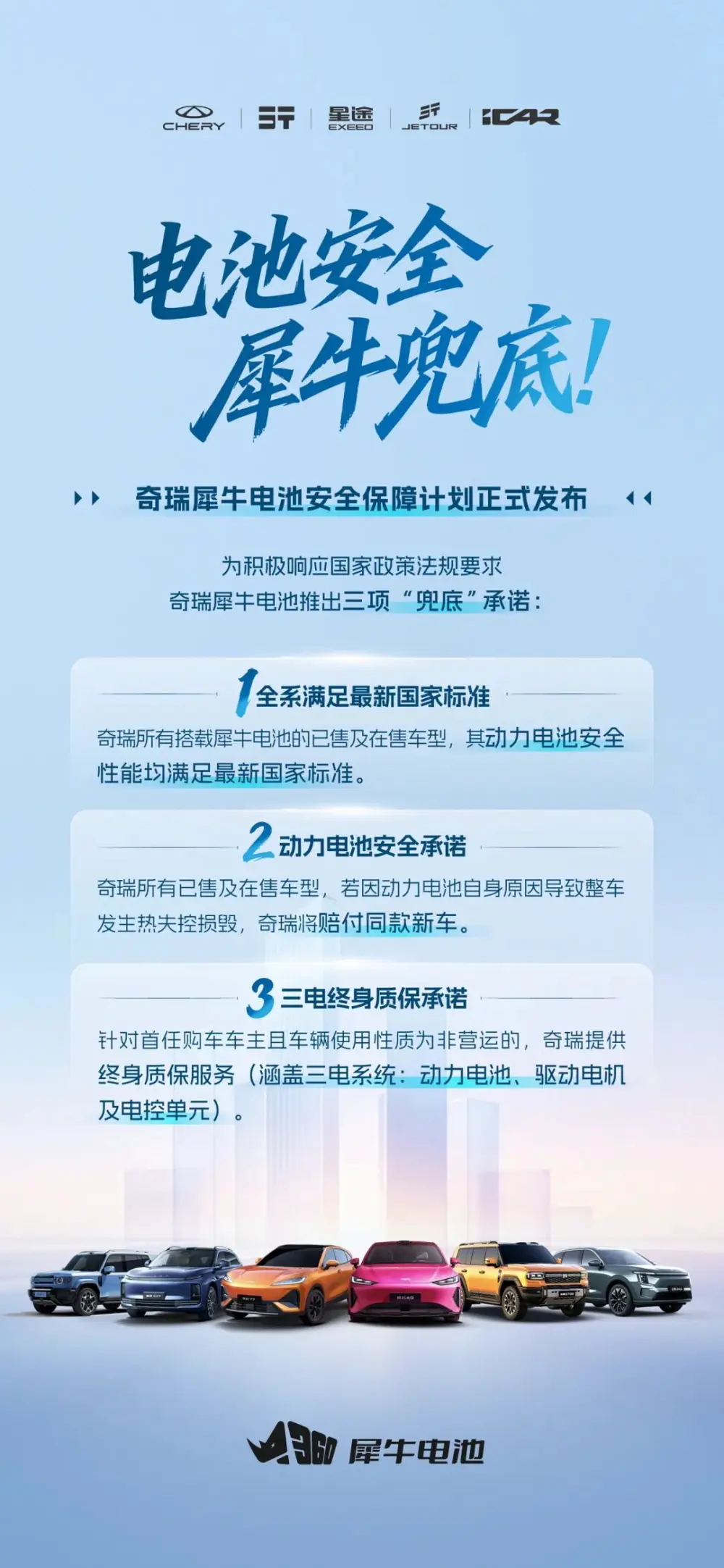
As Chinese electric vehicle (EV) manufacturers aggressively expand into global markets, they are finding new ways to dismantle the traditional trust barriers of Western consumers. On July 1, Chery Auto launched a disruptive initiative called the 'Rhino Battery Safety Guarantee Plan.' Underpinned by China's ultra-strict new safety regulations, the headline-grabbing feature of this plan is a promise that has sent shockwaves through the automotive world: a complete vehicle replacement in the event of battery thermal runaway, alongside a lifetime warranty on the electric 'three-core' systems. This aggressive Chery battery safety warranty sets an unprecedented benchmark for consumer confidence.
The Fine Print of Chery's 'Rhino' Warranty
Chery’s 'Rhino' safety assurance program represents a calculated, high-stakes marketing and engineering bet. The program promises a 'bottom-line' guarantee: if the traction battery experiences thermal runaway—the catastrophic chain reaction that leads to EV fires—Chery will replace the entire vehicle free of charge. Additionally, the plan offers a lifetime warranty on the 'Three Electrics' (battery, electric motor, and electronic control systems).
By offering to replace the entire vehicle rather than just swapping out a compromised module, Chery is tackling the 'EV fire anxiety' phenomenon head-on. From an E-E-A-T (Experience, Expertise, Authoritativeness, and Trustworthiness) perspective, this demonstrates extreme confidence in their structural battery pack integrity and thermal propagation prevention technologies.
The Regulatory Engine: GB 38031-2025 Standards
This warranty is not just a marketing stunt; it is heavily backed by China’s upcoming national standards, specifically the updated GB 38031-2025 battery safety regulation. This standard is widely recognized as one of the strictest in the world. It mandates that in the event of a single cell thermal runaway, the battery system must not propagate heat or catch fire for a minimum duration (previously 5 minutes, now pushing for absolute non-propagation), allowing occupants ample time to exit the vehicle safely.
By engineering systems to easily clear this high regulatory bar, Chery can afford to absorb the financial liability of a full-vehicle replacement. For Western OEMs, this highlights a growing compliance gap. While US and European regulatory frameworks are still debating standard thermal runaway testing procedures, Chinese regulators have codified these rules, driving domestic OEMs to build highly resilient battery architectures.
Warranty Breakdown: Chery vs. Western OEMs
To understand how disruptive this Chery battery safety warranty is, we must compare it to the current industry standards offered by prominent global OEMs.
| Warranty Feature | Chery Rhino Battery Guarantee | Standard Western EV Warranty (Tesla, Ford, VW) |
|---|---|---|
| Thermal Runaway Event | Complete vehicle replacement | Repair or pack replacement only (subject to investigation) |
| Core EV Components | Lifetime warranty (for first owner) | 8 Years or 100,000 miles (typically) |
| Battery Degradation Limit | Guaranteed capacity retention limits | 70% capacity retention over warranty period |
Investor Outlook: Can Western OEMs Compete?
For Western investors and automotive strategists, Chery's move signals a shift from 'price wars' to 'trust wars.' Western legacy OEMs are already struggling with high battery manufacturing costs and reliance on nickel-rich chemistries, which are more prone to thermal events than the Lithium Iron Phosphate (LFP) chemistry favored by Chinese OEMs like Chery. LFP’s inherent thermal stability is what makes Chery's aggressive warranty financially viable.
If Chery successfully exports this 'Rhino' warranty framework to Europe, Australia, and Latin America under its Omoda and Jaecoo brands, it will severely pressure Western competitors. Buyers hesitant to purchase Chinese EVs due to perceived quality issues will find it hard to ignore a lifetime warranty and a complete replacement guarantee.