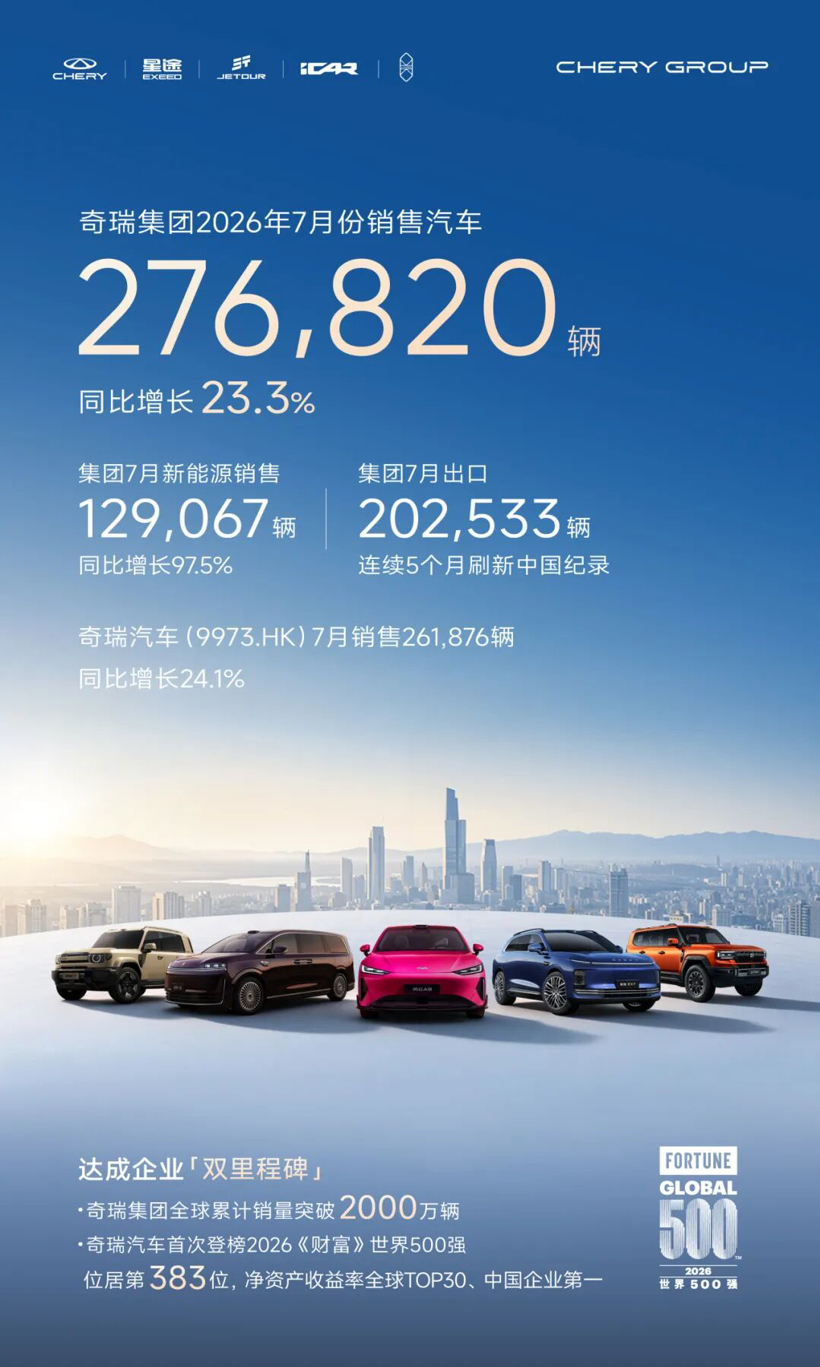
Chery Automotive Export Growth Breaks Records in July 2026
As global automotive supply chains undergo unprecedented transformations, the latest data from July 2026 highlights a monumental milestone for Chinese automakers. Chery automotive export growth has reached historic heights, with monthly exports surpassing the 200,000-unit threshold for the first time, while New Energy Vehicle (NEV) deliveries rapidly approached 130,000 units. This performance underlines Chery's transition from a regional domestic player into a highly adaptable global power.
Analyzing the Numbers: Chery's Milestone Performance
As a seasoned market analyst tracking the rapid evolution of China's 'Wuhu powerhouse,' Chery's July performance is not merely a statistical victory; it represents a major structural shift in global automotive supply. Historically, Chery has led Chinese passenger car exports for over two decades. However, breaking the 200,000-unit barrier in a single month indicates that international demand for their platform architecture is scaling at an accelerated pace.
Equally impressive is the brand's electrification trajectory. With NEV volume closing in on 130,000 units, Chery is successfully shifting its historical reliance on internal combustion engine (ICE) exports toward high-tech plug-in hybrid (PHEV) and battery electric (BEV) architectures.
| Metric Group | July 2026 Performance (Units) | Strategic Highlight |
|---|---|---|
| Total Group Exports | > 200,000 | All-time monthly record for the brand |
| NEV Sales Volume | ~ 130,000 | Rapid deployment of PHEV & BEV platforms |
| Primary Growth Drivers | Omoda, Jaecoo, Tiggo Series | Strong performance across mid-to-high end SUVs |
Strategic Localization Over Direct Exporting
For Western observers and investors, the key to understanding this expansion lies in Chery's shift from a pure-export model to a highly sophisticated localized regional footprint. In an era marked by shifting trade policies and complex tariff regimes, the traditional method of shipping finished vehicles from Chinese ports is increasingly insufficient.
Instead, Chery has focused heavily on supply chain compliance and strategic localization. By establishing local assembly facilities, sourcing components regionally, and investing in localized R&D hubs in Europe, South America, and Southeast Asia, Chery ensures long-term operational resilience. This localized integration allows the automaker to align with regional economic goals, creating local jobs and contributing to regional decarbonization efforts, which in turn fosters strong local political and consumer goodwill.
The Value of Cross-Border Collaboration
Rather than seeking to displace established regional players, Chery's global strategy increasingly relies on technology integration and cross-border collaboration. A prime example is their long-standing partnership strategy with global premium brands and regional distributors, leveraging local market expertise while providing highly competitive platform engineering and software solutions.
By positioning themselves as collaborative partners rather than disruptive competitors, Chery has successfully navigated complex regulatory environments. This collaborative framework demonstrates how international auto brands can work in tandem with Chinese suppliers to accelerate transition times for advanced driver-assistance systems (ADAS) and high-density lithium iron phosphate (LFP) battery technologies.
What This Means for Western OEMs and Investors
- Operational Agility: Chery’s rapid transition to localized assembly hubs offers a lesson in trade adaptability that global manufacturers must study to remain competitive.
- Platform Value: Chery's high-volume production scaling reduces unit costs for battery packs and electric drive units, positioning them as an attractive partner for strategic sourcing alliances.
- Investment Alpha: Analysts tracking automotive equities should monitor how Chery’s global joint ventures stabilize and grow profit margins relative to traditional export-only players.