CATL's Chocolate Swap Network Hits 2,520 Stations: Scale Without a Business Model
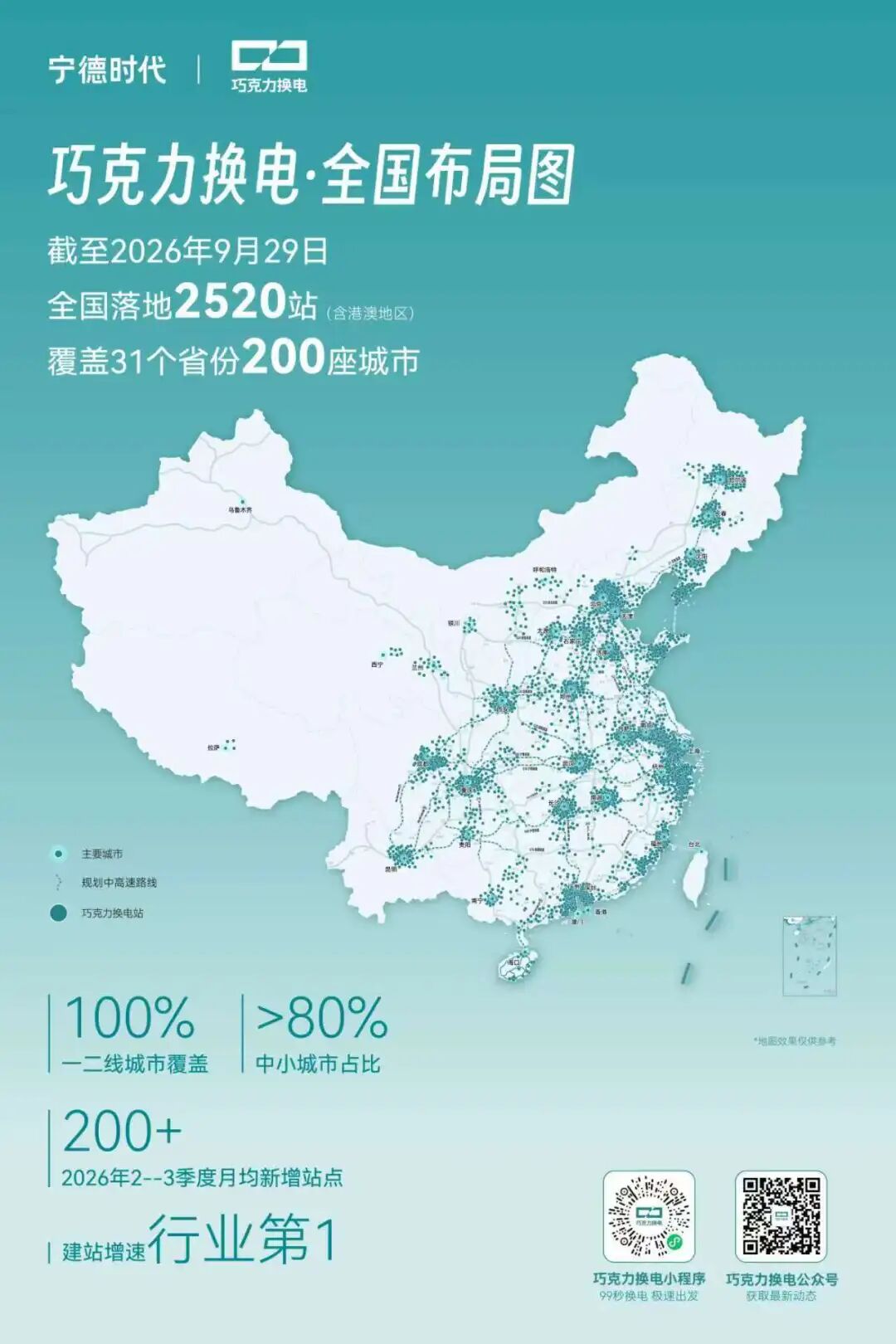
On September 29, 2025, CATL's Chocolate battery-swap subsidiary energized its 2,520th station in Lanzhou, Gansu — completing a network that now spans 31 provinces and 200 Chinese cities. The milestone arrives barely eighteen months after commercial launch and signals that China is standardizing EV energy replenishment at a velocity and geographic breadth no Western market has replicated.
CATL is not merely selling batteries anymore. It is attempting to become the Visa of Chinese EV energy — a clearinghouse layer between automakers, drivers, and grid operators. The strategic ambition is enormous. So is the capital intensity, the operational complexity, and the unanswered question of who eventually pays for a nationwide swap infrastructure that must function across at least six competing vehicle platforms.
The historical parallel is instructive. China's State Grid built the backbone of the world's largest EV charging network not because individual stations were profitable, but because standardization and state-backed capital deployment created a national asset. CATL is pursuing a similar playbook — privately funded, but with the same logic: control the interface, and the vehicles will follow.
Inside the Chocolate Architecture: Standardized Packs, E-Axle Integration, and the 20-Second Swap
The Technical Specifications
CATL's Chocolate battery — named for its modular, rectangular cell-to-pack configuration — is not a single product. It is a family of standardized swap packs offered in two primary variants:
- 20# pack: 42.5 kWh usable capacity, LFP chemistry, targeting A0 and A-segment city cars with 300–400 km CLTC range.
- 25# pack: 55 kWh usable capacity, LFP chemistry, targeting B-segment sedans and compact crossovers with 500–600 km CLTC range.
The packs use a standard chassis interface — mechanical locking points, high-voltage connectors, and liquid-cooling quick-disconnects — designed so that any participating OEM can integrate the swap bay into a vehicle platform without redesigning the entire underbody. CATL claims a swap cycle of approximately 20 seconds for the mechanical exchange, with total station dwell time of under three minutes including payment and bay positioning.
The critical engineering choice is LFP. By standardizing on lithium iron phosphate, CATL accepts lower gravimetric energy density (~160–180 Wh/kg at pack level, industry estimates) in exchange for cycle life exceeding 3,000 full cycles, superior thermal stability, and dramatically lower cost per kWh. For a swap model, cycle life is the single most important metric — a pack that must endure 50 swaps per day for five years needs chemistry that can absorb that abuse.
Comparison Table: CATL Chocolate vs. Global Swap and Charging Rivals
| System | Operator | Pack Capacity | Chemistry | Station Count (China) | Swap Time | Cross-Brand Support |
|---|---|---|---|---|---|---|
| Chocolate Swap | CATL / Caocao | 42.5 / 55 kWh | LFP | 2,520+ | ~20 sec mechanical | Yes (multi-OEM) |
| NIO Power Swap | NIO | 75 / 100 / 150 kWh | NCM / LFP hybrid | 3,400+ | ~3–5 min | Limited (NIO + Onvo) |
| Ample Swap | Ample (US/EU) | Not disclosed | Not disclosed | 0 (China) | ~5–10 min | Yes (fleet-focused) |
| 800V DC Fast Charge | Various (Tesla, XPeng, Li Auto) | N/A (onboard) | NCM / LFP | N/A | 10–80% in 15–25 min | Standard dependent |
The comparison reveals the fundamental trade-off. NIO's swap network is larger in absolute station count and offers higher-capacity packs, but it is vertically integrated — primarily serving NIO and Onvo vehicles. CATL's Chocolate network is smaller today but designed from the outset for multi-brand interoperability. If CATL succeeds in standardizing swap across a dozen OEMs, it creates a network effect that NIO's proprietary model cannot match.
Participating OEMs and Vehicle Integration
CATL has publicly confirmed partnerships with multiple automakers for Chocolate-compatible vehicles, including:
- Changan — first-mover on Chocolate swap; multiple models in production.
- GAC Aion — integrating swap packs into its Aion S and Y series for ride-hailing fleets.
- FAW Hongqi — premium swap-compatible sedan under development.
- BAIC — fleet-oriented swap models for taxi and ride-hailing operators.
- Li Auto — reportedly evaluating Chocolate swap for its lower-cost BEV lineup.
The fleet-first strategy is deliberate. Ride-hailing and taxi operators drive 150–300 km per day and are extremely sensitive to downtime. A 20-second swap that keeps a driver earning is fundamentally more valuable to a commercial operator than a 20-minute fast charge — even if the per-kWh energy cost is higher.
Who Builds the Chocolate Network — and Where the Money Actually Goes
The Supply Chain Stack
The Chocolate swap network involves a complex web of suppliers and partners. From our analysis of regulatory filings and supply chain disclosures, the key participants include:
- CATL (cell + pack): Provides LFP cells and assembles the standardized swap packs.
- Caocao Mobility (station operations): Geely-backed ride-hailing platform that operates many Chocolate stations, providing demand aggregation.
- State Grid and China Southern Power Grid: Provide grid interconnection and in some cases co-invest in substation upgrades.
- Local government development zones: Offer land at subsidized rates for swap stations — a critical hidden cost advantage.
- Swap mechanism suppliers: Companies such as Aodun and Sinexcel provide the robotic swap systems and power electronics.
The bill of materials for a single Chocolate swap station is not publicly disclosed by CATL. However, based on industry estimates for comparable automated swap systems, we estimate the following cost structure:
- Swap mechanism and robotics: RMB 800,000–1,200,000 per bay (industry estimates).
- Battery inventory (buffer stock): 8–12 packs per station at an assumed RMB 35,000–45,000 per pack (LFP, 50 kWh class) = RMB 280,000–540,000.
- Grid connection and transformers: RMB 300,000–800,000 depending on local grid capacity (industry estimates suggest higher-end for high-traffic urban sites).
- Civil works, canopy, and site preparation: RMB 200,000–500,000.
Total per-station capex likely ranges from RMB 1.5 million to RMB 3 million (USD 210,000–420,000), excluding land costs. At 2,520 stations, cumulative capex plausibly sits between RMB 3.8 billion and RMB 7.6 billion (USD 530 million–1.06 billion). That is a substantial balance-sheet commitment for a business whose unit economics remain unproven at scale.
The battery inventory is the hidden cost that kills swap economics. Unlike a charging station, which simply sells electricity, a swap station must maintain a buffer of 8–12 packs. That means 20–30% of the station's total capital is tied up in batteries that are not generating revenue. Every swap station is, in effect, a mini battery warehouse.
The Utilization Question
CATL has not disclosed average daily swaps per station. We estimate that a station needs 50–80 swaps per day to approach breakeven on an operating basis, assuming a service fee of RMB 0.4–0.6 per kWh and average energy throughput of 40 kWh per swap. That translates to 2,000–3,200 kWh per day per station — a substantial grid load and a demanding utilization target.
Early-stage stations in tier-1 cities may be hitting these numbers; stations in tier-3 and tier-4 cities, where the network has recently expanded, almost certainly are not. The geographic push to 200 cities suggests CATL is prioritizing coverage density over near-term utilization — a land-grab strategy financed by CATL's core battery business cash flow.
Who Wins and Who Loses in the Swap Standardization Battle
The Chinese Competitive Landscape
NIO is the most directly threatened player. NIO has invested billions in its proprietary swap network — 3,400+ stations as of early 2026 — and built its brand identity around swap. If CATL's open-standard Chocolate network achieves cross-brand scale, NIO's proprietary network becomes a strategic liability rather than an asset. NIO has responded by opening its network to Onvo and exploring partnerships, but it cannot match CATL's ability to aggregate demand across a dozen OEMs.
BYD has historically avoided swap, betting instead on its Blade Battery and high-power DC fast charging. BYD's dominance in LFP cell manufacturing gives it the option to enter swap at any time, but its vertically integrated model makes it a reluctant participant in any standard set by a competitor. Expect BYD to continue advocating for fast charging — a game it controls more completely.
Xpeng, Li Auto, and Xiaomi have largely committed to fast charging architectures (800V and above). Li Auto's 5C Kirin battery and Xpeng's 800V G6 platform represent the opposite strategic bet: faster charging rather than swap. These companies are unlikely to adopt Chocolate swap for their flagship models, though Li Auto has reportedly evaluated it for lower-cost BEV models.
The Western OEM Perspective
For Western OEMs, the Chocolate network is a double-edged sword. On one hand, it offers a pathway to participate in China's NEV market without building proprietary infrastructure — a critical consideration given the capital constraints at many legacy automakers. On the other hand, it deepens dependency on a Chinese supplier for a core energy-replenishment function.
Volkswagen, which operates through its joint ventures with SAIC and FAW, has no swap program in China. GM and Ford are similarly unprepared. The most likely Western response is not to adopt CATL swap, but to monitor its evolution and, if it succeeds, to negotiate strategic sourcing and technology-integration agreements that give them access without full dependency.
The more significant Western competitive threat comes from Hyundai-Kia. Hyundai has deliberately reduced its exposure to the Chinese domestic market, instead scaling its E-GMP platform (800V, 18-minute 10–80% charging) in North America, Europe, and India. Hyundai's strategy of decoupled resilience — avoiding the Chinese price war while building high-margin EVs — looks increasingly prescient if CATL's swap network fails to achieve profitability and becomes a capital drag on its backers.
The Reality Check: What CATL Isn't Telling You About the Swap Rollout
The 2,520-station milestone is real. The engineering behind the Chocolate packs is sound. The fleet-first strategy is commercially rational. But the gap between infrastructure deployment and a sustainable business model remains wide — and CATL's public disclosures conveniently omit the metrics that matter most.
Claim 1: "20-Second Swaps Will Replace Charging"
Reality: The 20-second figure refers only to the mechanical exchange. Total station dwell time — including queueing, positioning, payment, and battery health verification — is closer to 3–5 minutes. That is still faster than DC fast charging, but the difference is far less dramatic than CATL's marketing implies.
More importantly, the 20-second swap requires a perfectly aligned vehicle and robotically precise battery interface — conditions that are achievable in controlled fleet operations but less reliable with individual consumers who may not position the vehicle correctly. CATL's decision to prioritize ride-hailing fleets is not just about utilization; it is also about managing the operational fragility of the swap process.
Claim 2: "Standardization Solves the Chicken-and-Egg Problem"
Reality: Standardization is necessary but not sufficient. CATL's Chocolate packs are standardized, but the vehicles that use them must be engineered around the swap interface — a significant design constraint that automakers resist. The list of confirmed OEM partners is still relatively small and concentrated among state-owned automakers with less commercial leverage than BYD or Tesla.
The truly critical question is whether a major volume OEM — think BYD, Geely, or Tesla — commits to Chocolate swap. Until that happens, the network's utilization will remain dependent on a handful of fleet operators and lower-volume OEMs. CATL's own forecast of 30,000 stations by 2030 (a target that would require adding roughly 13 stations per day for five consecutive years) assumes broad OEM adoption that has not yet materialized.
Claim 3: "Swap Is Cheaper Than Fast Charging at Scale"
Reality: The per-kWh cost of swapped energy depends almost entirely on utilization. At 80 swaps per day, the amortized capex per kWh is manageable. At 20 swaps per day — typical for a peripheral urban station in a tier-3 city — the economics collapse. CATL has not disclosed fleet-wide utilization rates, and the geographic expansion to 200 cities suggests many stations are in low-traffic locations where utilization is unlikely to support profitability.
There is also the battery inventory cost. A swap station with 12 buffer packs has roughly RMB 500,000 in batteries sitting on shelves. That capital is not free, and it depreciates with every cycle. The economics only work if the swap fee revenue covers not just the electricity and station opex but also the eventual replacement of the buffer packs — a cost that CATL has not publicly modeled.
Claim 4: "2,520 Stations Means Scale"
Reality: China has over 1.8 million DC fast-charging connectors. The Chocolate swap network represents roughly 0.14% of the total energy-replenishment infrastructure by station count. It is a meaningful niche, not a mass-market alternative. For context, NIO's 3,400+ swap stations serve a fleet of roughly 600,000 vehicles — a ratio that works because NIO controls both the vehicles and the stations. CATL's network serves a diffuse, multi-brand fleet that is still in the low hundreds of thousands of units.
The scale story is real in one respect: CATL has demonstrated that it can deploy swap infrastructure faster than any other operator globally. But deployment speed is not the same as commercial viability. The company's core battery business generated the cash to fund this rollout; the swap network itself has not yet demonstrated that it can stand on its own.
Regulatory and Geopolitical Constraints on Swap Export
CATL has signaled ambitions to export the Chocolate swap model to Europe and Southeast Asia. Those ambitions will collide with a regulatory landscape that is far less accommodating than China's.
European Union
The EU's proposed Battery Regulation requires comprehensive carbon footprint declarations, recycled content minimums, and due diligence on supply chains — requirements that CATL can meet for its core battery business but that add compliance cost and complexity for swap infrastructure. More restrictive are the EU's countervailing duties on Chinese battery electric vehicles, which apply to the vehicle but not directly to the swap station. However, a vehicle with a Chocolate swap pack imported into the EU would still face the same tariff treatment as any Chinese BEV, potentially making swap economically unattractive for European buyers.
The critical issue is local content. To qualify for EU incentives or avoid punitive tariffs, CATL would need to assemble swap packs and stations within the EU — a capital-intensive undertaking that would require a dedicated European manufacturing footprint.
United States
The US market is effectively closed to CATL swap in the near term. Section 301 tariffs on Chinese batteries and EVs, combined with IRA FEOC (Foreign Entity of Concern) rules, make it commercially and legally difficult for CATL to deploy swap infrastructure in the US. Even if CATL were to license the technology to a US partner — a strategy it has explored for battery manufacturing — the swapping packs would need to comply with domestic content requirements that CATL's current supply chain cannot meet.
Southeast Asia and Emerging Markets
Thailand, Indonesia, and Vietnam are more promising. These markets have growing EV adoption, less restrictive trade barriers, and a willingness to accept Chinese technology standards. CATL has already announced battery manufacturing investments in Indonesia and Hungary; swap could follow. But the commercial case in these markets depends on fleet density and government support — neither of which is guaranteed.
The strategic approach for CATL outside China is likely to be localized pack assembly, partnerships with local fleet operators, and technology licensing to regional partners. That approach is compliant and adaptable but slower and less capital-efficient than the domestic build-out.
Strategic Outlook: Three Scenarios for CATL's Swap Ambitions
Bull Case
CATL signs two or three additional major volume OEMs to Chocolate swap, pushing annual swap-compatible vehicle sales above 500,000 units. Utilization on tier-1 and tier-2 stations reaches 80+ swaps per day, generating positive operating cash flow. CATL spins off the swap subsidiary at a premium valuation, raising capital to fund further expansion without drawing on the parent balance sheet. By 2028, swap becomes a meaningful revenue line (RMB 10–15 billion annually) and a defensible strategic moat.
Probability: 20–25%. This scenario requires broad OEM adoption that has not yet materialized and utilization rates that CATL has not publicly demonstrated.
Base Case
CATL expands to 5,000–8,000 stations by 2027, concentrated in tier-1 through tier-3 cities. Utilization remains modest (30–50 swaps per day on average), covering operating costs but not fully earning a return on capital. The swap network becomes a strategically important but financially marginal business — sustained by CATL's core battery profits as a defensive moat against charging-network competitors and a way to lock in OEM customers for its cells.
Probability: 50–55%. Infrastructure scale is achievable; profitability at scale is not yet proven.
Bear Case
OEM adoption stalls. Utilization remains below breakeven on 60%+ of stations. CATL slows expansion and writes down swap assets. The network contracts to a fleet-focused niche in top-tier cities. The 30,000-station target is abandoned or pushed beyond 2035. NIO's proprietary swap network regains competitive advantage as the only scaled, integrated swap operator in China.
Probability: 20–25%. The risk is highest if a major OEM — BYD, Geely, or Tesla — commits publicly to fast charging as its exclusive strategy, removing the demand that CATL needs to justify the network.
What Executives and Investors Should Watch
- Station-level utilization data. CATL has not disclosed average daily swaps per station. If it begins reporting this metric — or if third-party data emerges — it will be the single most important indicator of whether the swap model works.
- OEM commitments. A public commitment from BYD, Geely, or Tesla to produce Chocolate-compatible vehicles would be a game-changer. Absent that, the network remains a fleet-focused niche.
- The NIO response. If NIO opens its swap network to other OEMs — a strategic reversal it has hinted at — the competitive dynamic shifts from CATL vs. NIO to open-standard vs. proprietary. NIO's willingness to share is the tell.
- Capital structure. Watch for signs that CATL is spinning off the swap subsidiary, raising external capital, or writing down swap assets. The capital intensity of the network is the biggest risk to CATL's consolidated margins.
- Export strategy. The first Chocolate swap station outside China — anywhere — will signal whether CATL can adapt its model to different regulatory environments. Watch Europe and Southeast Asia specifically.
Frequently Asked Questions
What is CATL's Chocolate battery swap network?
The Chocolate swap network is CATL's standardized battery-swap infrastructure for electric vehicles. It uses modular LFP packs (42.5 kWh and 55 kWh variants) that can be robotically exchanged in approximately 20 seconds. As of September 2025, the network had 2,520 stations across 31 Chinese provinces and 200 cities, making it the largest multi-brand swap infrastructure in the world.
How does CATL's Chocolate swap compare to NIO's battery swap?
NIO's swap network is larger (3,400+ stations) and offers higher-capacity packs (75–150 kWh), but it is proprietary — primarily serving NIO and Onvo vehicles. CATL's Chocolate network is smaller but designed for multi-brand interoperability, which could create stronger network effects if adoption broadens. NIO's swaps take 3–5 minutes; CATL's mechanical exchange takes ~20 seconds.
Can CATL's swap network be exported to Western markets?
Not easily. US Section 301 tariffs, IRA FEOC rules, and EU countervailing duties create significant barriers. CATL would likely need to localize pack assembly and station manufacturing within target markets, partner with local fleet operators, and license technology to regional companies. Southeast Asia is a more promising near-term export market than the US or Europe.