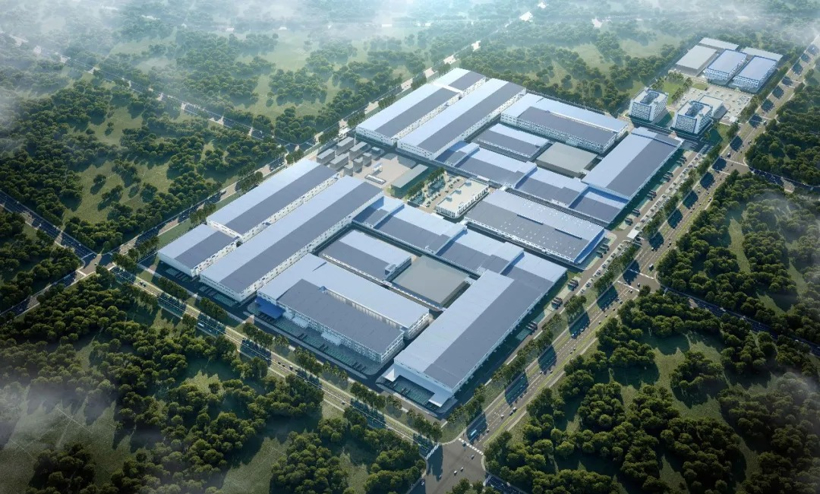
BYD has quietly completed full construction and entered production at its new power battery facility within the Qinhan Autonomous Driving Industrial Park in Xi'an's Xixian New Area — a move that carries far more strategic weight than its understated announcement suggests. According to Gasgoo, which cited the WeChat account 'Weidong Qinhan,' the project has reached full production status. The facility sits inside an autonomous driving industrial cluster, a deliberate geographic coupling that tells us something about how BYD intends to integrate its battery chemistry roadmap with its software-defined vehicle ambitions.
The timing is not accidental. BYD has been under intense pressure to rationalize its sprawling manufacturing footprint after a brutal domestic price war that saw multiple mass-market models cut by 10-20% in sticker price between 2023 and 2025. Simultaneously, its export offensive into Southeast Asia, Latin America, and parts of Europe has created genuine demand pull for LFP cells that can be assembled in jurisdictions offering tariff relief. Xi'an — already a major automotive hub hosting BYD's largest passenger car manufacturing complex — provides the logistical backbone for both domestic supply and westward overland export routes through Central Asia.
This is the fourth major battery capacity announcement from BYD in eighteen months, following facilities in Zhengzhou, Hefei, and the expansion of its Chongqing FinDreams base. The pattern is clear: BYD is out-executing virtually every legacy automaker on battery self-sufficiency, but the financial engineering behind this expansion deserves far more scrutiny than the headlines have given it.
Inside the Xi'an Project: What We Know and What Stays Unverified
BYD has not publicly disclosed the nameplate capacity of the Xi'an facility in gigawatt-hours, the specific cell chemistry mix, or the manufacturing technology deployed on the lines. This is characteristic — BYD's FinDreams Battery subsidiary rarely issues detailed technical press releases for domestic capacity additions, preferring to let production numbers speak once they hit vehicles.
Based on the scale of the Qinhan industrial park footprint and BYD's existing facility templates, industry estimates suggest the Xi'an plant likely targets somewhere between 20 GWh and 40 GWh of annual LFP cell output, with the capability to produce both prismatic blade cells and the newer short-blade variants used in the second-generation Han and Seal families. The location — inside an autonomous driving industrial park — suggests co-location with pack assembly and battery management system integration for vehicles destined for higher-trim, ADAS-equipped models.
| Parameter | BYD Xi'an (Estimated / Claimed) | CATL Yibin Base | Tesla Giga Nevada | LG Energy Solution Nanjing |
|---|---|---|---|---|
| Primary chemistry | LFP (blade / short-blade) | LFP + NCM (mixed) | NCA / LFP (mixed) | NCM (high-nickel) |
| Est. capacity (GWh/yr) | 20–40 (not disclosed) | ~100+ | ~37 (current) | ~90+ |
| Cell-to-pack integration | CTB (cell-to-body) | CTP 3.0 Kirin | Structural pack | CTP |
| Target market | Domestic + export assembly | Domestic + global OEM supply | North America | Global OEM supply |
| Significant regulatory exposure | US Section 301, EU CVDs, IRA FEOC | US Section 301, EU CVDs, IRA FEOC | Low (onshore US) | Moderate (Korean origin benefits) |
The comparison is instructive less for what it confirms than what it exposes. BYD's LFP-focused capacity expansion reinforces its cost leadership in the sub-$25,000 segment, but it does not address the industry's structural gap in high-nickel ternary and solid-state chemistries required for premium, cold-weather-resilient, high-performance vehicles. CATL continues to hedge across both LFP and NCM lines; BYD's concentration in LFP, while strategically coherent for its product mix, remains a technology ceiling.
On manufacturing technology, BYD has emphasized its proprietary blade cell architecture with cell-to-body (CTB) integration, which eliminates the traditional module layer and increases volumetric pack efficiency. Independent teardown analyses of the Seal and Atto 3 suggest pack-level energy densities in the 140-160 Wh/kg range — competitive for LFP but substantially below the 200+ Wh/kg territory of leading NCM packs.
The Cost Architecture Behind BYD's Battery Advantage
The Xi'an facility's strategic value lies almost entirely in its cost structure. BYD's vertical integration spans lithium procurement (through equity stakes in Chinese miners), cathode and anode production, cell manufacturing, pack assembly, and ultimately vehicle production. Industry estimates suggest this integration shaves 15-25% off the cell cost a comparable Western OEM would pay to a Tier-1 supplier like CATL or LG Energy Solution.
The primary Tier-1 suppliers in BYD's battery ecosystem are FinDreams Battery (BYD's own subsidiary) for cells and packs, with secondary sourcing from suppliers including Hunan Yuneng and Shenzhen Dynanonic for LFP cathode materials, and Shanshan Technology for anode materials. Separator sourcing leans on Yunnan Energy New Material and Senior Technology. This is a materially different supply chain posture than, for example, Tesla, which relies on a broader external supplier base across multiple continents.
Industry estimates suggest current LFP cell costs in China have fallen to approximately $50-60/kWh at the pack level, driven by lithium carbonate prices stabilizing in the RMB 90,000-110,000/ton range after the 2023 crash from RMB 600,000/ton. BYD's integrated cost structure may push its internal transfer cost meaningfully below the market average, though the company does not disclose segment-level battery margins.
- Lithium carbonate input: Estimated $12-15/kWh equivalent at current spot pricing
- Cathode (LFP) processing: Estimated $15-18/kWh
- Anode and electrolyte: Estimated $8-12/kWh
- Cell manufacturing and yield loss: Estimated $10-14/kWh
- Pack assembly and BMS: Estimated $6-9/kWh
These figures are analyst estimates, not company-disclosed data, and should be treated as directional. What matters for competitive analysis is not the precise number but the directional gap: BYD's battery cost is structurally lower than what any Western OEM can access through open-market procurement, and the Xi'an facility widens that gap by eliminating logistics costs between cell production and vehicle assembly.
The critical caveat here is debt. BYD's balance sheet has expanded aggressively alongside its capacity buildout, with total liabilities exceeding RMB 500 billion in recent filings. The Xi'an project adds to that leverage without a corresponding disclosure of expected internal rate of return. If domestic price wars continue to compress vehicle margins, the servicing cost of this debt could erode the very cost advantage the integration is meant to create.
Who Wins, Who Loses in the Battery Capacity Race
For Chinese competitors, BYD's Xi'an completion intensifies the pressure on already-thin margins. NIO, XPeng, and Li Auto do not manufacture their own cells at anything approaching BYD's scale — NIO has pursued a joint venture with WeLion for semi-solid-state cells, XPeng relies primarily on CATL and EVE Energy, and Li Auto sources from CATL and Sunwoda. Each of these OEMs pays a market price for cells that is structurally higher than BYD's internal transfer cost.
For Western OEMs, the calculus is more nuanced. Volkswagen's partnership with XPeng and its investment in Gotion High-Tech represent attempts to secure Chinese-origin battery supply at competitive cost, but these remain exposed to EU countervailing duties that now reach up to 35.3% on Chinese-made BEVs and could extend to battery components. Tesla's Shanghai operation benefits from proximity to BYD's and CATL's supply chains but faces the same export-wall problem when shipping to the US or EU.
The most interesting competitive set may be Korean and Japanese battery makers. LG Energy Solution, Samsung SDI, and SK On have invested heavily in US and European capacity precisely to capture IRA and EU incentives that exclude Chinese-origin cells. If BYD's Xi'an output primarily serves domestic vehicles and non-regulated export markets (Southeast Asia, Latin America, the Middle East), it does not directly threaten Korean market share in the US or EU. But if BYD uses Xi'an as a low-cost cell source for assembly operations in Thailand, Brazil, or Hungary — all jurisdictions where it is building or planning vehicle plants — then Korean cell makers face a genuine pricing challenge in those markets.
Hyundai-Kia's position deserves separate mention. Having deliberately reduced its exposure to the Chinese domestic retail market while maintaining a Chinese production footprint for export, Hyundai-Kia has preserved higher margins than most legacy OEMs. Its E-GMP platform uses cells sourced primarily from LG Energy Solution, SK On, and CATL, giving it flexibility to shift sourcing as trade rules evolve. BYD's Xi'an expansion does not directly threaten Hyundai-Kia's core markets, but it raises the baseline cost floor that Hyundai-Kia must beat in emerging markets where both compete.
Is BYD's Capacity Expansion Strategically Sound or Financially Reckless?
This is where the press release narrative collapses against engineering and financial reality.
The official framing — 'full completion and production launch' — implies a demand-driven expansion. But China's battery industry entered 2025 with nameplate capacity utilization rates estimated by various analysts in the 50-60% range. Adding Xi'an capacity into a market already characterized by severe overcapacity suggests one of three things: BYD expects domestic demand to accelerate well beyond current forecasts, it intends to use Xi'an output for export assembly in jurisdictions where Chinese cells can still qualify for incentives, or the project is advancing on state-aligned industrial policy timelines rather than pure commercial logic.
The export-assembly theory is the most plausible. BYD has announced or commenced vehicle assembly in Thailand (opened 2024), Brazil (targeting 2025), Hungary (targeting 2025-2026), and Turkey. In each case, locally assembled vehicles using Chinese-origin cells can potentially qualify for bilateral trade preferences that finished-vehicle imports cannot access. Whether such arrangements survive tightening rules-of-origin scrutiny — particularly in the EU, which is actively revising its battery passport and local-content requirements — remains unverified.
The physics of LFP also impose a ceiling that BYD's own PR rarely acknowledges. LFP delivers excellent cycle life and thermal stability but lower energy density and degraded cold-weather performance relative to NCM. For BYD's core market — city cars and mid-range family vehicles in warm and temperate climates — this is a minor constraint. For premium exports to Northern Europe or North America, it is a serious limitation. The Xi'an facility does not address this chemistry gap; it deepens BYD's exposure to it.
Finally, the financial opacity is a genuine concern. BYD does not break out FinDreams Battery profitability, does not disclose cell-level gross margins, and does not provide capacity utilization data. Any analyst modeling BYD's battery economics is working from estimates, not disclosures. That lack of transparency should be priced as a risk premium, not ignored.
Tariffs, Trade Walls, and the Compliance Tightrope
The regulatory environment for Chinese-origin batteries has tightened dramatically since 2023. The US Section 301 tariffs on Chinese lithium-ion batteries for EVs rose to 25% in 2024, with further increases scheduled. The Inflation Reduction Act's Foreign Entity of Concern (FEOC) rules disqualify vehicles containing battery components manufactured or assembled by Chinese entities from the $7,500 consumer tax credit starting in 2025 for critical minerals and 2024 for components.
The EU has imposed countervailing duties on Chinese BEVs ranging from 7.8% to 35.3% depending on the manufacturer's level of cooperation with the investigation, and is separately developing battery passport and local-content requirements that could effectively exclude Chinese-origin cells from qualifying for EU incentives by the end of the decade.For BYD, the strategic response has been a combination of strategic localization (building assembly plants in tariff-advantaged jurisdictions), supply chain compliance (sourcing non-Chinese battery components for vehicles destined for regulated markets), and technology licensing arrangements with partners in restricted markets. The Xi'an facility fits this strategy only if its output can be routed to compliant end markets — which requires BYD to build or partner for cell-to-pack assembly outside China, a capability it currently lacks at scale.
Turkey is the wildcard. BYD's planned Turkish assembly plant, announced in 2024, would potentially provide duty-free access to the EU customs union. If BYD can ship cells from Xi'an, assemble packs and vehicles in Turkey, and meet rules-of-origin thresholds, it could maintain cost competitiveness in the EU without triggering countervailing duties on finished vehicles. But the EU is actively reviewing exactly this kind of arrangement, and the window may be closing.
Strategic Scenarios for BYD's Battery Play
Bull Case
BYD's Xi'an output feeds a rapidly scaling export assembly network in Thailand, Brazil, Turkey, and Hungary, driving volume growth without exposing the company to countervailing duties on finished vehicles. Domestic price war pressure eases as weaker competitors exit, allowing BYD to restore vehicle margins. FinDreams Battery begins supplying third-party OEMs, creating a new revenue stream. Under this scenario, BYD's integrated cost structure translates into sustainable operating cash flow and the leverage on its balance sheet deleverages naturally through earnings growth.
Base Case
Xi'an adds capacity that is absorbed gradually by domestic demand and export growth, but utilization rates remain below 70% through 2026. BYD maintains its domestic cost advantage but faces persistent margin pressure. Export assembly plants ramp slower than planned due to local permitting, supply chain buildout, and regulatory friction. The investment generates positive returns but below the cost of capital for the first three to four years. BYD's balance sheet remains leveraged but serviced comfortably.
Bear Case
China's EV price war intensifies further in 2026, compressing BYD's vehicle margins below the level needed to service its cumulative debt. Xi'an output adds to industry overcapacity, driving cell prices lower and undermining the investment thesis of the facility itself. EU and US regulatory walls tighten faster than BYD can localize production, closing export channels to developed markets. FinDreams Battery's lack of external customers leaves BYD captive to its own vehicle demand, which proves insufficient to absorb new capacity. Under this scenario, Xi'an becomes a stranded asset and a drag on group profitability.
Key Takeaways for Executives and Investors
- BYD's Xi'an battery project deepens its vertical integration advantage, but the absence of disclosed capacity, chemistry mix, and financial returns makes the investment thesis unverifiable from public data alone.
- China's battery overcapacity means new gigafactory announcements should be read as market-share defense and export-enablement plays, not as evidence of demand-driven expansion.
- The LFP chemistry concentration that powers BYD's cost leadership also limits its addressable market in cold-climate, high-performance, and premium segments where Western OEMs retain genuine engineering advantages.
- Western tariff and FEOC walls are making Chinese-origin cells increasingly difficult to monetize in developed markets; BYD's ability to localize pack and vehicle assembly outside China is now the critical variable in its export economics.
- Investors should demand greater disclosure on FinDreams Battery's segment economics — without it, BYD's battery advantage is directionally clear but quantitatively opaque.
The Xi'an completion is a data point in a larger story about industrial scale, trade walls, and the limits of cost leadership. It is not, as some coverage might suggest, a decisive blow in the global EV competition. It is a capacity bet that will be proven right or wrong by utilization rates, export channel access, and — most critically — whether BYD's balance sheet can carry the weight of its own ambition.