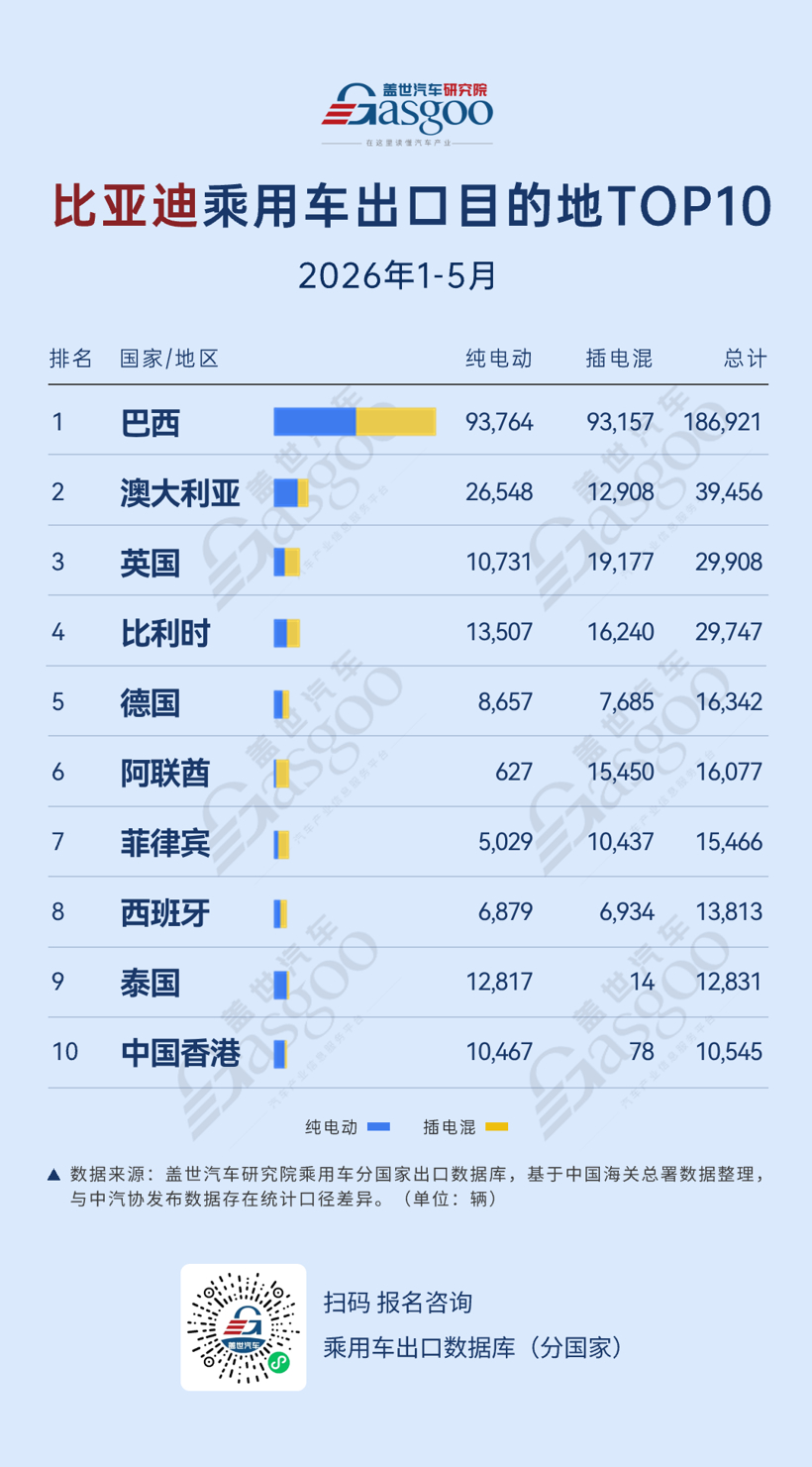
The global automotive landscape is witnessing a profound realignment as Chinese electric vehicle (EV) manufacturers accelerate their international footprint. At the forefront of this shift is the BYD global export strategy, which during the first five months of 2026 demonstrated remarkable resilience and growth. According to recent market analysis from the Gasgoo Research Institute, BYD's passenger car exports from January to May 2026 sustained an aggressive upward trajectory, characterized by Latin American leadership, deep cultivation in Europe, and diversified breakthroughs across the Asia-Pacific (APAC) and Middle East regions.
Mapping the Top Destinations of BYD's Export Expansion
A granular look at the export destination data reveals a highly diversified geographic distribution. Rather than relying on a single overseas market, BYD has successfully executed a multi-regional hedging strategy. Brazil has firmly established itself as the core hub of BYD's Latin American efforts, consistently ranking as the top export destination by volume.
This Latin American success is mirrored by steady expansion in alternative markets. The following table highlights the estimated trends and distribution of BYD's primary passenger vehicle export destinations for the Jan-May 2026 period:
| Region | Key Destinations (Jan-May 2026) | Strategic Role |
|---|---|---|
| Latin America | Brazil, Mexico | Volume anchor & regional manufacturing base |
| Asia-Pacific | Thailand, Australia, Japan | High-growth RHD (Right-Hand Drive) markets |
| Europe | Germany, UK, France | Premium brand positioning & localized supply compliance |
| Middle East | Israel, UAE | High-margin, rapid-adoption markets |
Strategic Localization and Trade Adaptability
As trade policies and regulatory developments reshape the global EV sector, BYD's approach has evolved from simple direct exports to sophisticated strategic localization. In Europe, rather than relying solely on shipments from China, BYD is actively developing a localized regional footprint with its upcoming manufacturing facility in Hungary. This move ensures long-term supply chain compliance and demonstrates a commitment to local value creation, establishing the brand as a domestic player within the European ecosystem.
Similarly, the newly operational manufacturing facility in Camaçari, Brazil, serves as a dual-purpose hub: it satisfies the soaring local demand while acting as a springboard for tariff-compliant distribution across the broader Mercosur trade bloc. This emphasis on local capital investment and job creation aligns perfectly with ESG (environmental, social, and governance) initiatives favored by global investors.
Cross-Border Collaboration and Global Supplier Partnerships
Rather than positioning itself as a disruptive outsider, BYD's global integration relies heavily on cross-border collaboration and strategic sourcing alliances. In Europe and the Asia-Pacific, BYD has partnered with established local dealer groups—such as Hedin Mobility Group in Europe and Rever Automotive in Thailand—to leverage their localized market expertise, logistics networks, and established customer trust.
By integrating global supplier expertise with its highly vertically integrated battery and powertrain technologies, BYD offers Western consumers a balance of competitive pricing and robust local support. This cooperative strategy alleviates the friction often associated with new market entrants and positions BYD as a stable, long-term partner in the global transition to decarbonized transport.