BYD Global Expansion Strategy: How Brazil Became the Launchpad for a 2026 Export Surge
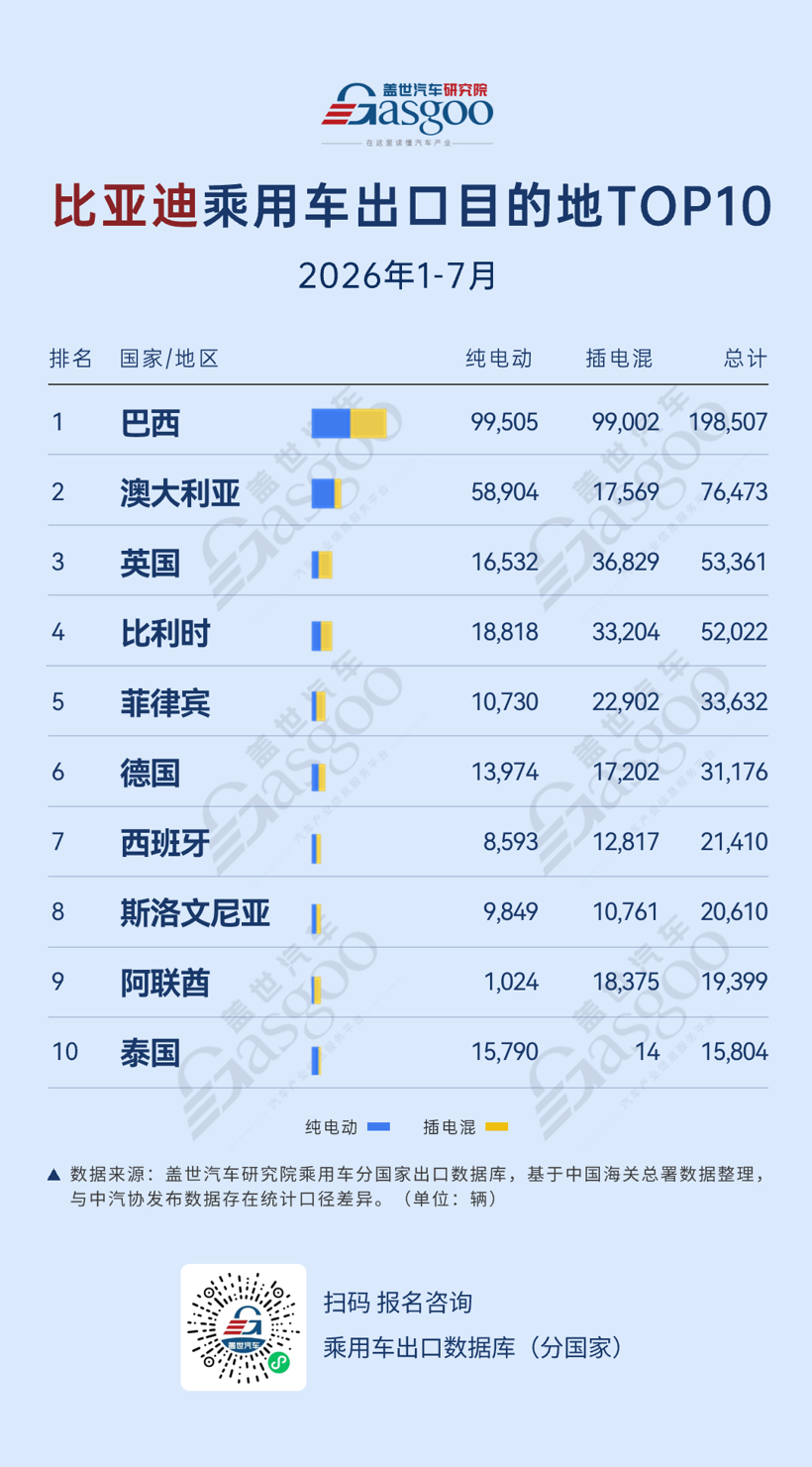
From January to July 2026, the BYD global expansion strategy entered a new phase of hyper-growth. According to the latest data from the Gasgoo Research Institute, the Chinese new energy vehicle (NEV) giant has significantly deepened its global footprint. Leading this charge is Brazil, which imported nearly 200,000 units in the first seven months of the year, emerging as BYD's primary international stronghold for both battery electric vehicles (BEVs) and plug-in hybrid electric vehicles (PHEVs).
Brazil Leads the Pack: Analyzing BYD's 2026 Export Destinations
As international trade dynamics shift, Chinese OEMs are rapidly adapting their distribution networks. Rather than relying solely on traditional Western markets, BYD has successfully prioritized the Global South. This strategic pivot is highly visible in the top export destinations for the first seven months of 2026, where Latin America and Southeast Asia dominate the volume charts.
This massive volume in Brazil is not a temporary spike; it is the result of a deliberate, multi-year market cultivation. BYD has established a strong consumer brand in South America by offering highly competitive technical specs—particularly in LFP battery range and advanced driver assistance systems (ADAS)—at price points that traditional legacy competitors have struggled to match.
Strategic Localization: Shifting from Direct Exports to Local Manufacturing
As an automotive trade analyst monitoring South American supply chains, it is clear that BYD's strategy in Brazil extends far beyond shipping finished vehicles from Shanghai or Shenzhen. A core component of the modern BYD global expansion strategy is localized regional footprint development to ensure trade adaptability and supply chain compliance.
BYD's major investment in the Camaçari manufacturing complex in Bahia, Brazil, is a prime example of this transition. By localizing production, the automaker achieves several critical strategic objectives:
- Tariff Compliance: Local assembly helps BYD navigate import tariff adjustments smoothly, maintaining cost competitiveness in the Mercosur trade bloc.
- ESG and Local Job Creation: By partnering with local authorities and investing in regional talent, BYD aligns with Brazil's industrial decarbonization goals.
- Supply Chain Resilience: Developing a localized supplier network reduces vulnerability to ocean freight volatility and global shipping bottlenecks.
The Dual-Drive Advantage: BEVs and PHEVs Accelerating Hand-in-Hand
While many Western OEMs have oscillated between pure electric goals and hybrid pullbacks, BYD’s consistent dual-drive approach (PHEV + BEV) has paid massive dividends in developing markets. In Brazil, where public charging infrastructure is still maturing outside major urban centers like São Paulo and Rio de Janeiro, plug-in hybrids like the Song Plus DM-i offer the perfect transitional solution.
These vehicles offer long range and fuel flexibility while introducing consumers to the benefits of electric drivetrains. Simultaneously, pure electric models like the Dolphin and Seal establish BYD as a technology leader, capturing early adopters and tech-focused consumers. This balanced portfolio mitigates infrastructure risks and maximizes market penetration across different consumer demographics.
What This Means for Western Investors and Competitors
For global investment firms and automotive strategists, BYD’s progress in Brazil is a masterclass in market-entry execution. Instead of confronting regulatory headwinds head-on in high-tariff jurisdictions, the company is securing deep market share in high-growth, neutral regions. By the time Western legacy OEMs establish localized EV supply chains in Latin America, BYD may already possess dominant market share and an entrenched localized dealer network.
Western OEMs should view these developments not as a threat, but as an opportunity for strategic sourcing alliances and potential cross-border collaboration. Leveraging localized supplier ecosystems and observing BYD’s rapid adaptation can provide valuable lessons for any automaker aiming to build a resilient, global EV footprint.
| Rank | Destination Country | Estimated Export Volume (Jan-July 2026) | Primary Vehicle Technology Focus |
|---|---|---|---|
| 1 | Brazil | ~198,000 units | BEV & PHEV (Dual-Drive) |
| 2 | Australia | Top Tier APAC | BEV (Atto 3, Seal) |
| 3 | Thailand | Top Tier ASEAN | BEV (Strategic Local Assembly) |