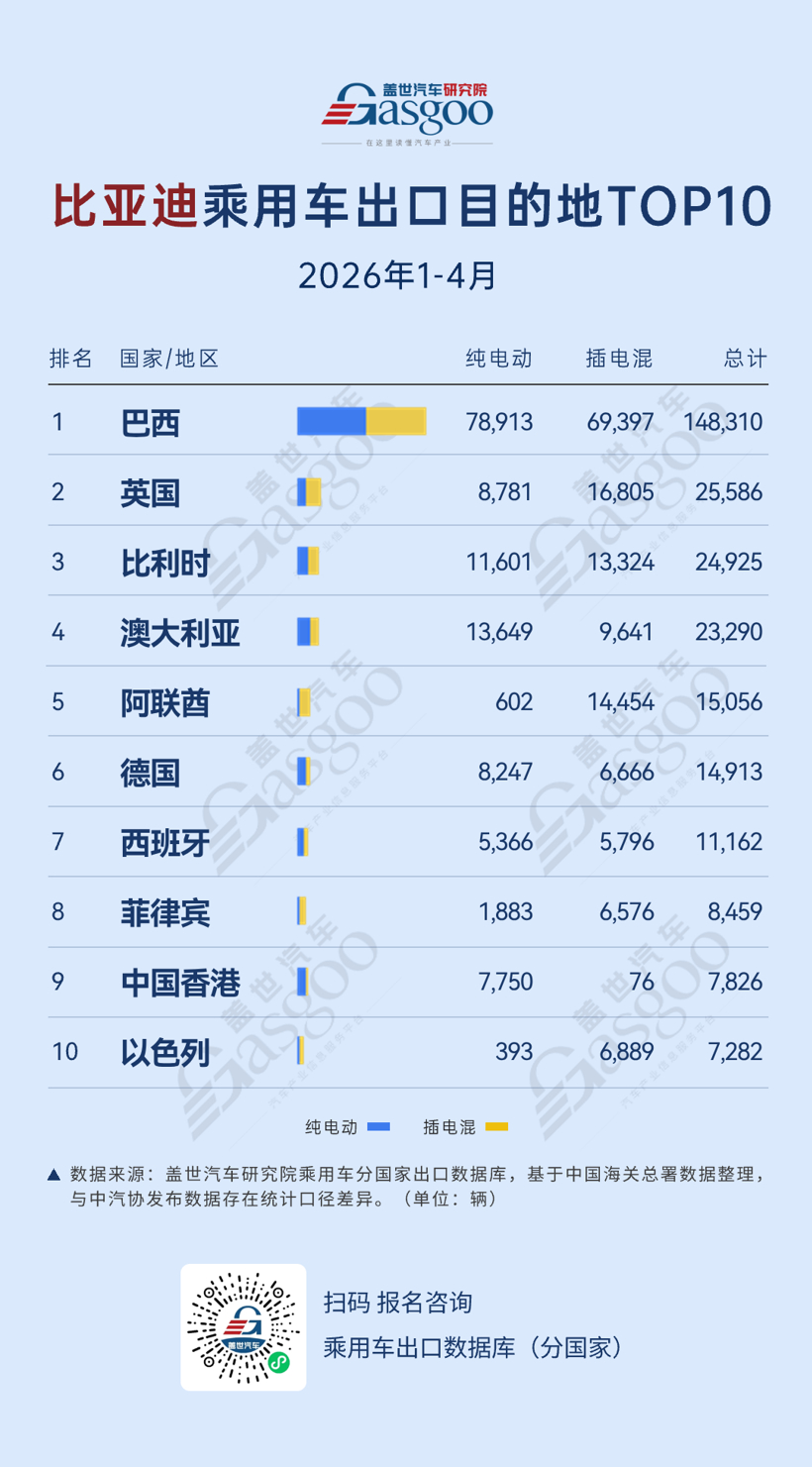
Analyzing the newly released BYD export destinations 2026 data reveals a highly calculated geopolitical hedging strategy by the Chinese automotive giant. Rather than pushing a uniform global fleet, BYD is dynamically shifting its product mix between Battery Electric Vehicles (BEVs) and Plug-in Hybrid Electric Vehicles (PHEVs) to circumvent rising tariff barriers and exploit regional infrastructure variations.
As global trade barriers rise, BYD’s distribution strategy demonstrates how Chinese OEMs are maintaining high-velocity global expansion. By decoupling their reliance on any single Western market and optimizing local supply routes, they are continuing their relentless global push despite geopolitical pushback.
Brazil Dominates: The Crown Jewel of BYD's Global Footprint
Between January and April 2026, Brazil solidified its position as BYD’s absolute powerhouse export market. Sourcing data from the Gasgoo Auto Research Institute, BYD exported a staggering 148,310 passenger vehicles to Brazil during this four-month window alone.
What is most compelling is the balanced split in powertrain selection:
- BEVs (Battery Electric Vehicles): 78,913 units
- PHEVs (Plug-in Hybrid Electric Vehicles): 69,397 units
This near 50-50 split highlights BYD's adaptability. Brazil's vast geography and developing charging networks make PHEVs highly appealing to rural and inter-city drivers, while metropolitan centers rapidly adopt pure electric models like the Dolphin. Furthermore, BYD's massive investment in the Camaçari manufacturing complex in Bahia is a clear sign that this export volume is a precursor to localized production designed to dodge future Latin American import taxes.
The European Divide: Mitigating Tariffs with PHEVs in the UK and Belgium
While the European Union has actively built tariff walls against Chinese-made BEVs, BYD has deployed a clever workaround: leveraging PHEVs and utilizing strategically critical gateways.
The United Kingdom: A Strong PHEV Beachhead
Coming in at No. 2 globally, the UK imported 25,586 BYD passenger vehicles. However, the internal distribution tells a crucial story: only 8,781 were BEVs, while 16,805 were PHEVs. Over 65% of BYD's UK exports are hybrids. By emphasizing PHEVs, BYD capitalizes on a product line less heavily targeted by anti-subsidy narratives, providing British consumers with affordable, high-range options while maintaining healthy margins.
Belgium: The Logistics Gateway
Ranked at No. 3, Belgium acts as BYD's main logistical entry point into mainland Europe. Port cities like Zeebrugge serve as distribution hubs, allowing BYD to land vehicles efficiently before routing them across the continent. While individual regional sales in Europe face headwind tariffs, the structural flow through Belgium remains a crucial artery for BYD's European long-game.
BYD Export Destinations & Powertrain Mix (Jan-Apr 2026)
The following table illustrates the stark differences in BYD's export strategy between Latin America and Europe:
| Rank | Destination | BEVs (Units) | PHEVs (Units) | Total Exports (Units) | PHEV Share (%) |
|---|---|---|---|---|---|
| 1 | Brazil | 78,913 | 69,397 | 148,310 | 46.8% |
| 2 | United Kingdom | 8,781 | 16,805 | 25,586 | 65.7% |
| 3 | Belgium | N/A | N/A | Top 3 Entry | N/A (Logistics Hub) |
Strategic Implications for Western OEMs and Investors
For Western automakers, the takeaway is clear: BYD is not a one-trick pony reliant purely on low-cost BEVs. Their DM-i plug-in hybrid technology is highly competitive and is being actively deployed in markets where pure EV infrastructure is lacking or where EV-specific tariffs are high.
By establishing manufacturing hubs in Brazil, Hungary, and potentially Turkey, BYD is transitioning from a pure exporter to a multinational transplant. Investors should watch the PHEV export ratios closely; they indicate how BYD plans to sustain global volume growth while waiting for localized factories to go online.