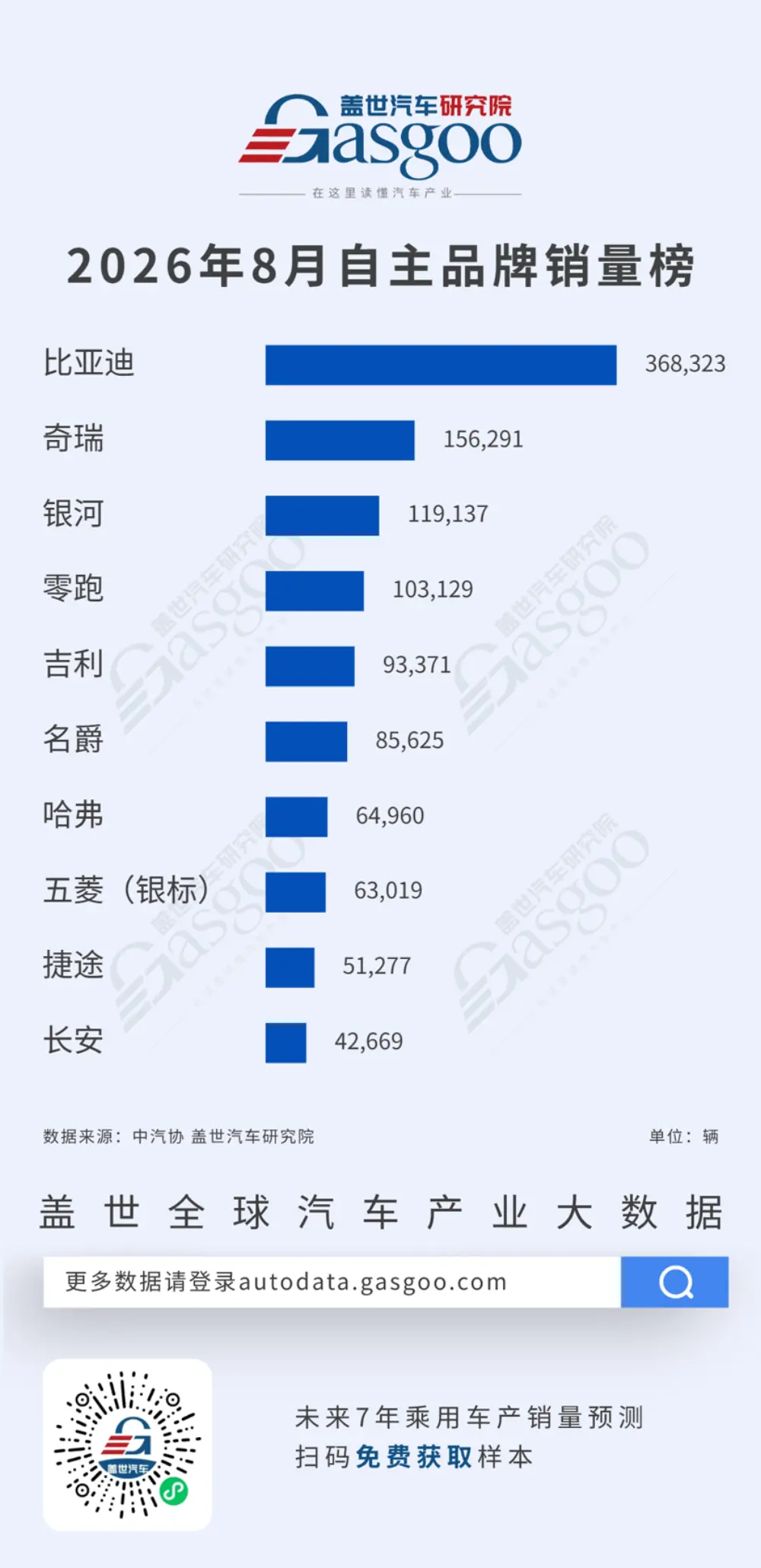
When monthly automotive registration data crossed the wire for August 2026, the headline figure from the Gasgoo Automotive Research Institute confirmed what legacy boardrooms have feared for three consecutive cycles: BYD recorded 368,323 passenger vehicle sales in a single month, establishing an insurmountable gulf between itself and domestic competitors. In Chinese automotive parlance, this performance is characterized as 'duanceng lingpao'—leading by a fault line so vast that second- and third-place contenders appear relegated to an entirely different tier of manufacturing reality. Yet behind this staggering display of operational velocity lies an increasingly high-stakes financial equation that institutional investors, Tier-1 suppliers, and Western original equipment manufacturers (OEMs) must urgently dissect.
To grasp how the market arrived at this inflection point, one must track the trajectory of China's domestic new energy vehicle (NEV) sector over the past thirty-six months. What began as a government-subsidized technological transition has metastasized into an unsparing war of attrition. Following the aggressive localized price cuts initiated across both battery electric (BEV) and dual-mode plug-in hybrid (PHEV) segments throughout 2024 and 2025, domestic market share has rapidly consolidated into the hands of a microscopic elite. While state-owned conglomerates and emerging venture-backed startups struggle to stem cash burn, BYD has weaponized its localized industrial base to flood regional tiers with ultra-cost-competitive models like the Qin, Song, and Seagull families. However, the sheer density of these monthly delivery figures raises a fundamental structural question: does this runaway volume reflect genuine corporate compounding, or is it an escalating operational treadmill compelled by domestic overcapacity?
The Anatomy of 368,323 Units: Engineering Teardown and Platform Dynamics
Unpacking the August 2026 sales breakdown demonstrates that BYD's momentum is not anchored in a solitary novelty vehicle, but rather across a relentless bifurcation of dual-mode plug-in architectures and dedicated 800V silicon carbide (SiC) battery-electric platforms. The company's dual-track platform cadence—spanning its DM-i/DM-p hybrid powertrains and e-Platform 3.0 Evo architecture—delivers an efficiency envelope that legacy competitors have failed to match at scale.
From an engineering perspective, BYD's volume foundation rests upon its high-volume DM-i architecture, which pairs an ultra-high thermal efficiency Atkinson-cycle internal combustion engine (reaching certified laboratory thermal efficiencies upwards of 46.06%) with a dual-motor electric hybrid system (EHS). By eliminating multi-speed planetary gearboxes in favor of direct engine-clutch engagement at high cruising velocities, BYD reduces mechanical Bill of Materials (BOM) cost by an estimated $1,200 to $1,800 per vehicle relative to traditional P2/P3 hybrid architectures favored by European automakers. Meanwhile, on the pure electric side, the rollout of 1,200V high-voltage Silicon Carbide power modules across the e-Platform 3.0 Evo architecture has compressed inverter losses, driving real-world powertrain efficiency to 92.5% under standard CLTC cycles.
The structural core of every unit rolling off BYD's production lines in Zhengzhou, Changsha, and Shenzhen remains the proprietary Lithium Iron Phosphate (LFP) Blade Battery. Leveraging Cell-to-Body (CTB) engineering, the battery enclosure doubles as the structural floor of the vehicle passenger cabin. This design yields a torsional rigidity exceeding 40,000 Nm/degree in platforms such as the Seal, while entirely bypassing cobalt and nickel spot price volatility. However, when measured against the global competitive frontier in the C- and D-segments, structural tradeoffs become visible.
| Metric / Architecture | BYD e-Platform 3.0 Evo (Seal/Han) | Tesla Model 3/Y (Highland/Juniper) | Hyundai E-GMP (Ioniq 6 / EV6) | VW MEB Entry (ID. 2all Prototyping) |
|---|---|---|---|---|
| Primary Chemistry | Prismatic LFP (Blade Battery) | High-Nickel NCA / CATL LFP M3P | High-Nickel NCM (811 / 9/0.5/0.5) | Prismatic LFP / Unified Cell NMC |
| System Voltage | 800V Nominal Architecture | 400V (Moving to 800V Cyber-platform) | 800V Native Architecture | 400V Nominal Architecture |
| Pack Energy Density (Wh/kg) | 145 - 155 Wh/kg | 165 - 175 Wh/kg | 170 - 180 Wh/kg | 140 - 150 Wh/kg |
| Peak Charging C-Rate | 2.5C - 3.2C (Dual-Gun Support) | 2.8C (Supercharger V4 Capable) | 3.5C - 4.0C (18-min 10-80%) | 2.0C - 2.5C |
| Inverter Technology | In-House SiC MOSFETs (BYD Semi) | Custom SiC MOSFETs (STMicro/Onsemi) | Dual SiC Inverters (Vitesco/Infineon) | Silicon IGBT / External Tier-1 SiC |
| Average Realized ASP ($ USD equiv.) | $18,500 - $27,000 | $34,000 - $46,000 | $38,000 - $52,000 | $24,000 - $32,000 (Target) |
As detailed above, while BYD trails high-nickel ternary competitors like Hyundai's E-GMP in gravimetric pack energy density and ultra-low temperature discharge retention, its structural efficiency and powertrain integration allow it to deliver functional parity to mid-market urban consumers at a price point roughly 35% to 50% below equivalent Western imports.
Vertical Integration Realities: Sourcing, Margins, and Tier-1 Compression
To understand how a single enterprise delivers 368,323 passenger vehicles in 31 days without succumbing to supply chain paralysis, one must trace the flow of components through BYD's sprawling internal ecosystem. Unlike General Motors, Stellantis, or Volkswagen—who function primarily as system integrators reliant on Tier-1 titans like Bosch, Continental, and ZF—BYD operates an insular, command-and-control manufacturing matrix via its FinDreams (Fudi) subsidiaries.
FinDreams Battery supplies the chemical storage; FinDreams Powertrain constructs the electric drive units, reduction gears, and on-board chargers; FinDreams Vision and BYD Semiconductor engineer CMOS image sensors, IGBT modules, and custom SiC wafer packaging; while FinDreams Precision handles metal stamping, thermal system conduits, and exterior closures. By our internal estimates of Shanghai and Shenzhen supply chain telemetry, internal procurement accounts for roughly 72% to 76% of total vehicle bill-of-materials cost on mainstream passenger models, compared to less than 35% for traditional European OEMs.
However, this intense verticality carries structural vulnerabilities that financial statements often disguise:
- Severe Supplier Margin Compression: For components that BYD does externalize—such as passive chassis dampening, raw chemical precursors (lithium carbonate, synthetic graphite), and basic microcontrollers—procurement terms have grown punishingly adversarial. Standard industry payment windows in China have stretched past 180 to 210 days in many instances, shifting balance sheet liquidity burdens onto upstream suppliers.
- Capital Expenditure Lock-in: In-house manufacturing of mature technologies like LFP cells and SiC packaging requires colossal ongoing depreciation amortization. If consumer preferences pivot toward semi-solid-state chemistries, or if sodium-ion tech disrupts low-end commuter vehicles, BYD faces massive balance sheet write-downs across its heavily capitalized domestic factories.
- Subsidized Scale vs. Free Cash Flow: While headline operational revenue grows parabolically alongside deliveries, net profit margins per vehicle delivered domestically hover uncomfortably between 4.5% and 6.8% (approx. RMB 8,500 to RMB 12,000 per vehicle). This leaves little buffer against macro commodity price swings or escalating domestic retail discounts.
Competitive Fallout: Structural Disruption Across Domestic and Western OEMs
The August 2026 Gasgoo volume data demonstrates that the domestic Chinese auto sector is completing a brutal zero-sum transition. As BYD absorbs nearly 370,000 buyers a month, the collateral damage is distributed unevenly across three distinct automotive cohorts.
First, joint-venture operations in China—principally SAIC-VW, FAW-Toyota, and Dongfeng-Nissan—are hemorrhaging market share in their historical profit breadbaskets: the RMB 100,000 to 180,000 ($14,000 to $25,000) sedan and compact crossover segments. The legacy strategy of selling de-contented ICE vehicles supported by brand equity has evaporated. German and Japanese joint ventures are operating at localized plant capacity utilization rates below 50%, forcing strategic restructuring and export repurposing of idle Chinese capacity.
Second, domestic venture-backed EV pure-plays are being forced to retreat upmarket. Brands like NIO, XPeng, and Li Auto can no longer compete head-to-head in mass commuter segments without destroying their gross margins. Instead, they are forced to shelter in the premium RMB 200,000+ ($28,000+) territory, relying on lidar-heavy end-to-end autonomous driving suites and luxury cabin architecture to justify pricing power.
Third, decoupled global automakers—most notably the Hyundai Motor Group—have largely avoided this domestic Chinese meat grinder. By pivoting capital allocation away from Chinese retail and toward high-margin export bastions in North America, India, and Western Europe, Hyundai-Kia has sustained corporate operating margins exceeding 9% to 10%. While BYD burns cash on aggressive promotional financing to claim domestic market volume, decoupled global players demonstrate that resilience lies in geographic diversification rather than chasing vanity volume in hyper-deflationary markets.
The Reality Check: Interrogating the 368k Scale Narrative
Every automotive analyst must resist the temptation to mistake raw volume for unchecked geopolitical dominance. While corporate communiqués celebrate 368,323 units as proof of engineering supremacy, rigorous physical and macroeconomic cross-examination reveals profound friction points that could destabilize this momentum.
1. The Domestic Overcapacity Treadmill
China's internal passenger car capacity is estimated to exceed 40 million units annually, while domestic consumer absorption hovers closer to 24 to 26 million. BYD's aggressive monthly volume is not solely pulled by organic domestic demand; it is pushed by the imperative to keep multi-billion-dollar gigafactories running above critical capacity thresholds. Slowing production lines even marginally spikes per-unit fixed amortization costs, instantly obliterating paper-thin operating margins. The company is effectively trapped on an operational treadmill: it must keep producing and discounting at astronomical scale simply to preserve unit cost competitiveness.
2. The LFP Chemistry Ceiling
BYD's structural dominance is inextricably bound to Lithium Iron Phosphate. While LFP is chemically stable, robust against thermal runaway, and inexpensive, it faces an unyielding electrochemical ceiling. Gravimetric energy densities at the pack level struggle to surpass 160 Wh/kg in production form. More critically, in sub-zero ambient environments (-10°C to -20°C), LFP batteries experience accelerated internal impedance spikes, precipitating severe range degradation (often 35% to 45% of real-world range) and sluggish DC fast-charging acceptance. For export markets in Northern Europe, North America, and high-altitude regions, this chemical ceiling presents a severe customer satisfaction and marketing liability that software cannot fully engineer away.
3. The Megawatt Charging and Grid Myth
To differentiate its high-end Denza and Yangwang architectures, BYD has promoted extreme high-voltage fast charging. However, claims of scaling massive continuous charging power run into the immutable realities of utility grid physics. Deploying banks of ultra-fast chargers capable of drawing 300 kW to 500 kW per bay simultaneously requires medium-voltage local substation upgrades and multi-megawatt grid interconnects equivalent to powering modern commercial high-rises. In tier-3 and tier-4 Chinese municipalities, as well as suburban European motorway networks, deploying this charging architecture without localized, multi-million-dollar Battery Energy Storage Systems (BESS) risks local transformer tripping and massive peak-demand utility surcharges. What is demonstrated in a controlled Shenzhen test bay cannot be replicated ubiquitously across global retail networks without astronomical municipal capex.
Geopolitical Realities: Tariffs, FEOC Exclusion, and the Localization Hurdle
The strategic imperative driving BYD to register 368,323 vehicles per month domestically is intimately connected to its deteriorating access to Western export markets. For years, financial models assumed Chinese automotive champions would seamlessly offset low domestic margins by exporting high-margin vehicles to Europe and North America. In 2026, those assumptions have collapsed under tectonic regulatory realignments.
Under European Union definitive countervailing duties, BYD passenger vehicles face individualized tariffs on top of the standard 10% baseline import duty, severely eroding the retail price advantage of models like the Dolphin and Atto 3. In the United States, Section 301 tariffs reaching 100% on Chinese-manufactured electric vehicles, combined with strict Foreign Entity of Concern (FEOC) restrictions under the Inflation Reduction Act (IRA), effectively seal off the world's most lucrative profit pool from direct vehicle exports originating in mainland factories.
Consequently, BYD's path forward is no longer defined by simple shipping logistics, but by complex, capital-intensive industrial localization. Developing full-scale assembly and battery pack manufacturing facilities in Hungary, Turkey, Brazil, and Thailand requires navigating European labor laws, environmental compliance, localized Tier-1 supplier qualifications, and sovereign data governance mandates. As BYD shifts from centralized Chinese manufacturing to decentralized international operations, its legendary cost advantages inevitably compress. Constructing vehicles with European labor rates, localized clean energy inputs, and Western compliance overhead adds thousands of dollars per unit, diminishing the price chasm that fueled its initial domestic rise.
Strategic Scenarios and Institutional Investor Outlook
For institutional equity analysts, corporate strategists, and auto executives benchmarking their five-year capital expenditure plans, BYD's August 2026 performance must be viewed through three distinct forward-looking scenarios.
Bull Case: Global Footprint Secures Durable Low-Cost Moat
In this scenario, BYD successfully stabilizes domestic retail deliveries above 350,000 units monthly while bringing its overseas greenfield factories in Hungary, Turkey, and Southeast Asia online on schedule and under budget. By standardizing localized supply chains and establishing regional joint ventures, BYD successfully bypasses punitive trade actions while preserving a 15% to 20% total cost advantage over legacy Western OEMs. Operating margins expand from 5% to 8.5% as high-margin overseas sales scale to 25% of total corporate delivery mix, cementing BYD as the global automotive volume leader.
Base Case: Domestic Cannibalization Amidst Rising Protectionism
BYD maintains domestic delivery dominance between 320,000 and 370,000 units monthly, but domestic price wars prevent meaningful margin expansion, keeping automotive gross margins locked in the 16% to 18% corridor. Overseas expansion encounters bureaucratic delays, labor friction, and local content compliance disputes in Europe, capping export growth. Western OEMs lose domestic Chinese market share permanently but hold their home markets behind tariff fortifications. BYD functions as a massive, low-margin manufacturing powerhouse: domestically dominant, highly cash-generative on a gross basis, but structurally constrained from capturing outsized profits in developed Western markets.
Bear Case: Balance Sheet Strain and Upstream Supply Chain Fracture
Sustained domestic deflation and retaliatory price actions from domestic rivals erode vehicle margins below 3.5%. Mounting debts and extended payment terms across the upstream Chinese automotive supply base trigger liquidity crises among Tier-2 and Tier-3 part suppliers, disrupting assembly schedules. Simultaneously, the European Union strengthens local value-add requirements, classifying kit assembly from third-party nations as tariff-evasion, while domestic Chinese overcapacity leads to state-mandated production caps. BYD finds its massive gigafactory footprint underutilized, leading to catastrophic depreciation write-downs and severe corporate margin contraction.
Strategic Takeaways for Automotive Executives
- Do Not Conflate Volume with Resilience: A monthly volume of 368,323 units confirms unrivaled scale, but thin operating margins mean BYD has very little tolerance for geopolitical disruptions or sudden shifts in domestic purchase subsidies.
- Recognize the Value of Strategic Decoupling: Legacy Western automakers must acknowledge that chasing unprofitable market share inside China's domestic market is value-destructive; capital is better deployed defending high-margin home markets and rapidly developing regions like India and Latin America.
- Prepare for Localized Competition, Not Import Floods: The threat posed by BYD over the next 36 months will not arrive on car carrier ships docking in Antwerp or Los Angeles, but via localized, compliant factories built inside regional trading blocs.
- Engineering Focus Must Target LFP Limitations: Competitors cannot win on LFP cost parity; their engineering investments should exploit LFP's inherent vulnerabilities by advancing extreme-temperature solid-state chemistries, standardized 800V fast-charging infrastructure, and superior software-defined architecture.