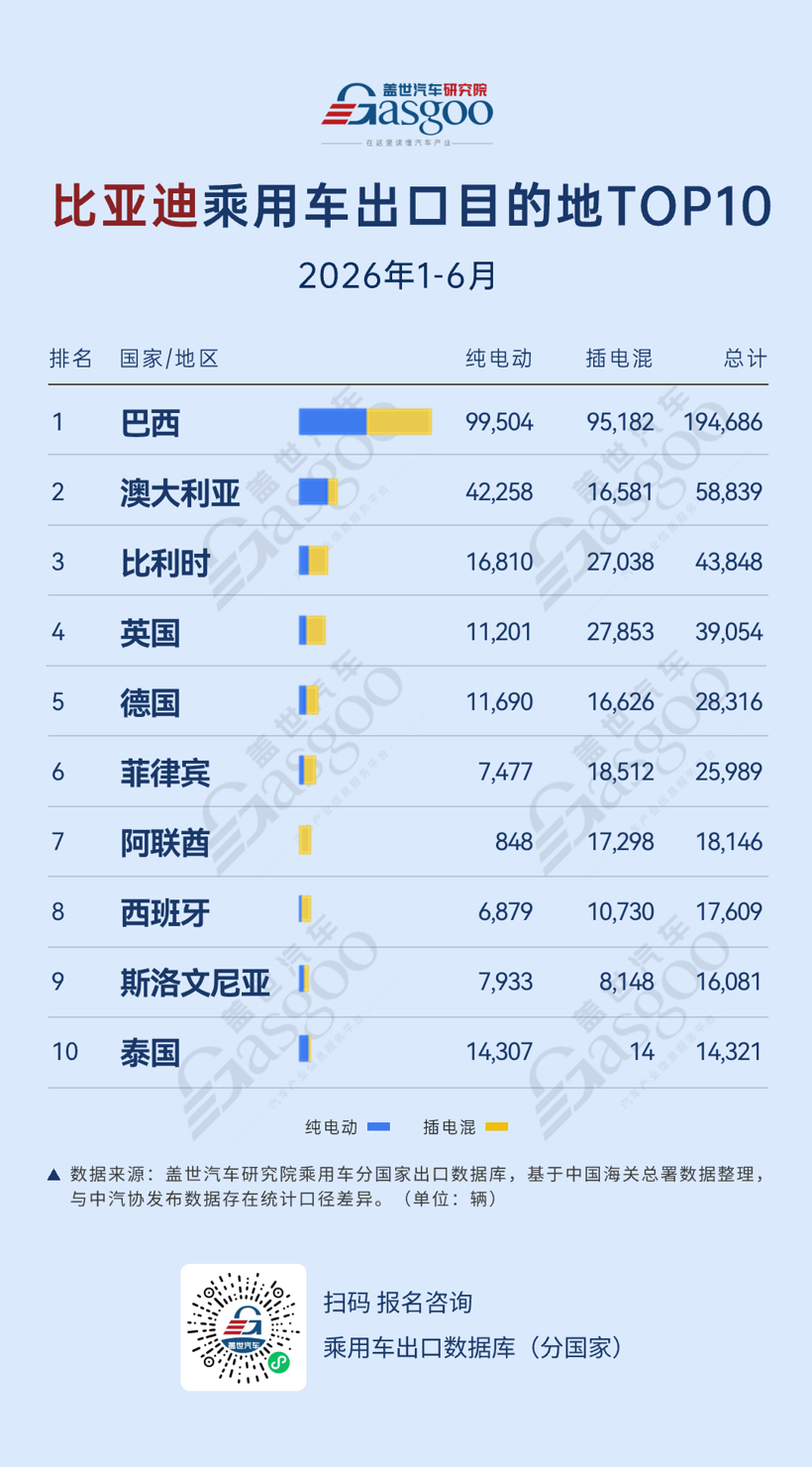
The global automotive landscape is experiencing a profound realignment as Chinese electric vehicle (EV) giant BYD accelerates its international footprint. According to the latest market intelligence from the Gasgoo Research Institute covering the first half of 2026 (Jan-Jun), BYD's passenger vehicle exports have sustained an aggressive growth trajectory. Rather than relying on traditional Western markets currently navigating complex trade policy adjustments, the automaker has successfully diversified its focus toward Latin America, Southeast Asia, and Europe through multi-point strategic positioning.
Decoding the H1 2026 Export Metrics: Latin America Takes the Lead
As a veteran global automotive supply chain analyst specializing in cross-border trade, I view these latest export figures as a masterclass in market diversification and trade adaptability. BYD's reliance on Brazil as its primary volume driver is no longer just a trend—it is a cornerstone of its global business model.
During the first six months of 2026, passenger car export destinations for BYD revealed a highly targeted geographic distribution. While the complete Top 10 list shows progress across multiple continents, the gap between the top spot and the tenth spot highlights where BYD is concentrating its immediate volume play:
| Export Destination Rank (H1 2026) | Volume (Units) | Strategic Significance & Market Role |
|---|---|---|
| Brazil (Rank #1) | 194,700 | Regional anchor; serves as the foundation for South American market integration. |
| Thailand (Rank #10) | 14,321 | Strategic hub for Right-Hand Drive (RHD) vehicles in the ASEAN region. |
The stark difference between Brazil's near-200k volume and Thailand's 14k volume shows that while Southeast Asia remains a vital tactical market, Latin America has emerged as the high-velocity volume engine for BYD. This regional success is driven by growing consumer demand for affordable, high-tech plug-in hybrid electric vehicles (PHEVs) and battery electric vehicles (BEVs) like the Dolphin and Song families.
Strategic Localization: Mitigating Trade Friction Through Regional Investments
For global investors and strategic planners, the core takeaway of the H1 2026 data is how BYD is proactively adapting to shifting trade dynamics. Rather than engaging in regulatory friction or contesting import tariffs in North America and Europe, BYD is leveraging a sophisticated strategy of localized regional manufacturing.
The Latin American Stronghold
In Brazil, the massive 194,700 export volume acts as a bridge to localized assembly. BYD's ongoing industrial investments in the Camaçari manufacturing complex in Bahia aim to transition the company from a pure exporter to a local producer. This localized footprint ensures long-term tariff compliance, creates domestic jobs, and aligns with Brazil's national green mobility initiatives.
The ASEAN Gateway
Similarly, while Thailand sits at the tenth spot with 14,321 units, its significance is amplified by BYD's localized factory in Rayong province. This facility not only serves the Thai domestic market but acts as a strategic sourcing alliance for neighboring right-hand-drive markets across Oceania and Southeast Asia, reinforcing supply chain resilience.
A New Era of Cross-Border Collaboration
This macro shift represents a natural evolutionary step for the automotive industry. Much like Japanese and European OEMs localized production in North America during the late 20th century, Chinese OEMs are executing a similar regional manufacturing playbook. For Western legacy OEMs, this creates valuable opportunities for technology integration, joint ventures, and strategic sourcing alliances, particularly in low-cost LFP battery supply chains and advanced ADAS software collaboration.