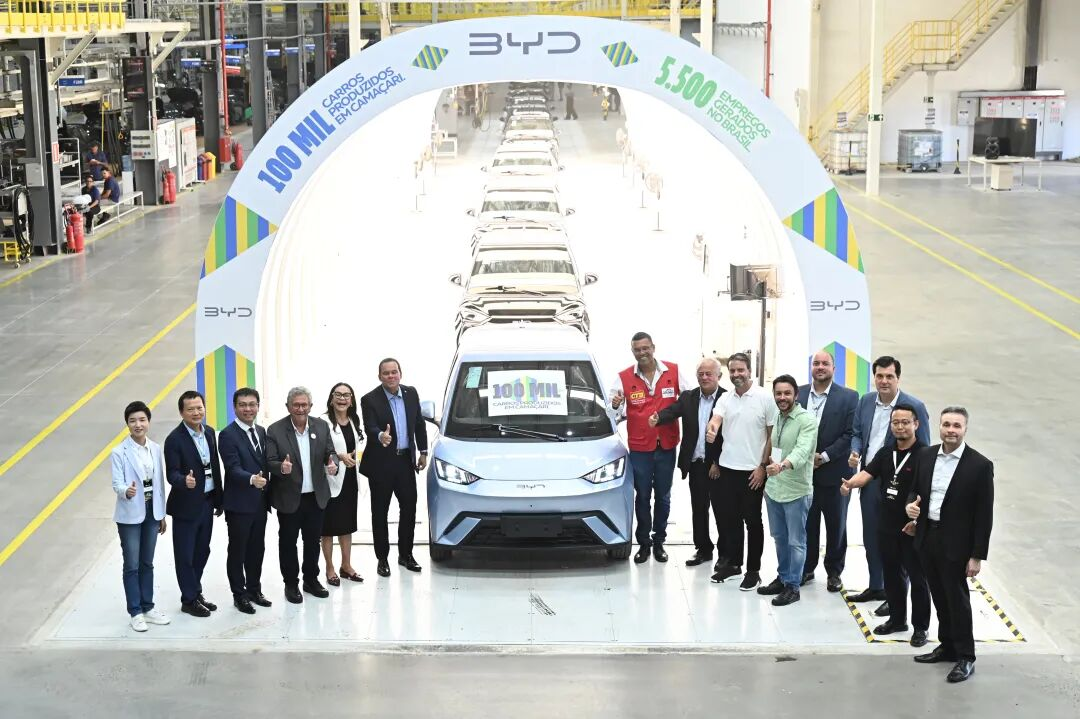
As the global automotive sector shifts toward decentralized manufacturing, BYD Brazil EV production has officially entered its next phase of maturity. On July 16, BYD's production complex in Camaçari, Bahia, celebrated a dual milestone: the rollout of its 100,000th new energy vehicle (NEV) and the accelerating transition toward a highly localized regional footprint. This development highlights how major Chinese OEMs are shifting away from pure export models toward local value creation to build resilient global supply chains.
Establishing a Localized Regional Footprint in Bahia
The Camaçari plant, built on a site formerly owned by Ford, represents a massive strategic pivot for BYD. Rather than relying solely on completely built-up (CBU) imports from China, the Shenzhen-based automaker has committed substantial capital to establish a robust manufacturing presence in Brazil. This move aligns perfectly with Brazil's federal green mobility initiatives, such as the 'Mover' program, which incentivizes low-emission technology and local industrial investments.
By localizing production in Bahia, BYD is not only securing a logistical stronghold in South America but is also aligning with regional trade regulations. This strategic localization enables the automaker to maintain competitive pricing in the Mercosur trade bloc while ensuring full supply chain compliance with evolving regional import rules.
The Scaling of BYD Brazil EV Production
The rapid acceleration to 100,000 units demonstrates BYD's remarkable scaling efficiency—often referred to as 'China-speed'—adapted to a Latin American context. The plant’s production portfolio features popular consumer models designed to capture both the premium and mass-market segments in Brazil.
| Key Facility Metric | Strategic Significance |
|---|---|
| Location | Camaçari, Bahia, Brazil (Strategic Port Access) |
| Milestone Reached | 100,000th New Energy Vehicle (NEV) rolled off the assembly line |
| Primary Models | BYD Dolphin, Song Plus DM-i, and local market adaptations |
| Strategic Focus | Tariff compliance, local employment, and regional supply chain resilience |
Why This Milestone Matters to Western OEMs and Investors
For Western automotive executives and global investment analysts, BYD’s progress in Brazil serves as a blueprint for how Chinese automakers plan to navigate geopolitical trade dynamics. Rather than retreating from global markets due to localized tariffs, Chinese players are choosing deep integration.
1. Proactive Tariff Compliance
Brazil has gradually reintroduced import taxes on hybrid and electric vehicles to protect local industries. BYD’s swift transition to local manufacturing is a proactive compliance mechanism. By assembling vehicles locally, BYD mitigates the impact of these import duties, ensuring sustained price competitiveness over traditional legacy OEMs who rely on shipping fully built vehicles from North America or Europe.
2. Leveraging Global Supplier Alliances
Rather than working in isolation, BYD is actively engaging with regional and international tier-1 suppliers in Brazil. This cross-border collaboration fosters a mutually beneficial ecosystem, upgrading the local automotive supply chain and building strong alliances with regional policymakers who welcome industrial modernization.
Analytical Outlook: The Next Phase of Expansion
As the Camaçari plant continues to scale, expect BYD to further integrate battery assembly and raw material sourcing directly within South America. Brazil's rich mineral reserves, including lithium, present a unique opportunity for vertical integration. For global competitors, the message is clear: the battle for EV leadership is no longer just about exporting technology; it is about who can localize and integrate into regional economies the fastest.