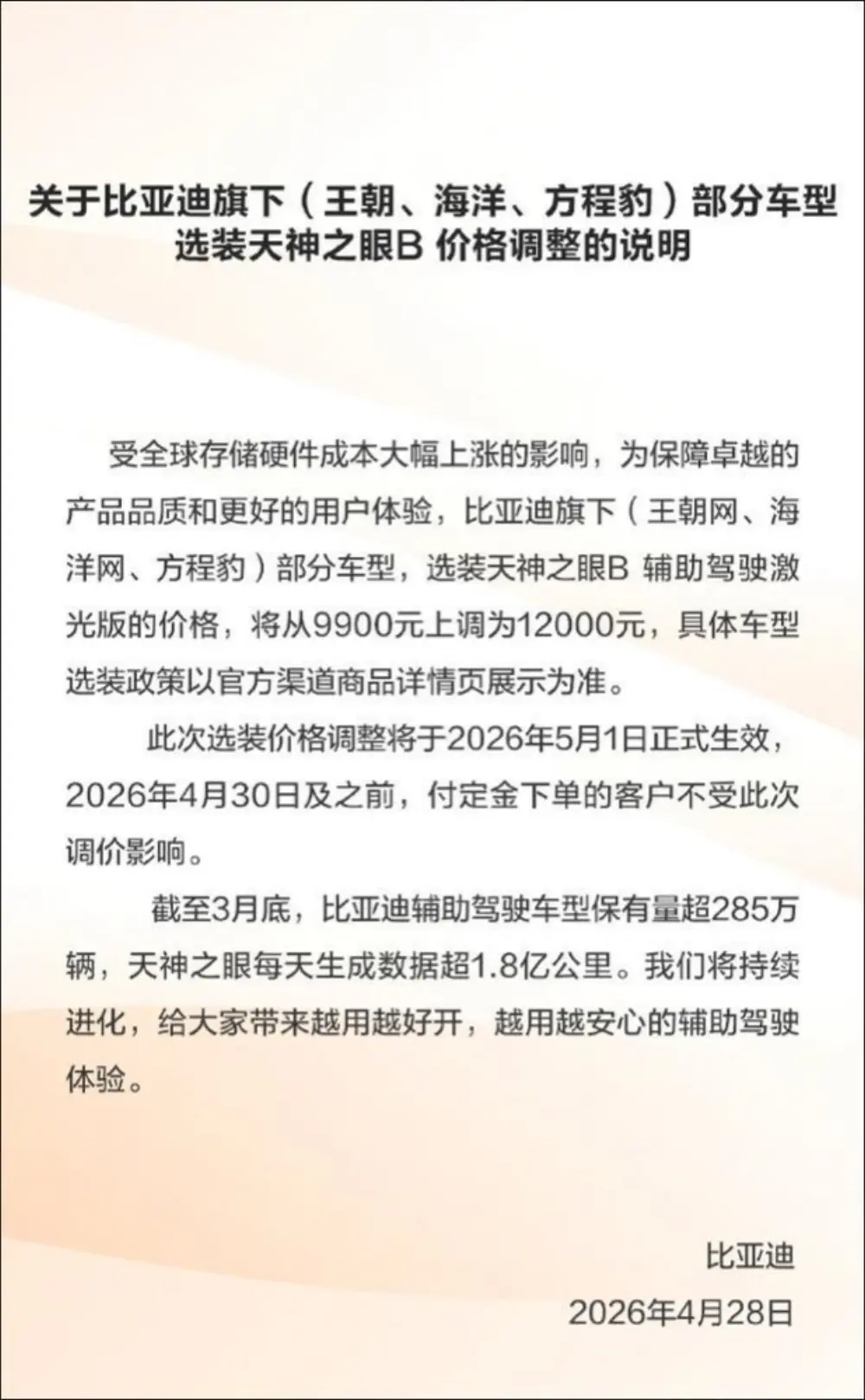
Is the soaring cost of advanced driver-assistance systems (ADAS) in China set to reshape the EV landscape? BYD, a titan in the electric vehicle sector, has announced a significant price increase for its ‘Tianxing Eye B’ (天神之眼B) assisted driving laser version, effective May 1, 2026. This move, attributed to soaring global storage hardware costs, highlights a growing challenge facing even the most dominant EV manufacturers. The price for this premium ADAS option will jump from 9,900 yuan to 12,000 yuan, a nearly 21% increase. Customers who have already paid a deposit before April 30, 2026, will be exempt from this adjustment, ensuring fairness for early adopters.
BYD’s ADAS Strategy: A Data-Driven Approach
BYD’s ‘Tianxing Eye’ intelligent driving system is a sophisticated suite of technologies designed to enhance safety and convenience. The system employs a tiered hardware approach: ‘C’ offers basic highway navigation, ‘B’ adds a lidar for city navigation, and the top-tier ‘A’ includes three lidars for all-scenario navigation and advanced parking. As of March 2026, BYD boasted over 2.85 million assisted driving vehicles in operation, with its systems generating more than 180 million kilometers of real-world driving data daily. This massive data influx is crucial for refining its end-to-end large model architecture, enabling the system to learn and improve continuously, offering an experience that becomes “easier to drive and safer to use the more you use it.”
The Impact of Rising Hardware Costs
The price adjustment for the ‘Tianxing Eye B’ is a direct response to the escalating costs of essential hardware components, particularly storage. This is not an isolated incident within the Chinese EV market. Reports indicate that the overall cost of automotive chips and advanced hardware is on an upward trajectory, impacting development and production budgets across the industry. BYD’s decision to pass on some of these costs to consumers, while also emphasizing its commitment to product quality and user experience, underscores the delicate balance manufacturers must strike.
Navigating the Future of Autonomous Driving
BYD’s ‘Tianxing Eye’ system showcases impressive capabilities, including autonomous emergency braking (AEB) at speeds up to 135 km/h in tunnels and the ability to handle complex urban scenarios like “ghost pedestrians” and narrow alleyways. This technological prowess, fueled by real-world data, positions BYD at the forefront of autonomous driving development. However, the rising costs associated with these advanced systems raise questions about their long-term affordability and accessibility for a broader consumer base.
For Western automakers and suppliers, BYD’s pricing strategy and the underlying cost pressures offer valuable insights. Understanding these dynamics is crucial for developing competitive ADAS solutions and managing supply chain risks. As the industry pushes towards higher levels of autonomy, the interplay between technological innovation, hardware costs, and consumer affordability will be a defining factor in market success.
Explore our previous analysis on the challenges and opportunities in the global semiconductor supply chain for the automotive industry: [Related Topic: Semiconductor Supply Chain Challenges].
Sources:
-
盖世汽车 (Gasgoo) - Original reporting on BYD’s price adjustment and ADAS data.
-
[Insert citation for Reuters/Bloomberg if found]