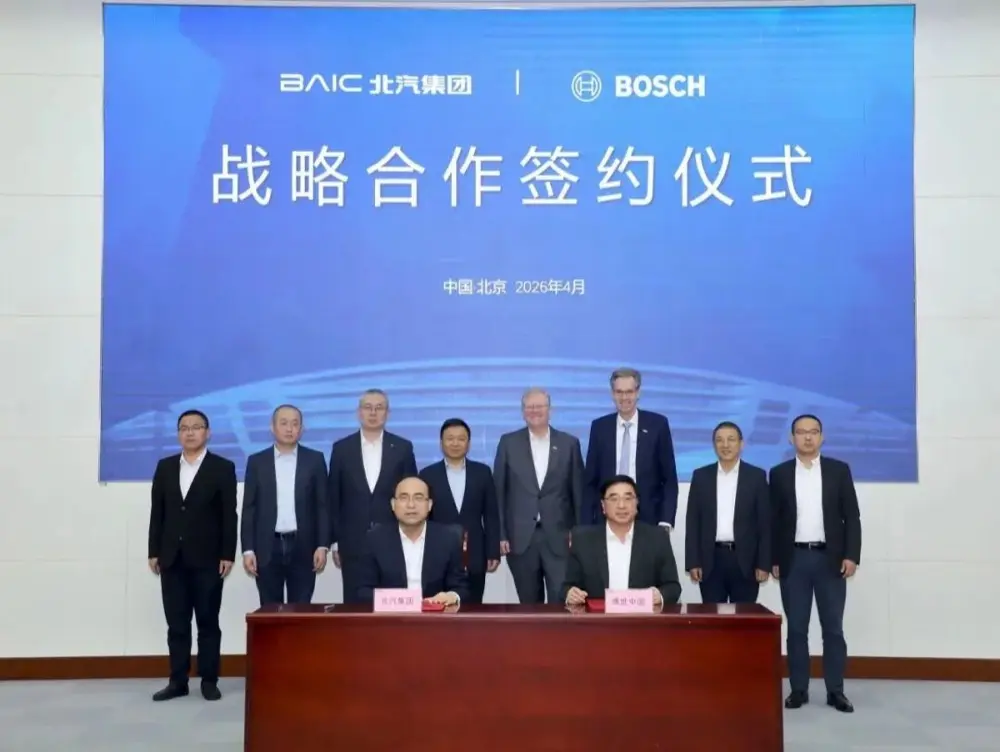
What happens when Europe’s largest auto supplier bets its semiconductor future on Beijing’s state-owned giants? On April 23, 2024, Bosch China and BAIC Group signed a strategic framework agreement that goes far beyond typical supplier relationships. This Bosch China ADAS localization move represents one of the most significant attempts by a Western Tier 1 supplier to lock in chip supply resilience amid escalating geopolitical decoupling risks.
The deal signals a fundamental shift in how global automotive technology flows are being rewired. While Washington and Brussels discuss supply chain security, Bosch is executing a parallel strategy: embedding itself deeper into China’s intelligent vehicle ecosystem through state-backed partnerships that secure advanced driver-assistance system (ADAS) semiconductor access.
The BAIC-Bosch Alliance: Decoding the April Agreement
According to industry reports, the April 23 framework agreement builds upon a February 2023 strategic cooperation focused on intelligent driving products. However, the 2024 iteration expands dramatically into four critical domains:
- Next-Generation ADAS Development: Joint R&D on intelligent mobility technologies specifically targeting localization of ADAS chips and software within China’s regulatory framework
- Commercial Vehicle Electrification: Accelerating new energy and intelligent tech deployment in heavy-duty segments where BAIC maintains significant market share
- Industrial Automation: Deepening synergies in manufacturing automation to improve production efficiency and embed Bosch systems into BAIC’s operational infrastructure
- Overseas Expansion Support: Bosch assisting BAIC’s internationalization efforts through global operational expertise and service networks
This multi-vector approach distinguishes the partnership from traditional component supply arrangements. By integrating industrial automation and export logistics support, Bosch positions itself as an infrastructure partner rather than merely a parts vendor.
Historical Context: From 2023 to 2024
The February 2023 agreement established the foundation for co-developing industry-leading intelligent driving products. Eighteen months later, the expanded framework reflects successful execution of that initial phase while addressing new market realities. Reuters reported in early 2024 that Bosch planned significant investments in Chinese manufacturing capacity despite geopolitical tensions, confirming the strategic imperative behind deepening BAIC ties.
Why Western Investors Should Watch This Deal
For US and European stakeholders, the Bosch-BAIC partnership represents a case study in geopolitical hedging. As export controls tighten around advanced semiconductors, Western Tier 1 suppliers face an existential choice: localize production within China or risk exclusion from the world’s largest EV market.
The Semiconductor Security Angle
BAIC, as a state-owned enterprise (SOE), provides Bosch with something increasingly valuable: guaranteed market access and supply chain stability. In an era where Bloomberg analysts note that advanced chip localization has become a strategic priority for Beijing, partnerships with SOEs like BAIC offer Western suppliers political insulation against sudden regulatory shifts.
The agreement specifically targets ‘efficient, stable supply chain systems’—code for reducing dependence on cross-border semiconductor shipments that face increasing US export scrutiny. By co-developing ADAS technologies within China’s regulatory framework, Bosch ensures its advanced driver-assistance chips and software remain compliant with evolving localization mandates.
Competitive Positioning Against Huawei
See our analysis on Huawei’s growing dominance in China’s intelligent driving sector to understand the competitive pressure driving this alliance. As Huawei HI (Huawei Inside) solutions capture premium market share, traditional suppliers like Bosch risk displacement without strong local partnerships.
Technical Implications: Beyond Passenger Cars
While media attention focuses on passenger vehicle ADAS, the commercial vehicle (CV) dimension carries significant implications. BAIC’s commercial arm represents one of China’s largest truck and bus manufacturers. The partnership’s focus on CV electrification and intelligence addresses a segment where European suppliers traditionally held advantages but now face aggressive domestic competition.
Industrial Automation Synergies
The inclusion of industrial automation cooperation reveals Bosch’s broader strategy. By optimizing BAIC’s manufacturing processes, Bosch embeds its factory automation technologies deep into China’s automotive production base. This creates switching costs that protect long-term supplier relationships even as domestic Chinese alternatives mature.
Market Analysis: Global Expansion vs. Localization
Perhaps the most intriguing element involves Bosch supporting BAIC’s overseas expansion. This represents a reversal of traditional technology flows: instead of Western OEMs entering China, Chinese state-owned OEMs are exporting globally—with Western suppliers facilitating the expansion.
For BAIC, leveraging Bosch’s global service networks and regulatory expertise accelerates entry into European and Southeast Asian markets. For Bosch, it transforms a potential competitor into a channel partner, capturing revenue from Chinese OEMs’ global growth while maintaining technological relevance.
Risks and Opportunities
The strategy carries dual risks. Regulatory scrutiny in Washington and Brussels may intensify around Western suppliers enabling Chinese OEMs’ global expansion. Conversely, failure to secure partnerships within China’s protected market guarantees marginalization as domestic ADAS solutions mature.
Financial Times coverage of EU-China trade dynamics suggests that automotive technology partnerships face increasing scrutiny under new economic security frameworks. Bosch’s simultaneous investment in European semiconductor facilities alongside China partnerships illustrates the delicate balancing act required.
Conclusion: The New Rules of Auto Tech
The Bosch-BAIC framework agreement exemplifies the fragmentation of global automotive supply chains into competing technological spheres. Bosch China ADAS localization isn’t merely about selling components—it’s about survival in a market where semiconductor access requires political and commercial alignment with state-backed champions.
For Western investors, the deal signals that decoupling remains theoretical while de-risking through localization becomes operational reality. As BAIC advances its ‘Tech BAIC’ initiative with Bosch’s assistance, expect similar alliances between Western Tier 1s and Chinese SOEs to proliferate—reshaping competitive dynamics in autonomous driving, EV architecture, and semiconductor supply chains for the next decade.