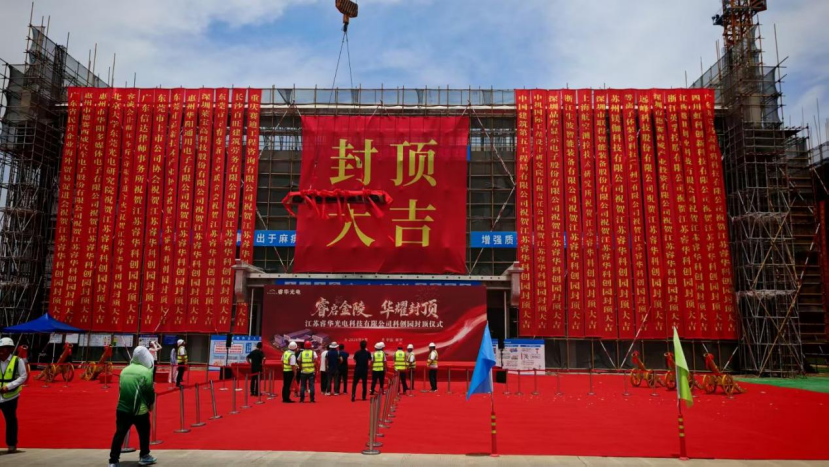
The integration of massive panoramic glass roofs has become a defining feature of modern electric vehicles, from Tesla's Model Y to the Xiaomi SU7. However, these expansive glass structures present a severe engineering headache: heat and glare. To address this issue without relying on clumsy mechanical sunshades, the EV industry is rapidly transitioning toward automotive smart dimming glass. Leading this physical-digital convergence is China's Ruihua Optoelectronics, which recently completed the topping-out ceremony for its massive new 3-billion-yuan ($415 million USD) production base in Nanjing, Jiangsu Province.
Breaking the Smart Cabin Bottleneck: Inside the Nanjing Project
Listed as a major industrial project in Jiangsu Province, the Nanjing Gouchun facility represents a highly strategic play to vertically integrate the optical glass supply chain. Spanning 180 acres, with Phase 1 covering a built area of 76,800 square meters, the plant is being outfitted with over 2,000 sets of advanced, automotive-grade automated equipment.
By controlling the entire production process from cover plates and backlighting modules to the complex Liquid Crystal (LC) active dimming layers, Ruihua aims to eliminate the yield rate bottlenecks that have historically plagued automotive smart dimming glass technology. The facility's planned annual capacity of 700,000 sets is scheduled for commercial production in the fourth quarter of 2026.
LC vs. EC vs. SPD: Why Liquid Crystal is the Ultimate Winner
To understand why Western Tier-1 suppliers and OEMs should monitor this development closely, one must look at the competing technologies in the smart glass space:
- Electrochromic (EC) Glass: Widely used in premium EVs today (such as the Zeekr 001). While highly effective at blockout, EC glass suffers from slow transition times (often taking minutes to change state) and can degrade over long-term UV exposure.
- Suspended Particle Device (SPD) Glass: Highly responsive but notoriously expensive, requiring continuous high-voltage power to remain transparent, which is inefficient for EV battery conservation.
- Liquid Crystal (LC) Dimming Glass: Offers near-instantaneous switching (milliseconds), highly granular grayscale control, and superior thermal isolation capabilities. Historically, the challenge has been scaling production to lower costs. Ruihua's factory is specifically engineered to solve this exact scale problem.
| Technology | Switching Speed | Power Consumption | Relative Cost | Key Limitation |
|---|---|---|---|---|
| Electrochromic (EC) | Slow (Minutes) | Low | Medium | UV degradation |
| Suspended Particle (SPD) | Fast (Seconds) | High (Constant active voltage) | Very High | Expensive driver hardware |
| Liquid Crystal (LC) | Instant (Milliseconds) | Low (Pulse-width modulated) | High (Dropping via Ruihua's scale) | Complex manufacturing |
Strategic Implications for Western OEMs and Investors
As a market analyst observing the 'China-speed' scale-up of EV tech, this massive capacity expansion serves as an early signal for Western OEMs. Currently, companies like Tesla, Ford, and BMW rely on expensive, low-yield Western glass suppliers or force consumers to accept manual cabin shades. Once Ruihua's 700,000-set capacity hits the market in late 2026, the price of premium LC automotive smart dimming glass will plummet, transitioning from an expensive premium option to a standardized mid-market feature.
Western Tier-1 auto suppliers must act quickly to match this scaling efficiency, or risk losing the entire high-margin smart-glass market to integrated Chinese suppliers. For global automotive investors, tracking the scale-up of such hardware component providers in the Yangtze River Delta offers the true 'Alpha' signals long before they manifest in finished vehicles.