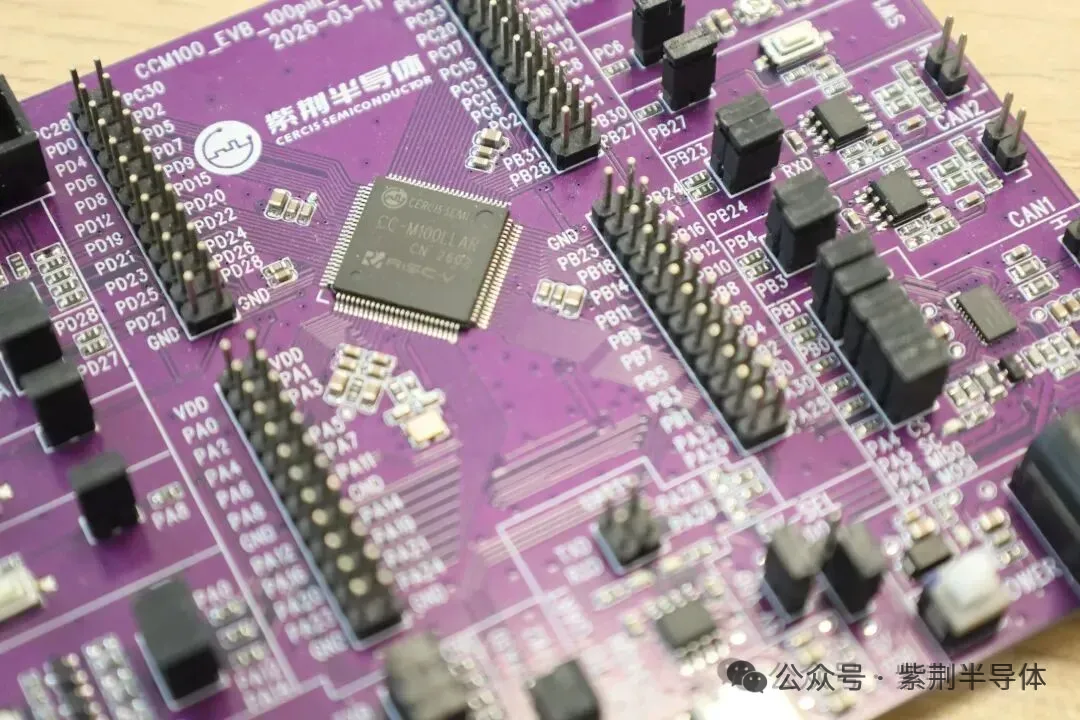
When Zijing Semiconductor, an automotive chipmaker incubated by Great Wall Motor (GWM), crossed the cumulative milestone of shipping over 10 million automotive-grade microcontrollers (MCUs) powered by the open-source RISC-V instruction set architecture, the announcement triggered ripple effects across global semiconductor supply chains. Long relegated to low-power microcontrollers in consumer electronics, the emergence of production-grade automotive RISC-V chips deployed at eight-figure scale inside production passenger vehicles confirms that China’s domestic silicon sovereignty strategy is moving rapidly beyond theoretical research papers into high-reliability volume manufacturing.
Historically, the automotive electronics architecture has been an impenetrable fortress dominated by proprietary architectures: Arm Ltd.’s Cortex-M and Cortex-R cores for real-time controllers, alongside legacy PowerPC and Infineon Tricore architectures powering safety-critical engine control units (ECUs) and body domain modules. However, tightening geopolitical friction, export controls on advanced semiconductor intellectual property (IP), and sovereign semiconductor mandates in Beijing have accelerated an aggressive pivot toward RISC-V. Created at UC Berkeley and governed by the Switzerland-based RISC-V International, the open standard provides an architecture immune to unilateral unilateral export licensing restrictions. Zijing’s 10-million milestone serves as an empirical proof point that automotive-grade qualification—traditionally an agonizing 3-to-5-year multi-million-dollar qualification cycle—can be successfully executed on open-source ISA primitives.
The Silicon Teardown: How RISC-V Scaled from Body Electronics to Chassis Domains
To understand the technical reality beneath the milestone, industry analysts must dissect exactly where these 10 million chips are deployed. Modern vehicle architectures require three distinct computing tiers: low-end 8-bit/32-bit microcontrollers handling basic switching and sensor aggregation, mid-tier real-time domain controllers managing chassis dynamics and battery management systems (BMS), and high-performance computing (HPC) system-on-chips (SoCs) executing perception neural networks for autonomous driving. Zijing Semiconductor’s primary production volume is rooted in the first and second tiers, specifically its automotive-grade 32-bit RISC-V MCU product portfolio.
These microcontrollers, such as the ZJ32 series, feature custom-extended 32-bit RISC-V pipeline cores operating between 80 MHz and 160 MHz, fabricated primarily on mature 40nm to 55nm embedded flash (eFlash) manufacturing nodes. The microcontrollers are certified to AEC-Q100 Grade 1 reliability (operating across severe ambient thermal ranges of -40°C to +125°C) and meet ISO 26262 ASIL-B functional safety ratings. They operate across body control modules (BCM), smart actuators, thermal management valves, seat controllers, and ambient lighting controllers across GWM’s Haval, Tank, and WEY sub-brands, with selective tier-1 adoption across competing Chinese OEMs.
| Metric / Specification | Zijing Semiconductor (RISC-V MCU) | Infineon AURIX TC3xx (TriCore) | NXP S32K3 Series (Arm Cortex-M7) | STMicroelectronics Stellar (Arm Cortex-R52) |
|---|---|---|---|---|
| Instruction Set Architecture | Open-Source RISC-V (RV32IMAFC) | Proprietary TriCore V1.6.2 | Proprietary Armv7-M | Proprietary Armv8-R |
| Manufacturing Process Node | 40nm / 55nm eFlash | 40nm / 28nm eFlash | 40nm eFlash | 28nm FD-SOI / Phase-Change |
| Functional Safety Integrity | ISO 26262 ASIL-B (Select ASIL-D R&D) | ISO 26262 ASIL-D (Native Lockstep) | ISO 26262 ASIL-D (Dual Lockstep) | ISO 26262 ASIL-D (Full Lockstep) |
| Core Clock Frequency | 80 MHz – 160 MHz | Up to 300 MHz | 120 MHz – 240 MHz | Up to 400 MHz |
| Compiler & RTOS Maturity | Emerging (IAR/Segger + GCC port) | Decades-proven (Tasking, HighTec, AUTOSAR) | Mature (Keil, Green Hills, Classic AUTOSAR) | Mature (Vector, Green Hills, Adaptive AUTOSAR) |
| Estimated BOM Unit Cost | $1.10 – $2.30 | $4.50 – $9.20 | $2.80 – $5.40 | $6.50 – $12.00 |
The engineering breakthrough demonstrated by Zijing does not lie in raw clock frequency, but rather in architectural modularity and silicon efficiency. By leveraging the extensible RISC-V base integer instructions (RV32I) paired with standard extensions for Multiplication/Division (M), Atomic operations (A), Single/Double precision Floating Point (F/D), and Compressed instructions (C), Zijing eliminated proprietary IP core licensing royalties payable to Arm Ltd., which typically levy an upfront architecture access fee running into millions of dollars alongside per-unit royalties ranging from 1% to 2.5% of chip value. More critically, the unencumbered instruction set allowed internal microarchitects to implement custom acceleration instructions for proprietary CAN-FD packet handling and sensor checksum calculations directly into the silicon datapath.
Supply Chain Economics: Bill of Materials Arbitrage and Fab Resilience
The underlying economic driver behind Zijing’s volume surge is an aggressive Bill of Materials (BOM) cost reduction strategy intertwined with domestic foundry survivability. In the post-2021 automotive chip shortage era, global Tier-1 suppliers saw prices for legacy microcontrollers from STMicroelectronics, NXP, and Renesas spike from $1.50 per unit to spot-market premiums exceeding $50.00. That supply shock fundamentally transformed Chinese OEM risk modeling. Incubated directly within GWM’s corporate venture architecture, Zijing was constructed specifically to insulate the OEM’s 1.2-million-vehicle annual manufacturing run rate from offshore supply disruptions.
From a manufacturing supply chain perspective, Zijing avoids advanced FinFET packaging constraints. Its 10 million units were produced utilizing mature node domestic foundries, primarily Semiconductor Manufacturing International Corporation (SMIC) and Hua Hong Semiconductor. Operating on 55nm and 40nm planar CMOS processes, these fabs possess deep, unconstrained domestic equipment utilization that sits entirely outside current US Department of Commerce Entity List export control thresholds on sub-14nm extreme ultraviolet (EUV) lithography. By producing microcontrollers on domestic mature trailing nodes, Zijing achieves an estimated 25% to 35% BOM cost advantage per unit relative to imported Western equivalents, driven by lower tape-out expenses, zero intellectual property license fees, and domestic wafer volume discounts.
However, the bill of materials equation changes when factoring in the total cost of ownership (TCO) across software development. While the raw silicon is demonstrably cheaper, porting proprietary automotive operating systems and calibrating Classic AUTOSAR (Automotive Open System Architecture) stacks to a non-standard RISC-V microarchitecture introduces significant software engineering overhead. Chinese OEMs absorbing these chips must build bespoke device abstraction layers and compile custom safety drivers, front-loading engineering headcounts in Baoding and Shanghai to offset the per-chip silicon savings.
Competitive Impact Assessment: The Fragmentation of the Global Microcontroller Cartel
Zijing’s milestone of 10 million shipped units shatters the historical perception that RISC-V in automotive is a speculative venture confined to academic whitepapers. The competitive fallout from this milestone is bifurcated across three distinct automotive market segments:
- Western MCU Oligopolists (Infineon, NXP, STMicroelectronics, Renesas): These four suppliers collectively control over 70% of the global automotive MCU market. While they remain firmly entrenched in the high-margin, ASIL-D safety-critical powertrain and active safety sectors, their high-volume, low-margin perimeter in body domain controllers and smart peripheral sensors is facing direct margin erosion inside the world's largest automotive market. Western suppliers can no longer command pricing power for generic 32-bit automotive MCUs within Chinese vehicle assembly lines.
- Proprietary IP Licensors (Arm Ltd.): For Arm, the rapid institutionalization of RISC-V in Chinese automotive represents an existential threat to its long-term royalty funnel. While Arm’s Automotive Enhanced (AE) processors remain the gold standard for high-compute cockpit systems (e.g., Qualcomm Snapdragon 8295) and centralized ADAS computers, China’s bottom-up displacement of Cortex-M0/M3/M4 microcontrollers directly deprives Arm of its high-volume licensing footprint across edge actuators.
- Decoupled Global OEMs (Hyundai-Kia, Toyota, European Transnationals): Global OEMs operating primarily outside the Chinese mainland face a strategic dilemma. While Chinese competitors like GWM, BYD, and Geely lower their vehicle hardware floor costs through vertically integrated, royalty-free silicon, Western and Japanese legacy OEMs remain locked into rigid global tier-1 supply agreements anchored to proprietary architectures, sustaining higher per-vehicle electronics BOM costs.
The Reality Check: Interrogating the 10-Million Shipment Milestone
Despite the celebratory PR narrative, an independent engineering cross-examination of the 10-million shipment figure reveals critical technical boundaries and structural limitations that corporate announcements routinely omit.
First, shipment volume must not be conflated with domain universality. An overwhelming majority of the 10 million chips deployed by Zijing are low-complexity, peripheral microcontrollers handling non-safety-critical tasks: window lifters, seat positioning motors, HVAC flap actuators, and interior ambient lighting. Moving from a Class B body microcontroller operating at 80 MHz to an ASIL-D fail-operational brake-by-wire or steer-by-wire controller is not an incremental step; it represents an order-of-magnitude leap in microarchitectural complexity. High-reliability chassis controllers require dual-core lockstep (DCLS) architectures, hardware fault injection verification, transient upset management, and specialized memory built-in self-test (MBIST) circuitry—domains where RISC-V tooling remains fundamentally nascent.
Second, the software ecosystem gap remains an immense bottleneck. Decades of automotive engineering have consolidated toolchains around certified commercial compilers like Tasking, HighTec, and Green Hills, with robust AUTOSAR Basic Software (BSW) stacks developed by Vector Informatik and EB (Elektrobit). The RISC-V automotive software ecosystem, by contrast, relies heavily on open-source GCC/LLVM compilers and emerging domestic RTOS ports that have not endured billions of operating hours across extreme real-world corner cases. Until international functional safety validation bodies extensively audit mature RISC-V AUTOSAR runtime environments, Western tier-1 integrators (Bosch, Continental, Denso) will view adopting Chinese RISC-V MCUs as an unacceptable product liability risk.
Third, the captive customer paradox looms large. Zijing Semiconductor was created, financed, and nurtured by Great Wall Motor. Shipping 10 million units within a captive OEM ecosystem—where vehicle architecture teams are mandated by corporate leadership to integrate in-house silicon regardless of software teething issues—is vastly different from winning contested, open-market bids against global semiconductor incumbents at neutral tier-1 suppliers. True commercial validation will only occur when independent foreign tier-1s or non-affiliated competing OEMs deploy Zijing’s silicon into high-volume international export platforms.
Regulatory and Geopolitical Landscape: Decoupling and the Open-Source Haven
The strategic ascendance of automotive RISC-V is fundamentally an artifact of the escalating geopolitical conflict surrounding advanced computing technologies. Under United States export controls, advanced electronic design automation (EDA) software, sub-16nm semiconductor manufacturing tools, and high-performance compute accelerators face rigorous export restrictions when destined for Chinese state or commercial entities. While microcontrollers fabricated at 40nm or 55nm are not currently restricted under US Department of Commerce regulations, Chinese automotive planners operate under the foundational assumption that sanctions could eventually expand to encompass proprietary instruction set architectures, IP core licenses, or architecture access agreements.
RISC-V represents an asymmetric geopolitical hedge. Because the open ISA specification is published under a free and open Creative Commons license and governed by RISC-V International—which explicitly relocated its legal headquarters from Delaware to Switzerland in 2019 to mitigate US regulatory jurisdiction—the architecture itself cannot be placed on the Entity List or revoked by unilateral sanctions. Chinese semiconductor consortiums, backed by state funding, have recognized that investing billions into the RISC-V architecture guarantees architectural continuity regardless of geopolitical tensions.
However, this open-source haven faces emerging Western regulatory scrutiny. Members of the US Congress have repeatedly petitioned the Department of Commerce to explore export restrictions on US companies contributing technical IP to the open-source RISC-V foundation. While enforcing intellectual property export controls on an open-source standard presents monumental legal and practical hurdles, any future regulatory friction could isolate Chinese RISC-V implementations from international standardization efforts, potentially creating two distinct, non-interoperable branches of computing architectures: a Western standard and an aligned domestic Chinese ecosystem.
Strategic Outlook and Investor Implications
The institutional scaling of automotive RISC-V microcontrollers by Zijing marks a critical inflection point in the vertical integration of automotive electronics. To assess the multi-year trajectory for equity analysts and automotive strategists, three forward-looking scenarios present distinct operational outcomes:
Bull Case
Zijing successfully leverages its 10-million unit baseline to validate its next-generation multi-core lockstep ASIL-D microcontroller architecture, expanding integration from captive GWM platforms into tier-1 supply agreements across Geely, Changan, and BYD. Mature node foundries in China scale yields, depressing standard MCU market prices globally. Major automotive software suppliers like Vector and Green Hills fully certify comprehensive commercial AUTOSAR and functional safety toolchains for RISC-V, triggering rapid adoption across developing export markets and eroding 15% to 20% of Western MCU market share in China by 2028.
Base Case
Zijing solidifies its position as GWM’s primary internal silicon supplier for body, comfort, and basic thermal domain controllers, incrementally expanding volume to 25 million units annually. However, software ecosystem friction and safety certification overhead restrict its penetration in chassis dynamics, ADAS perception, and powertrain control. Western MCU incumbents retain their stranglehold on high-margin ASIL-D sockets. RISC-V stabilizes as a high-volume, low-margin Chinese domestic body electronics standard, delivering cost savings to domestic OEMs without completely disrupting the global tier-1 architecture landscape.
Bear Case
Software toolchain instability, edge-case hardware errata, and functional safety liabilities in field vehicles trigger costly recalls, forcing Chinese OEMs to scale back proprietary MCU deployments. Simultaneously, Western semiconductor leaders slash prices on legacy Arm Cortex-M microcontrollers produced on expanded global 28nm/40nm capacities, erasing Zijing’s BOM cost advantage. Stricter Western automotive cyber-compliance and functional safety validation standards prevent RISC-V-equipped vehicles from clearing export compliance audits in Europe and North America, confining the technology to domestic price-war vehicles.
For global automotive executives and semiconductor portfolio managers, several tactical conclusions emerge from this milestone:
- Vertical Integration is No Longer Confined to Batteries: Chinese OEMs are actively replicating their lithium battery vertical integration strategies within vehicle silicon, targeting proprietary trailing-edge components to squeeze out tier-1 margins.
- Mature Nodes Are the True Geopolitical Battleground: While Western media focuses on cutting-edge 3nm AI accelerators, the real volume war for automotive resilience is being waged across 40nm and 55nm embedded flash fabs powering millions of everyday vehicle microcontrollers.
- The Arm Royalty Tax Faces Structural Attrition: As open-source architectures prove their physical reliability across millions of vehicles, global tier-1s will increasingly leverage RISC-V as a negotiating lever to force license fee concessions from Arm Ltd.
- Software Toolchains Dictate the True Ceiling: Hardware maturity on RISC-V has outpaced software readiness; institutional investors tracking Chinese semiconductor independence must evaluate developer toolchain adoption and ISO 26262 ASIL-D software certification rather than raw silicon shipment milestones alone.