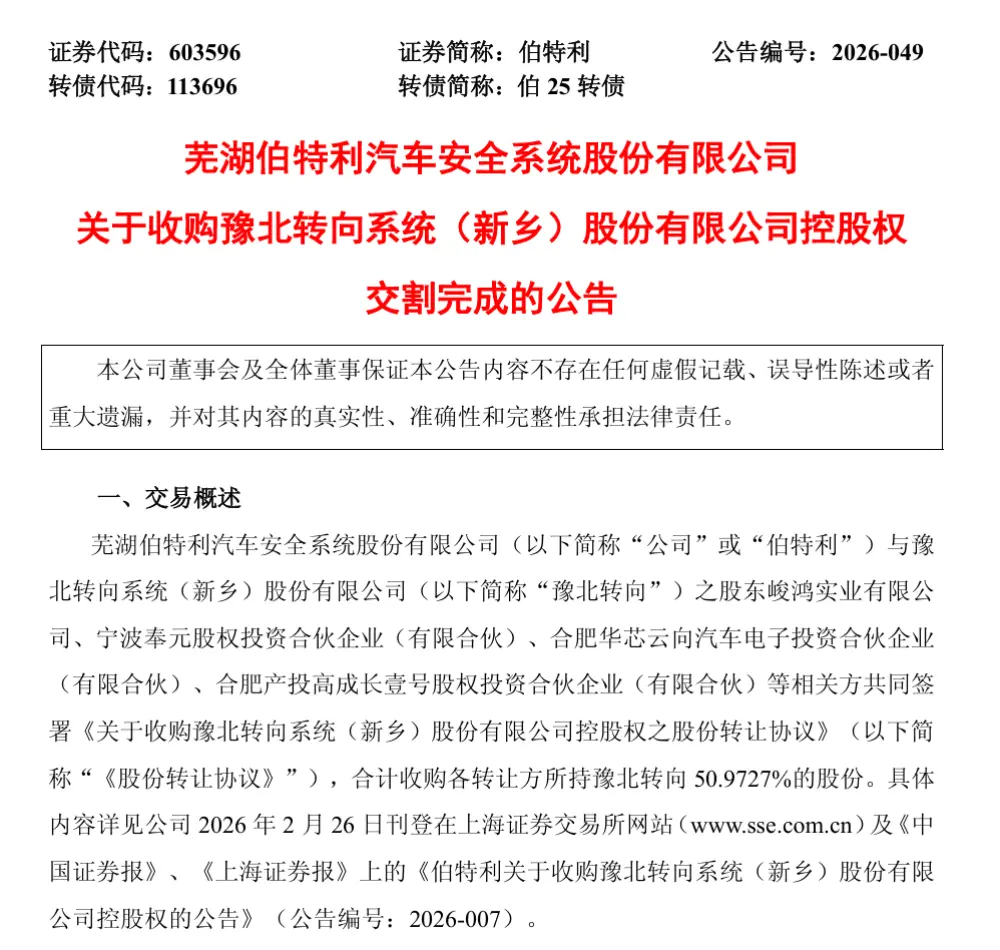
In the first half of 2026, the automotive parts industry has seen a significant acceleration in mergers and acquisitions (M&A). According to data from iFinD, as reported by Economic Information Daily, the pace of consolidation has notably increased, with a total of 15 major deals announced by June 12, 2026. This trend is reshaping the global supply chain and signaling a new era of strategic positioning for automotive suppliers.
Key Drivers of M&A Activity
The surge in M&A activity can be attributed to several factors, including the need for technological integration, cost optimization, and strategic market positioning. As the automotive industry continues to evolve, particularly with the rise of electric vehicles (EVs) and autonomous driving technologies, suppliers are looking to consolidate their resources and capabilities to stay ahead of the curve.
Technological Integration
One of the primary drivers of M&A in the automotive parts industry is the need for advanced technology. With the increasing demand for EVs and autonomous vehicles, suppliers are acquiring companies that specialize in battery technology, ADAS systems, and other cutting-edge innovations. This not only enhances their product offerings but also positions them as leaders in the rapidly evolving automotive landscape.
Cost Optimization
Another significant factor is the pursuit of cost efficiencies. By merging or acquiring smaller companies, larger suppliers can achieve economies of scale, reduce operational costs, and improve their overall financial performance. This is particularly important in an industry where margins are often tight and competition is fierce.
Strategic Market Positioning
M&A activities also allow companies to expand their geographic reach and enter new markets. For example, Western OEMs and Tier 1 suppliers are increasingly looking to acquire Chinese companies to gain a foothold in the fast-growing Chinese EV market. Conversely, Chinese companies are expanding their presence in Europe and North America through strategic acquisitions.
Impact on the Global Supply Chain
The consolidation trend in the automotive parts industry is likely to have a profound impact on the global supply chain. As companies merge and acquire, the supply chain will become more integrated and efficient, potentially leading to better coordination and reduced lead times. However, it may also result in a more concentrated market, with fewer, larger players dominating the industry.
Enhanced Collaboration and Innovation
On the positive side, the consolidation trend could foster greater collaboration and innovation. Larger, more integrated companies may have the resources and expertise to develop and implement new technologies more effectively. This could lead to faster advancements in areas such as battery technology, ADAS systems, and other critical components of the modern vehicle.
Potential Risks and Challenges
However, there are also potential risks and challenges associated with this consolidation. Smaller, niche players may find it difficult to compete with larger, more established companies, leading to a loss of diversity and innovation. Additionally, the concentration of power in the hands of a few large players could lead to higher prices and reduced consumer choice.
Conclusion
The accelerating M&A activity in the automotive parts industry is a clear sign of the ongoing transformation in the global supply chain. While it presents significant opportunities for technological integration, cost optimization, and strategic market positioning, it also poses challenges and risks. As the industry continues to evolve, it will be crucial for companies to navigate these changes carefully and strategically to ensure long-term success.